EUR/JPY climbs as risk sentiment, policy divergence weigh on the Yen
- EUR/JPY surges as risk sentiment bolsters the Euro's strength.
- Concerns over tariffs overshadow hawkish comments from the Bank of Japan (BoJ).
- EUR/JPY heads toward 170.00, pushing momentum indicators into overbought territory.


The Euro (EUR) is strengthening against the Japanese Yen (JPY) in Wednesday’s trading session, with improved risk sentiment dampening demand for the safe-haven Yen.
With EUR/JPY trading above the key psychological level of 169.00, a resurgence of bullish momentum could provide the potential for a retest of 170.00.
As tensions in the Middle East continue to ease, focus has shifted back to monetary policy and the potential growth outlook for global markets.
For Japan, the Bank of Japan (BoJ) Wednesday's Summary of Opinions offered temporary relief for the Yen as some policymakers adopted a hawkish tone. However, the majority of policymakers expressed concerns about the potential threats that tariffs pose to the Japanese economy.
While BoJ policymaker Naoki Tamura hinted at the prospects of a potential rate hike “as early as July” in response to rising inflation, the ability for the BoJ to hike rates appears to depend on the prospects of a trade deal with the United States.
EUR/JPY technical analysis: Can bulls push prices to 170.00?
EUR/JPY is trading at 169.25, just below the key psychological resistance level of 170.00. The next level of resistance is observed at the 78.6% Fibonacci retracement level of the July-August decline, located at 170.93.
EUR/JPY daily chart
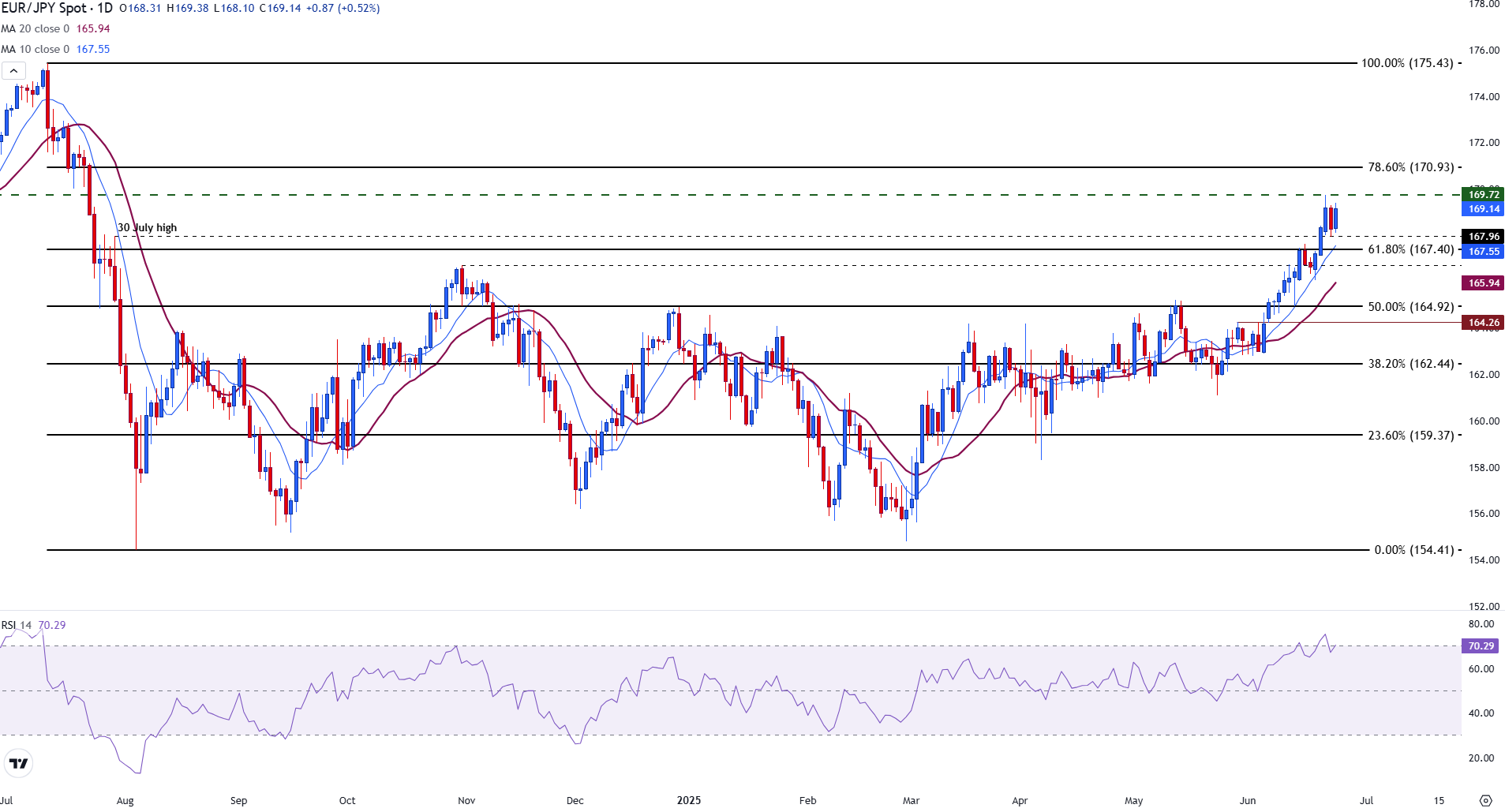
The pair’s upward momentum remains strong, supported by the wide policy divergence between the European Central Bank (ECB) and the BoJ.
Technically, EUR/JPY remains in overbought territory, with the Relative Strength Index (RSI) above 70, suggesting stretched conditions; however, dip buying continues to support the pair.
The price is well above both the 10-day (167.56) and 20-day (165.95) Simple Moving Averages (SMA), reinforcing the bullish trend.
However, traders are now closely watching for signs of exhaustion or a break above 171 to test the 175.43 level, which marks the 100% retracement from the July 2024 peak.
Interest rates FAQs
Interest rates are charged by financial institutions on loans to borrowers and are paid as interest to savers and depositors. They are influenced by base lending rates, which are set by central banks in response to changes in the economy. Central banks normally have a mandate to ensure price stability, which in most cases means targeting a core inflation rate of around 2%. If inflation falls below target the central bank may cut base lending rates, with a view to stimulating lending and boosting the economy. If inflation rises substantially above 2% it normally results in the central bank raising base lending rates in an attempt to lower inflation.
Higher interest rates generally help strengthen a country’s currency as they make it a more attractive place for global investors to park their money.
Higher interest rates overall weigh on the price of Gold because they increase the opportunity cost of holding Gold instead of investing in an interest-bearing asset or placing cash in the bank. If interest rates are high that usually pushes up the price of the US Dollar (USD), and since Gold is priced in Dollars, this has the effect of lowering the price of Gold.
The Fed funds rate is the overnight rate at which US banks lend to each other. It is the oft-quoted headline rate set by the Federal Reserve at its FOMC meetings. It is set as a range, for example 4.75%-5.00%, though the upper limit (in that case 5.00%) is the quoted figure. Market expectations for future Fed funds rate are tracked by the CME FedWatch tool, which shapes how many financial markets behave in anticipation of future Federal Reserve monetary policy decisions.
Author
Tammy Da Costa, CFTe®
FXStreet
Tammy is an economist and market analyst with a deep passion for financial markets, particularly commodities and geopolitics.

















