EUR/GBP Price Forecast: Euro bulls struggle at 0.8770 previous support
- The Euro ticks up from 0.8740 to test resistance at the 0.8770 area.
- The common currency is on track for its second consecutive weekly decline.
- Failure to breach 0.8770 might bring the 0.8720 support area to the focus.

The Euro is showing a mild positive tone against the British Pound on a calm trading session on Friday, yet with bulls struggling to find acceptance above a previous support, now turned resistance, in the area between 0.8765 and 0.8770.
A batch of Eurozone releases has not been particularly supportive of the Euro on Friday. German Retail Sales declined 0.3% in October, against expectations of a 0.2% increase, while import prices contracted at a 1.4% year-on-year pace, less than the -1.6% expected, which has eased the negative impact on the Euro.
In France, the GDP confirmed the preliminary estimations of a 0.5% growth in the third quarter, while the Consumer Price Index (CPI) remained steady at a 0.8% yearly pace, against market expectations of an acceleration to 1%.
Technical Analysis: Failure at 0.8770 brings 0.8720 into play
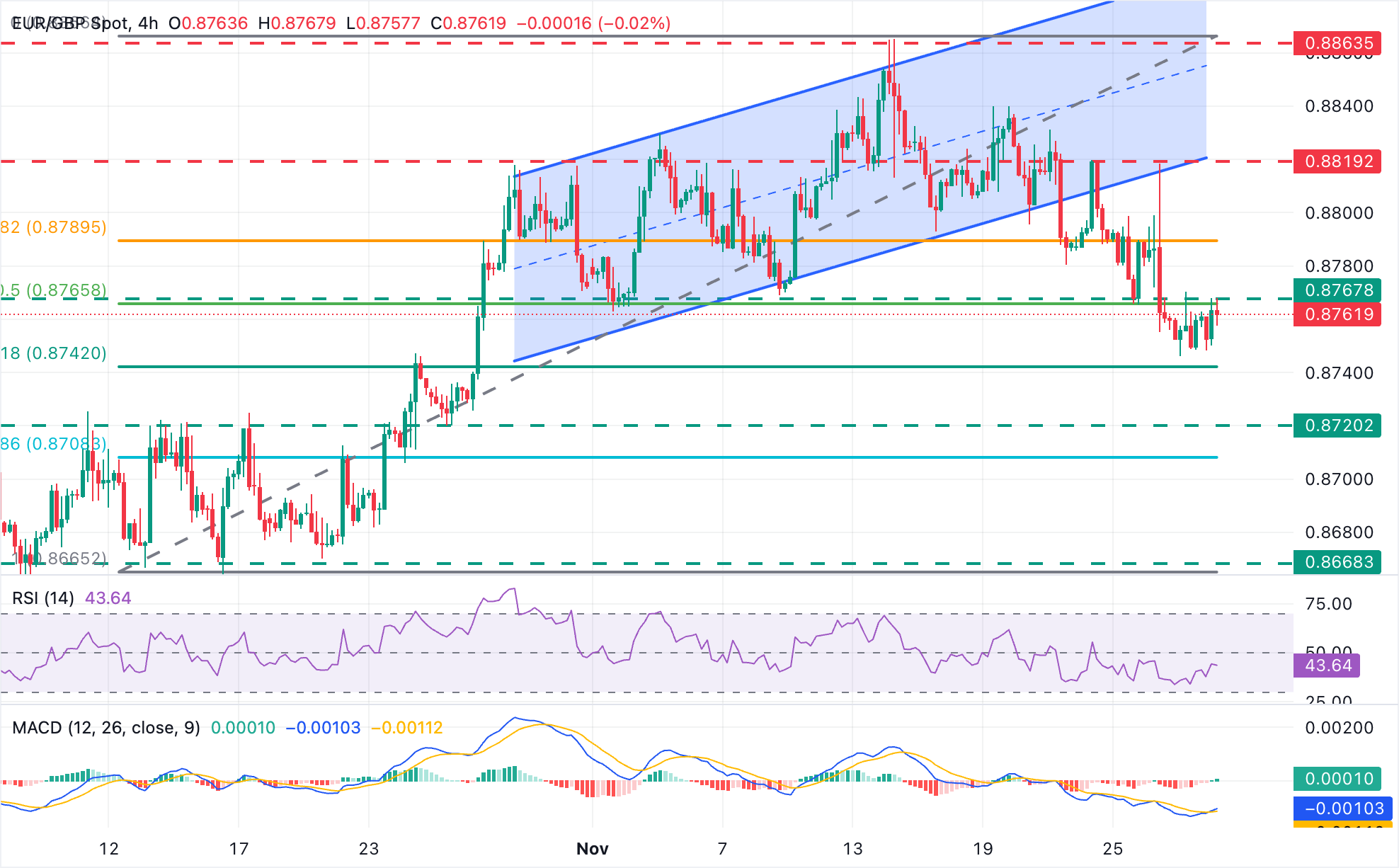
The technical picture remains bearish, with the pair on track for a nearly 0.7% decline over the last two weeks. Price action confirmed a bearish shift earlier this week, after breaking the bottom of the ascending channel, although technical indicators are showing a fading bearish momentum.
The 4-Hour Relative Strength Index (RSI) is trading higher, yet still below the 50 level, while the Moving Average Convergence Divergence (MACD) in the same timeframe is turning up and crossing above the signal line.
The Euro found support at the 61.8% Fibonacci retracement of the late October - early November rally, at 0.8742, and is trying to rise past a previous support area around 0.8770 (November 3,10, and 25 lows). Further up, a cluster of resistances lies around at 0.8820, where a reverse trendline meets the November 24 and 26 lows, ahead of the November 14 high, at 0.8765.
Immediate support remains at the mentioned Fibonacci retracement of 0.8743, ahead of the area between the October 27 low, at 0.8720, and the 78.6% Fibonacci retracement of the late October rally, at 0.8710.
(This story was corrected on November 28 at 09:20 GMT to say that the EUR/GBP resistance is at 0.8770, and not at 0.8670 as previously reported.)
Economic Indicator
Retail Sales (MoM)
The Retail Sales released by the Statistisches Bundesamt Deutschland is a measure of changes in sales of the German retail sector. It shows the performance of the retail sector in the short term. Percent changes reflect the rate of changes of such sales.The changes are widely followed as an indicator of consumer spending. The positive economic growth usually anticipates "Bullish" for the EUR, while a low reading is seen as negative, or bearish, for the EUR.
Read more.Economic Indicator
Gross Domestic Product (QoQ)
The Gross Domestic Product released by INSEE is a measure of the total value of all goods and services produced by France. The GDP is considered as a broad measure of economic activity and health. A rising trend has a positive effect on the Euro, while a falling trend is seen as negative (or bearish ).
Read more.Last release: Fri Nov 28, 2025 07:45
Frequency: Quarterly
Actual: 0.5%
Consensus: 0.5%
Previous: 0.5%
Source: INSEE
Author

Guillermo Alcala
FXStreet
Graduated in Communication Sciences at the Universidad del Pais Vasco and Universiteit van Amsterdam, Guillermo has been working as financial news editor and copywriter in diverse Forex-related firms, like FXStreet and Kantox.

















