EUR/GBP climbs as weak UK data fuels BoE rate cut speculation
- EUR/GBP rises as UK economic data for May misses expectations.
- UK GDP, Industrial and Manufacturing data fall, raising expectations that the Bank of England may be forced to cut rates further.
- The EUR/GBP pair clings to gains as bullish momentum supports higher prices.

The British Pound (GBP) is falling against the Euro (EUR) on Friday, following a series of economic data releases that pointed to a weakening UK economy.
With Gross Domestic Product (GDP), Industrial and Manufacturing production figures missing expectations, a lift in EUR/GBP has pushed prices above the 0.8650 handle at the time of writing.
The monthly GDP figures released on Friday revealed that the UK economy shrank by 0.1% in May, missing forecasts of a 0.1% expansion.
Meanwhile, Industrial and Manufacturing Production figures in May fell sharply by 0.9% and 1.0% respectively, both below expectations.
With economic momentum faltering, the data reinforces expectations that the Bank of England (BoE) could shift toward a more dovish stance, increasing the likelihood of a rate cut, pressuring the GBP and lifting EUR/GBP.
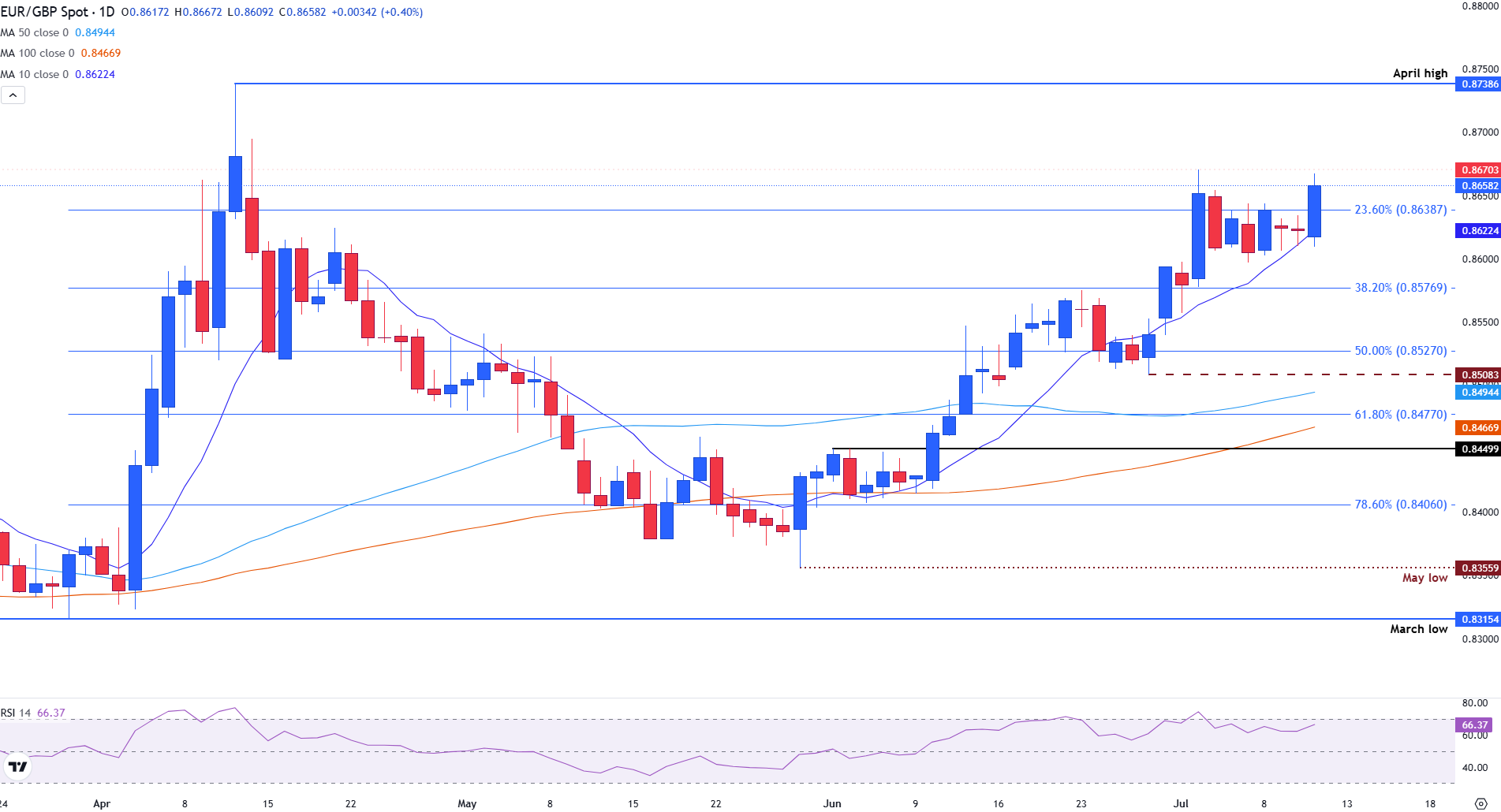
This fundamental weakness in UK data provided a fresh catalyst for EUR/GBP, with the pair breaking above the 23.6% Fibonacci retracement level of the March–April uptrend at 0.8634. The move reinforces bullish sentiment as the 10-day moving average continues to rise and the Relative Strength Index (RSI) climbs to 66, approaching overbought territory but not yet signaling exhaustion.
On the upside, a sustained close above the 0.8670 psychological barrier could clear the path for a retest of the April high near 0.8738, with further extension possible toward the 0.8750–0.8780 resistance zone.
Continued weak UK data, widening yield spreads, or any dovish shift from the Bank of England would likely add fuel to the rally.
In contrast, failure to hold above 0.8634 could trigger a pullback toward initial support at 0.8622 (10-day moving average), followed by the 38.2% Fibonacci level at 0.8576. A break below that could expose the 50-day moving average near 0.8494 and shift the near-term outlook back to neutral.
EUR/GBP daily chart
Pound Sterling FAQs
The Pound Sterling (GBP) is the oldest currency in the world (886 AD) and the official currency of the United Kingdom. It is the fourth most traded unit for foreign exchange (FX) in the world, accounting for 12% of all transactions, averaging $630 billion a day, according to 2022 data. Its key trading pairs are GBP/USD, also known as ‘Cable’, which accounts for 11% of FX, GBP/JPY, or the ‘Dragon’ as it is known by traders (3%), and EUR/GBP (2%). The Pound Sterling is issued by the Bank of England (BoE).
The single most important factor influencing the value of the Pound Sterling is monetary policy decided by the Bank of England. The BoE bases its decisions on whether it has achieved its primary goal of “price stability” – a steady inflation rate of around 2%. Its primary tool for achieving this is the adjustment of interest rates. When inflation is too high, the BoE will try to rein it in by raising interest rates, making it more expensive for people and businesses to access credit. This is generally positive for GBP, as higher interest rates make the UK a more attractive place for global investors to park their money. When inflation falls too low it is a sign economic growth is slowing. In this scenario, the BoE will consider lowering interest rates to cheapen credit so businesses will borrow more to invest in growth-generating projects.
Data releases gauge the health of the economy and can impact the value of the Pound Sterling. Indicators such as GDP, Manufacturing and Services PMIs, and employment can all influence the direction of the GBP. A strong economy is good for Sterling. Not only does it attract more foreign investment but it may encourage the BoE to put up interest rates, which will directly strengthen GBP. Otherwise, if economic data is weak, the Pound Sterling is likely to fall.
Another significant data release for the Pound Sterling is the Trade Balance. This indicator measures the difference between what a country earns from its exports and what it spends on imports over a given period. If a country produces highly sought-after exports, its currency will benefit purely from the extra demand created from foreign buyers seeking to purchase these goods. Therefore, a positive net Trade Balance strengthens a currency and vice versa for a negative balance.
Author

Tammy Da Costa, CFTe®
FXStreet
Tammy is an economist and market analyst with a deep passion for financial markets, particularly commodities and geopolitics.