Dow Jones Industrial Average surges on Middle East peace deal
- The Dow Jones surged around 500 points on Tuesday, climbing above 35,000.
- Investors are banking on a continued easing of tensions in the Middle East.
- Fed policymakers remain leery of tariff-led inflation and unemployment pressures.


The Dow Jones Industrial Average (DJIA) rallied on Tuesday, with equity markets bolstered across the board as the Israel-US-Iran conflict looks set to continue cooling off. Crude Oil markets are receding, falling into two-week lows and further easing market fears. Despite the overall improvement in general investor sentiment, Federal Reserve (Fed) officials remain uneasy at the prospect of a tariff-led inflation uptick, especially around the Q2-Q3 midpoint.
Israel and Iran appear to be inching toward a ceasefire deal, albeit with some hiccups, sparking a bull run in equity markets. A shaky ceasefire deal, which was largely brokered by US President Donald Trump, helped to bolster market confidence that their bets of a cool-off in tensions would pay off. Reports of missile exchanges between Iran and Israel hours after the start of Trump’s phased ceasefire deal sparked a public chastising from President Trump aimed at both Israel and Iran, but markets continue to expect a walkback on tensions between the two Middle East countries.
Fed Chair Jerome Powell kicked off the first half of his two-day testimony before congressional and Senate financial committees on Tuesday. Fed head Powell reaffirmed the Fed’s determination to hold off on making any policy rate adjustments until they get a clearer sense of what kind of inflation impact tariffs could bring, with the Fed Chair specifically highlighting concerns of an uptick in inflation pressure heading through the summer months.
Rate traders still have their hopes pinned on a September rate cut, according to the CME’s FedWatch Tool. Odds of at least a quarter-point rate trim on September 17 are holding near 80%, with odds of a follow-up cut in October hovering around 60%.
Read more stock news: US stock markets to open higher as shaky ceasefire continues risk-on sentiment
Dow Jones price forecast
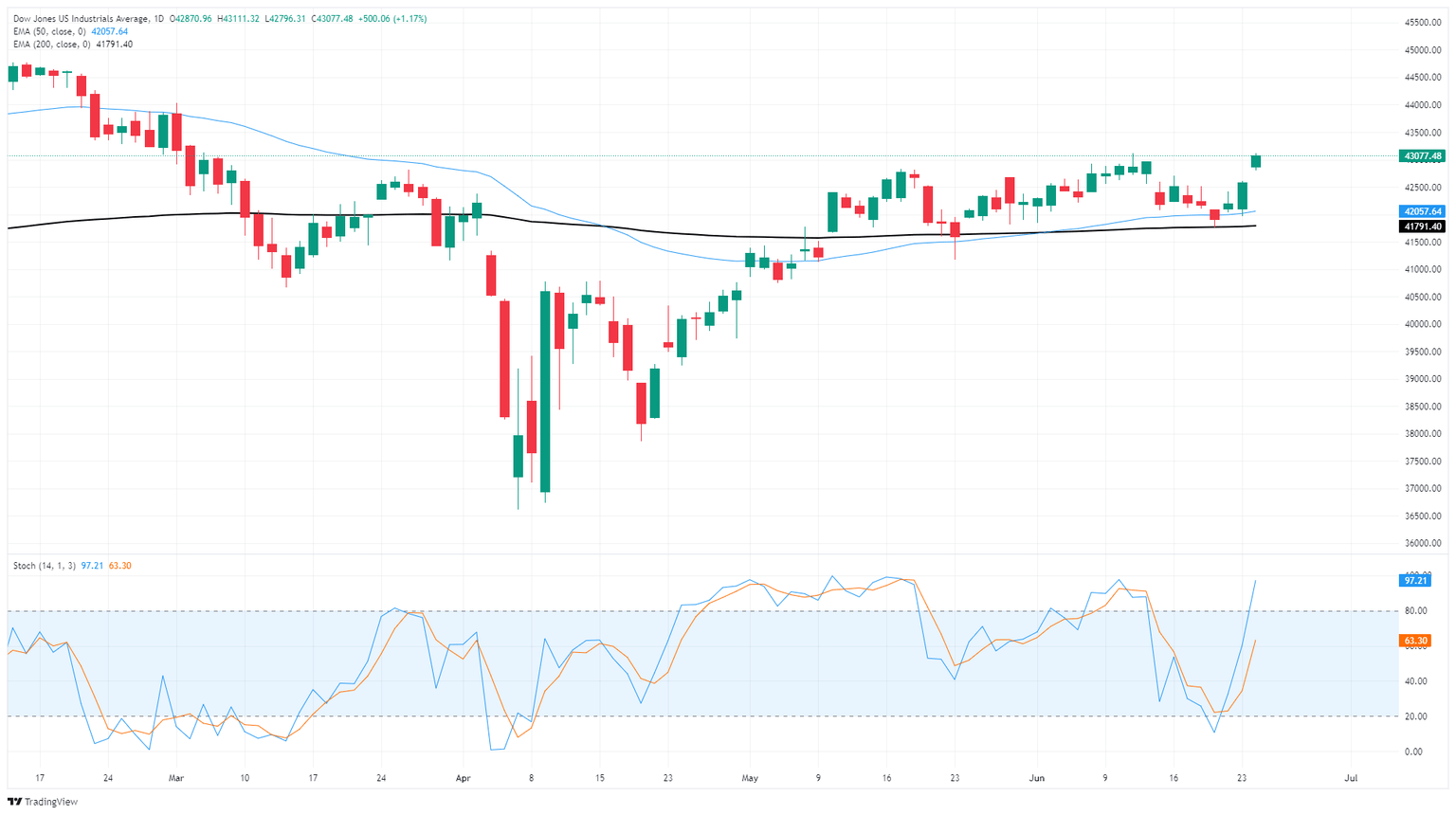
The Dow Jones Industrial Average’s Tuesday push has knocked intraday bids back above the 43,000 handle, and the DJIA is poised to close above the major psychological level for the first time since early March. The major equity index has fully recovered from its post-tariff announcement rout that kicked off in early April, and bullish momentum is poised to carry the Dow back into all-time highs above 45,000.
Dow Jones daily chart
Fed FAQs
Monetary policy in the US is shaped by the Federal Reserve (Fed). The Fed has two mandates: to achieve price stability and foster full employment. Its primary tool to achieve these goals is by adjusting interest rates. When prices are rising too quickly and inflation is above the Fed’s 2% target, it raises interest rates, increasing borrowing costs throughout the economy. This results in a stronger US Dollar (USD) as it makes the US a more attractive place for international investors to park their money. When inflation falls below 2% or the Unemployment Rate is too high, the Fed may lower interest rates to encourage borrowing, which weighs on the Greenback.
The Federal Reserve (Fed) holds eight policy meetings a year, where the Federal Open Market Committee (FOMC) assesses economic conditions and makes monetary policy decisions. The FOMC is attended by twelve Fed officials – the seven members of the Board of Governors, the president of the Federal Reserve Bank of New York, and four of the remaining eleven regional Reserve Bank presidents, who serve one-year terms on a rotating basis.
In extreme situations, the Federal Reserve may resort to a policy named Quantitative Easing (QE). QE is the process by which the Fed substantially increases the flow of credit in a stuck financial system. It is a non-standard policy measure used during crises or when inflation is extremely low. It was the Fed’s weapon of choice during the Great Financial Crisis in 2008. It involves the Fed printing more Dollars and using them to buy high grade bonds from financial institutions. QE usually weakens the US Dollar.
Quantitative tightening (QT) is the reverse process of QE, whereby the Federal Reserve stops buying bonds from financial institutions and does not reinvest the principal from the bonds it holds maturing, to purchase new bonds. It is usually positive for the value of the US Dollar.
Author
Joshua Gibson
FXStreet
Joshua joins the FXStreet team as an Economics and Finance double major from Vancouver Island University with twelve years' experience as an independent trader focusing on technical analysis.