Dow Jones Industrial Average sinks over 200 points on risk aversion
- Dow Jones index pressured by rising Treasury yields and significant losses in Microsoft (-5.37%) and Meta (-4%) amid disappointing mega-cap tech guidance.
- Sentiment turns cautious as investors brace for the US presidential election, VIX up over 11%.
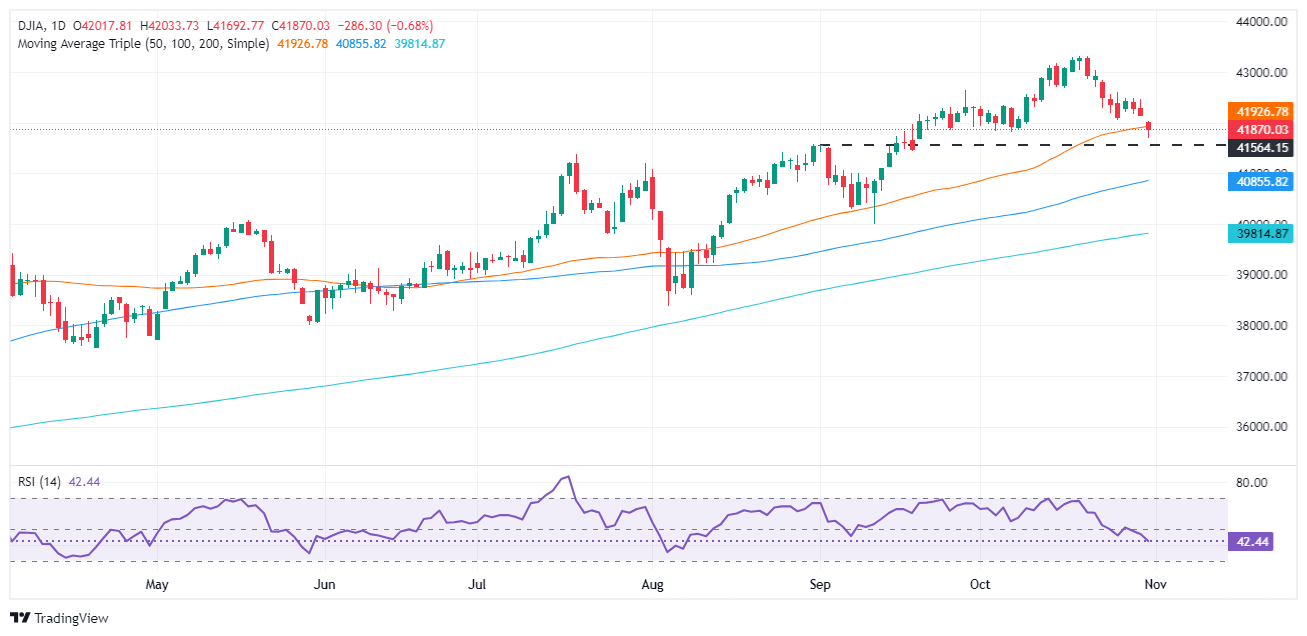
- Key support levels for DJIA lie at 41,564 and the 100-day SMA at 40,856, while resistance remains at 42,122 and the October 31 high of 42,460.


The Dow Jones Industrial Average (DJIA) plummeted over 200 points or more than half a percentage point during the North American session on Thursday. US Treasury bond yields spiked, sparked by a jump in global bond yields as traders digested the UK budget. At the same time, Microsoft (MSFT) and Meta (META) dropped by over 5.8% and 4% each, while investors braced for the release of Apple (APPL) and Amazon (AMZN) earnings reports.
Sentiment shifted sour as investors prepare for next week's US election, while US data hinted the Federal Reserve (Fed) wouldn’t need to take aggressive steps to ease policy as jobs data was solid. The US 10-year Treasury note rose as high as 4.333% in the session, while the US Dollar Index (DXY) clung to the 104.00 figure.
Quincy Krosbye of LPL Financial said, “The market overall has been disappointed with mega-tech guidance.” He added that the US presidential election on November 5 would bring more uncertainty, causing a spike in volatility. The CBOE Volatility Index (VIX) rises over 11.46% to 22.67 at the time of writing.
The US Personal Consumption Expenditures (PCE) Price Index dipped in October from 2.2% to 2.1% YoY as expected. Meanwhile, the Fed’s favorite inflation gauge, the core PCE, rose by 2.7% annually, unchanged from September, decreasing traders' hopes for a more dovish US central bank.
Other data showed that Initial Jobless Claims for the week ending October 26 fell to a five-month low. It came at 216K, below estimates of 230K and the previous reading of 227K.
After the data, the CME FedWatch Tool shows odds for a 25 bps rate cut by the Fed reaching 95%, down from 97% a day ago. This would leave rates in the 4.50%-4.75% range.
Dow Jones news
On Wednesday, Microsoft revealed its fiscal Q1 2025 earnings. The company revealed that earnings per share (EPS) were $3.30, exceeding estimates of $3.11, and revenue was $65.59 billion, above forecasts of $64.51 billion. Digging deep into the data, cloud revenue rose to $38.9 billion, above estimates of $38.11 billion, while Intelligent Cloud revenue was $24.09 billion.
At the same time, Amgen (AMGN) earnings beat estimates, but revenue fell short of Wall Street’s consensus. EPS was $5.58 (consensus of $5.11), while revenue was expected at $8.52 billion but was reported at $8.50 billion.
Although the DJIA extends its losses, Verizon (VZ) is up 2.69% at $42.39 a share, followed by Amgen, up 2.69% at $320.59, and Walt Disney (DIS), gaining 1.12% at $96.15. The three main losers are Microsoft, losing over 5.37% to $409.30, followed by Amazon, down 3.12% at $186.72, and Boeing (BA) fell 3.09% at $149.52.
Dow Jones price forecast
The Dow Jones Industrial Average dropped below 42,000 points and extended its losses toward 41,692, below the 50-day Simple Moving Average (SMA) at 41,928. If bears push the DJIA below the 50-day SMA, look for further losses, as they could test the September 2 high turned support at 41,564. If surpassed, traders could test 41,000 ahead of the 100-day SMA at 40,856.
Conversely, if buyers reclaim 42,000, look for a test of the October 30 low, which turned resistance at 42,122. Once cleared, the next stop would be the October 31 high at 42,460.
Otherwise, if the Dow extends its losses below 42,000, then 41,500 would provide the first support.
The momentum shifted to bearish even though the Relative Strength Index (RSI) remains bullish. Nevertheless, it’s aiming downward, accelerating to clear its neutral line.
Dow Jones daily chart
Dow Jones FAQs
The Dow Jones Industrial Average, one of the oldest stock market indices in the world, is compiled of the 30 most traded stocks in the US. The index is price-weighted rather than weighted by capitalization. It is calculated by summing the prices of the constituent stocks and dividing them by a factor, currently 0.152. The index was founded by Charles Dow, who also founded the Wall Street Journal. In later years it has been criticized for not being broadly representative enough because it only tracks 30 conglomerates, unlike broader indices such as the S&P 500.
Many different factors drive the Dow Jones Industrial Average (DJIA). The aggregate performance of the component companies revealed in quarterly company earnings reports is the main one. US and global macroeconomic data also contributes as it impacts on investor sentiment. The level of interest rates, set by the Federal Reserve (Fed), also influences the DJIA as it affects the cost of credit, on which many corporations are heavily reliant. Therefore, inflation can be a major driver as well as other metrics which impact the Fed decisions.
Dow Theory is a method for identifying the primary trend of the stock market developed by Charles Dow. A key step is to compare the direction of the Dow Jones Industrial Average (DJIA) and the Dow Jones Transportation Average (DJTA) and only follow trends where both are moving in the same direction. Volume is a confirmatory criteria. The theory uses elements of peak and trough analysis. Dow’s theory posits three trend phases: accumulation, when smart money starts buying or selling; public participation, when the wider public joins in; and distribution, when the smart money exits.
There are a number of ways to trade the DJIA. One is to use ETFs which allow investors to trade the DJIA as a single security, rather than having to buy shares in all 30 constituent companies. A leading example is the SPDR Dow Jones Industrial Average ETF (DIA). DJIA futures contracts enable traders to speculate on the future value of the index and Options provide the right, but not the obligation, to buy or sell the index at a predetermined price in the future. Mutual funds enable investors to buy a share of a diversified portfolio of DJIA stocks thus providing exposure to the overall index.
Author
Christian Borjon Valencia
FXStreet
Markets analyst, news editor, and trading instructor with over 14 years of experience across FX, commodities, US equity indices, and global macro markets.