Dow Jones Industrial Average backslides as NFP Friday looms
- The Dow Jones tested the low side of the 45,000 handle on Thursday.
- US Initial Jobless Claims ticked higher on a weekly basis.
- Investors are shuffling their feet ahead of this week’s NFP jobs report.

The Dow Jones Industrial Average (DJIA) fell back slightly on Thursday, easing down around 250 points at its lowest and keeping price action in a tense standoff with the 45,000 major price handle. Markets are coiling ahead of Friday’s upcoming Nonfarm Payrolls (NFP) report, and investors are growing uneasy after a batch of missed expectations in preview labor figures.
Overall market sentiment remains firmly bullish, keeping equities close to record highs. Clear signs of an economic slowdown remain elusive, preventing traders from pivoting firmly into a risk-off stance. Still, a murky policy outlook for 2025 has bulls second-guessing sky-high valuations. Incoming President Donald Trump favors a policy stance that could reignite inflation pressures, sacrifice economic stability, and send government budgets spiraling. However, that’s a long way off, and markets are holding onto hopes that Trump’s pro-market stance and distaste for regulation will help offset downside pressures on business earnings.
Initial Jobless Claims for the week ended November 29 rose to a six-week high of 224K, missing the expected print of 215K and stepping above the previous week’s revised 215K. Challenger Job Cuts in November also rose to 57.727K, but the batch of mid-tier labor data pales in comparison to Friday’s upcoming NFP print. Investors are expecting November’s NFP net jobs additions to rebound to 200K after the previous month’s stumble to 12K. October’s shockingly low print was attributed to layoffs from hurricanes and labor strikes, and investors are hoping for a healthy rebound in job gains.
Dow Jones news
Most of the Dow Jones equity board is rising on Thursday, with equities overall bidding into positive territory, however key losses in overweighted securities are dragging the Dow Jones into the low side for the day. Unitedhealth Group (UNH) sank 4% to $586 per share after the CEO of Unitedhealth’s insurance unit was assassinated in New York this week. Salesforce (CRM) also eased down 2%, falling to $360 per share as the heavily overvalued stock sheds some weight. CRM has been swept up along with the broader AI craze gripping tech stocks and single-handedly driving the market’s equities rally, but some investors are beginning to caution that they would like to see some evidence of CRM’s revenue margins expand as a result of AI incorporation in the company’s platform.
Dow Jones price forecast
The Dow Jones is grinding into a near-term sideways pattern as daily candlesticks struggle to find momentum in either direction. The major equity index is grappling with the 45,000 handle, but a meaningful downside pullback has yet to materialize after the DJIA found fresh record highs last week.
Traders looking to catch another leg higher will be looking for a fresh retracement to the 50-day Exponential Moving Average (EMA) rising through 43,300. A deep pullback to the last swing low near the 42,000 key level is unlikely to materialize, but represents a significant discount compared to recent price action, and could spark a steep rebound.
Dow Jones daily chart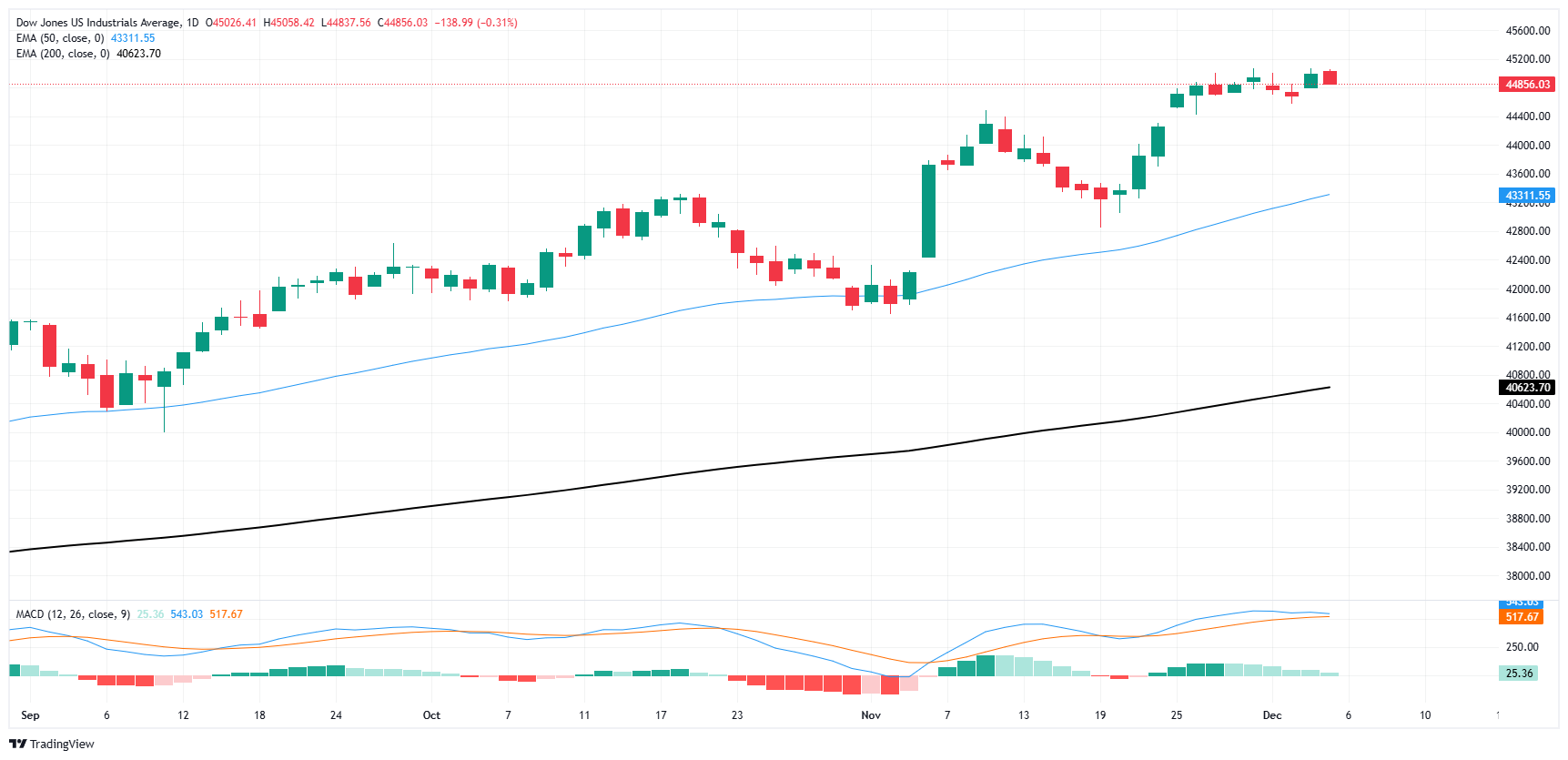
Dow Jones FAQs
The Dow Jones Industrial Average, one of the oldest stock market indices in the world, is compiled of the 30 most traded stocks in the US. The index is price-weighted rather than weighted by capitalization. It is calculated by summing the prices of the constituent stocks and dividing them by a factor, currently 0.152. The index was founded by Charles Dow, who also founded the Wall Street Journal. In later years it has been criticized for not being broadly representative enough because it only tracks 30 conglomerates, unlike broader indices such as the S&P 500.
Many different factors drive the Dow Jones Industrial Average (DJIA). The aggregate performance of the component companies revealed in quarterly company earnings reports is the main one. US and global macroeconomic data also contributes as it impacts on investor sentiment. The level of interest rates, set by the Federal Reserve (Fed), also influences the DJIA as it affects the cost of credit, on which many corporations are heavily reliant. Therefore, inflation can be a major driver as well as other metrics which impact the Fed decisions.
Dow Theory is a method for identifying the primary trend of the stock market developed by Charles Dow. A key step is to compare the direction of the Dow Jones Industrial Average (DJIA) and the Dow Jones Transportation Average (DJTA) and only follow trends where both are moving in the same direction. Volume is a confirmatory criteria. The theory uses elements of peak and trough analysis. Dow’s theory posits three trend phases: accumulation, when smart money starts buying or selling; public participation, when the wider public joins in; and distribution, when the smart money exits.
There are a number of ways to trade the DJIA. One is to use ETFs which allow investors to trade the DJIA as a single security, rather than having to buy shares in all 30 constituent companies. A leading example is the SPDR Dow Jones Industrial Average ETF (DIA). DJIA futures contracts enable traders to speculate on the future value of the index and Options provide the right, but not the obligation, to buy or sell the index at a predetermined price in the future. Mutual funds enable investors to buy a share of a diversified portfolio of DJIA stocks thus providing exposure to the overall index.
Author

Joshua Gibson
FXStreet
Joshua joins the FXStreet team as an Economics and Finance double major from Vancouver Island University with twelve years' experience as an independent trader focusing on technical analysis.