Dow Jones Industrial Average extends rebound on Wednesday, but gains remain limited
- The Dow Jones rose around 100 points from the previous day’s close on Wednesday.
- The Dow is recovering from last week’s one-sided declines.
- A constant cycle of fresh tariff threats continue to weigh on investor sentiment.

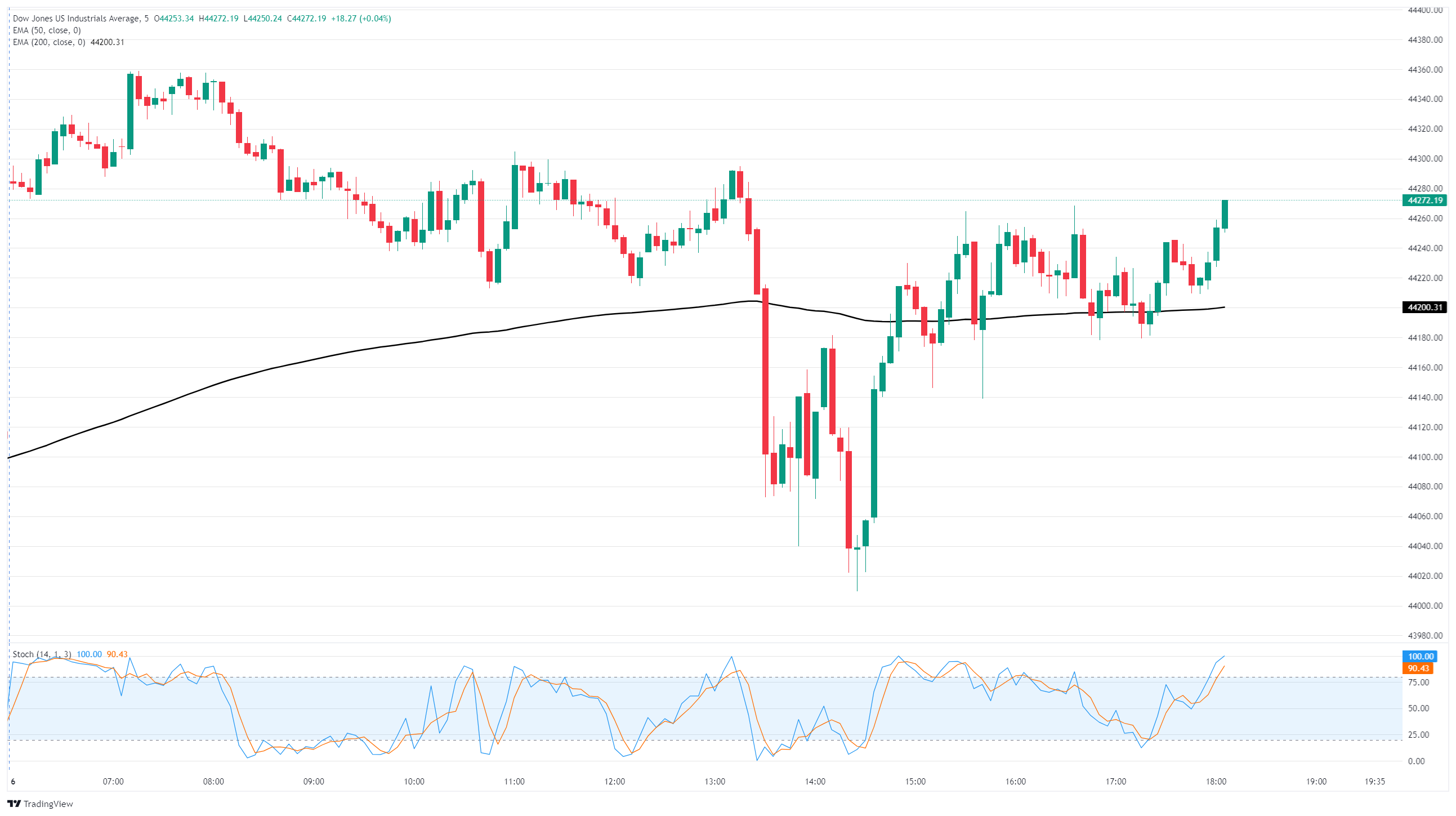
The Dow Jones Industrial Average (DJIA) found slim gains on Wednesday, gaining around 100 points from Tuesday’s close. The Dow is testing the 44,250 region as the major equity index rebounds from a near-term low after five straight sessions of declines last week.
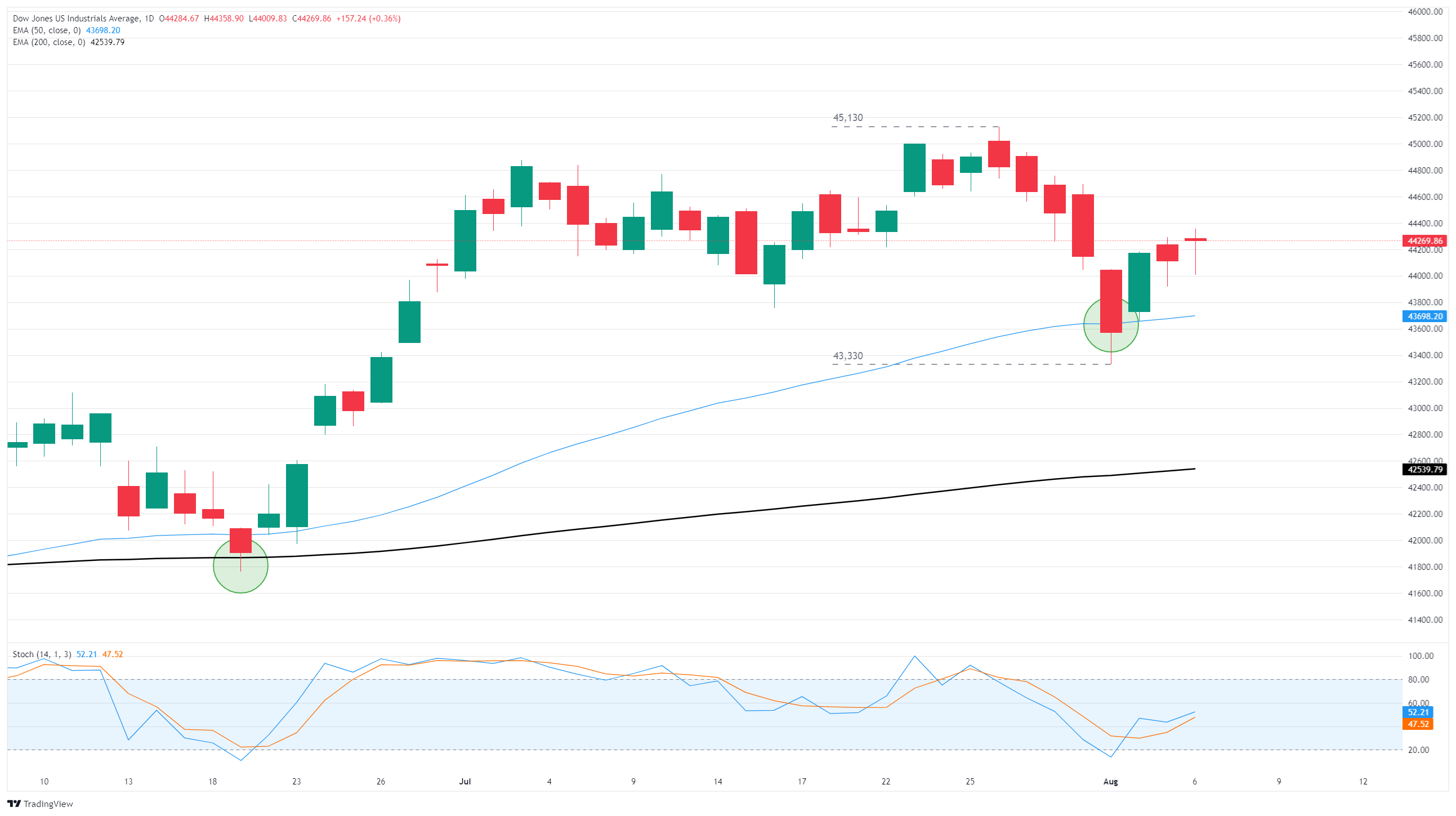
The Dow Jones has clawed back nearly half of the declines priced in last week, rebounding around 2% after hitting a near-term low of 43,330. The Dow caught a technical bounce from the 50-day Exponential Moving Average (EMA), now rising into 43,550 as bullish momentum drags price action back into the high end.
Equities claw back losses as rate cut hopes rise
A sharp downgrade to US employment data last week sparked a rebalancing of rate cut expectations from the Federal Reserve (Fed) at its upcoming interest rate decision next month. Markets have piled back into bets that the Fed will deliver at least a quarter-point rate cut on September 17 in an effort to shore up the United States (US) economy, but the potential for a steepening slowdown in job creation, as well as still-stubborn inflation data, is capping continued record-setting index growth.
Earnings season is still in full swing, with over 80% of all reporting companies listed on the Standard & Poor’s 500 (SP500) index posting better-than-expected Q2 results. Mcdonald’s (MCD) rose 2%, climbing into fresh two-month highs above $308.50 per share after beating the street on earnings through the second quarter, while Advanced Micro Devices (AMD) shed over 6% to test below $163.00 per share after flubbing earnings per share forecasts.
Read more stock news: Shopify stock soars 20% as Q2 revenue spikes over 30%
Dow Jones 5-minute chart
Dow Jones daily chart
S&P 500 FAQs
The S&P 500 is a widely followed stock price index which measures the performance of 500 publicly owned companies, and is seen as a broad measure of the US stock market. Each company’s influence on the computation of the index is weighted based on market capitalization. This is calculated by multiplying the number of publicly traded shares of the company by the share price. The S&P 500 index has achieved impressive returns – $1.00 invested in 1970 would have yielded a return of almost $192.00 in 2022. The average annual return since its inception in 1957 has been 11.9%.
Companies are selected by committee, unlike some other indexes where they are included based on set rules. Still, they must meet certain eligibility criteria, the most important of which is market capitalization, which must be greater than or equal to $12.7 billion. Other criteria include liquidity, domicile, public float, sector, financial viability, length of time publicly traded, and representation of the industries in the economy of the United States. The nine largest companies in the index account for 27.8% of the market capitalization of the index.
There are a number of ways to trade the S&P 500. Most retail brokers and spread betting platforms allow traders to use Contracts for Difference (CFD) to place bets on the direction of the price. In addition, that can buy into Index, Mutual and Exchange Traded Funds (ETF) that track the price of the S&P 500. The most liquid of the ETFs is State Street Corporation’s SPY. The Chicago Mercantile Exchange (CME) offers futures contracts in the index and the Chicago Board of Options (CMOE) offers options as well as ETFs, inverse ETFs and leveraged ETFs.
Many different factors drive the S&P 500 but mainly it is the aggregate performance of the component companies revealed in their quarterly and annual company earnings reports. US and global macroeconomic data also contributes as it impacts on investor sentiment, which if positive drives gains. The level of interest rates, set by the Federal Reserve (Fed), also influences the S&P 500 as it affects the cost of credit, on which many corporations are heavily reliant. Therefore, inflation can be a major driver as well as other metrics which impact the Fed decisions.
Author

Joshua Gibson
FXStreet
Joshua joins the FXStreet team as an Economics and Finance double major from Vancouver Island University with twelve years' experience as an independent trader focusing on technical analysis.

















