Dow Jones Industrial Average flops as headwinds mount, declines 300 points
- The Dow Jones fell over 1,100 points peak-to-trough on Thursday after early gains.
- Markets soured following Nvidia’s after-hours earnings as revenues remain murky.
- A surge in September’s NFP solidified market expectations for a Fed rate hold in December.
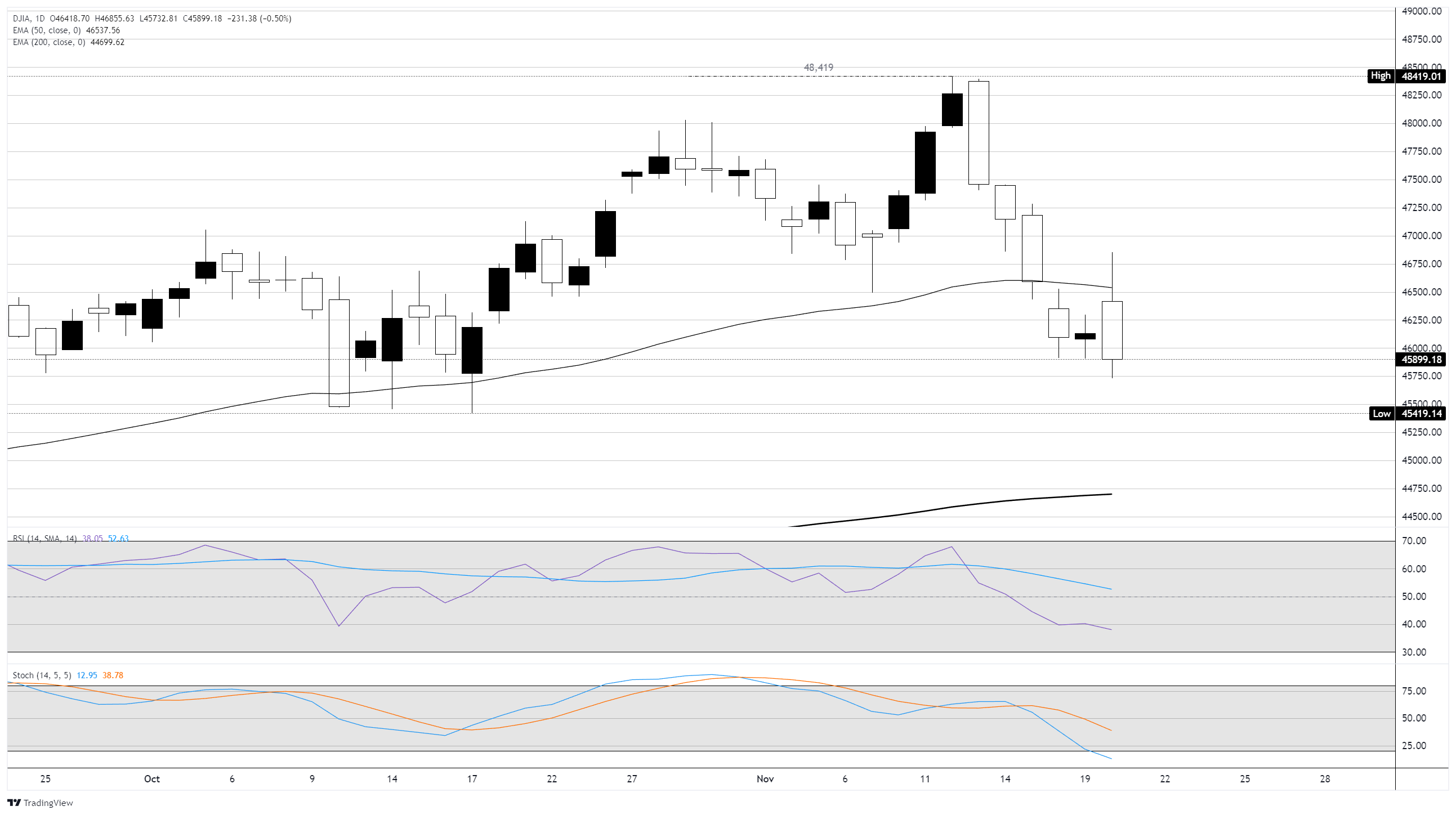
The Dow Jones started Thursday off on a high note. The major equity index soared 725 points in the early hours before promptly reversing course at 1545 GMT (1045 EST) and sinking over 1,100 points top-to-bottom, hitting a five-week low of 45,732 in the process. Markets are facing fresh headwinds on multiple fronts, and a poorly-timed announcement that the Nonfarm Payrolls (NFP) employment “situation” data releases would be delayed until December 16th was the cherry on top.
The Dow Jones Industrial Average is down 2.2% on the week, and on pace for its worst weekly performance since the beginning of October. Equities are facing fresh challenges across the board, with the tech-heavy NASDAQ 100 down around 0.6% for the day after testing its lowest bids in nearly nine weeks. The Dow found an eventual foothold to reclaim the 46,000 handle in midday trading, before sinking back into the day's lows, down around 0.65% on Thursday.
AI under a microscope as high chip demand still doesn't mean high revenues
The AI trade remains under threat, with investor trepidation on the rise in the face of hard mathematics disagreeing with pie-eyed expectations of infinite earnings potential. Nvidia (NVDA) posted strong paper figures during its after-market earnings call after the closing bell on Wednesday, claiming another quarter of strong double-digit demand growth for its AI-focused chipsets. However, skeptical analysts noted that several key categories in Nvidia’s earnings should raise concern among tech wonks.
According to Nvidia’s earnings call, the chipmaker stockpiled nearly $20 billion in unsold product, a 32% increase in a single quarter. For a company claiming “strong demand growth”, it represents a worrying increase in stockpiles. Nvidia also posted $19.3 billion in quarterly revenue, but only $14.5 billion of that converted to cash, leaving an almost $5 billion shortfall between cash and earnings, a significantly slower pace of cash generation compared to Nvidia’s peers.
NFP data pipeline has resumed, but delays leave rate cut hopes on the floor
September’s backdated Nonfarm Payrolls (NFP) was released on Thursday following the recent resumption of federal government operations, showing a surprising upswing of 119K in the number of net new jobs created during the month. The strong NFP showing has limited the chances of a Federal Reserve (Fed) interest rate cut on December 10. October’s and November’s NFP releases have been delayed until December 16, pushing out market expectations for a third interest rate trim to the Fed’s January rate call.
Dow Jones daily chart
AI stocks FAQs
First and foremost, artificial intelligence is an academic discipline that seeks to recreate the cognitive functions, logical understanding, perceptions and pattern recognition of humans in machines. Often abbreviated as AI, artificial intelligence has a number of sub-fields including artificial neural networks, machine learning or predictive analytics, symbolic reasoning, deep learning, natural language processing, speech recognition, image recognition and expert systems. The end goal of the entire field is the creation of artificial general intelligence or AGI. This means producing a machine that can solve arbitrary problems that it has not been trained to solve.
There are a number of different use cases for artificial intelligence. The most well-known of them are generative AI platforms that use training on large language models (LLMs) to answer text-based queries. These include ChatGPT and Google’s Bard platform. Midjourney is a program that generates original images based on user-created text. Other forms of AI utilize probabilistic techniques to determine a quality or perception of an entity, like Upstart’s lending platform, which uses an AI-enhanced credit rating system to determine credit worthiness of applicants by scouring the internet for data related to their career, wealth profile and relationships. Other types of AI use large databases from scientific studies to generate new ideas for possible pharmaceuticals to be tested in laboratories. YouTube, Spotify, Facebook and other content aggregators use AI applications to suggest personalized content to users by collecting and organizing data on their viewing habits.
Nvidia (NVDA) is a semiconductor company that builds both the AI-focused computer chips and some of the platforms that AI engineers use to build their applications. Many proponents view Nvidia as the pick-and-shovel play for the AI revolution since it builds the tools needed to carry out further applications of artificial intelligence. Palantir Technologies (PLTR) is a “big data” analytics company. It has large contracts with the US intelligence community, which uses its Gotham platform to sift through data and determine intelligence leads and inform on pattern recognition. Its Foundry product is used by major corporations to track employee and customer data for use in predictive analytics and discovering anomalies. Microsoft (MSFT) has a large stake in ChatGPT creator OpenAI, the latter of which has not gone public. Microsoft has integrated OpenAI’s technology with its Bing search engine.
Following the introduction of ChatGPT to the general public in late 2022, many stocks associated with AI began to rally. Nvidia for instance advanced well over 200% in the six months following the release. Immediately, pundits on Wall Street began to wonder whether the market was being consumed by another tech bubble. Famous investor Stanley Druckenmiller, who has held major investments in both Palantir and Nvidia, said that bubbles never last just six months. He said that if the excitement over AI did become a bubble, then the extreme valuations would last at least two and a half years or long like the DotCom bubble in the late 1990s. At the midpoint of 2023, the best guess is that the market is not in a bubble, at least for now. Yes, Nvidia traded at 27 times forward sales at that time, but analysts were predicting extremely high revenue growth for years to come. At the height of the DotCom bubble, the NASDAQ 100 traded for 60 times earnings, but in mid-2023 the index traded at 25 times earnings.
Author

Joshua Gibson
FXStreet
Joshua joins the FXStreet team as an Economics and Finance double major from Vancouver Island University with twelve years' experience as an independent trader focusing on technical analysis.