Canadian Dollar rebounds on fresh Crude Oil strength
- The Canadian Dollar caught a much-needed rebound on Tuesday.
- Loonie markets are on the rise as the CAD catches fresh support from rising Crude Oil prices.
- Despite a near-term Loonie surge, the economic backdrop remains sticky.

The Canadian Dollar (CAD) found a fresh foothold on Tuesday, climbing around one-half of one percent against the US Dollar (USD). Crude Oil prices are on the rise in the front half of the week, providing some much-needed support for the otherwise underperforming Loonie.
There is little meaningful fundamental support for the Canadian Dollar on the offering; Canadian inflation metrics are still on the wrong side of the Bank of Canada’s (BoC) 2% annual inflation target following Monday’s Consumer Price Index (CPI) inflation print. Rate markets see less than a 10% chance of a BoC rate cut at the Canadian central bank’s next meeting. Canadian employment figures continue to hit somewhere between middling and disappointing, and Retail Sales data, due on Friday, is expected to dip back into contraction territory.
Daily digest market movers: Canadian Dollar catches tailwind from rising Crude Oil
- The Canadian Dollar found a three-week high against the Greenback on Tuesday, pushing back from seven-month lows.
- The Loonie is back into the green against the US Dollar for November, bucking two months of straight losses.
- Canadian fundamentals remain relatively unchanged from one release to the next, with the majority of datapoints pointing toward a creeping downturn.
- Despite flubbing data releases, odds of further interest rate cuts from the BoC remain functionally nonexistent as inflation continues to run above the band.
- Crude Oil prices found further support on Tuesday, with West Texas Intermediate (WTI) barrel bids climbing 1.4% on the day. Oil barrel prices remain the singular technical support for the Loonie after climbing for a fourth straight trading session.
Canadian Dollar price forecast
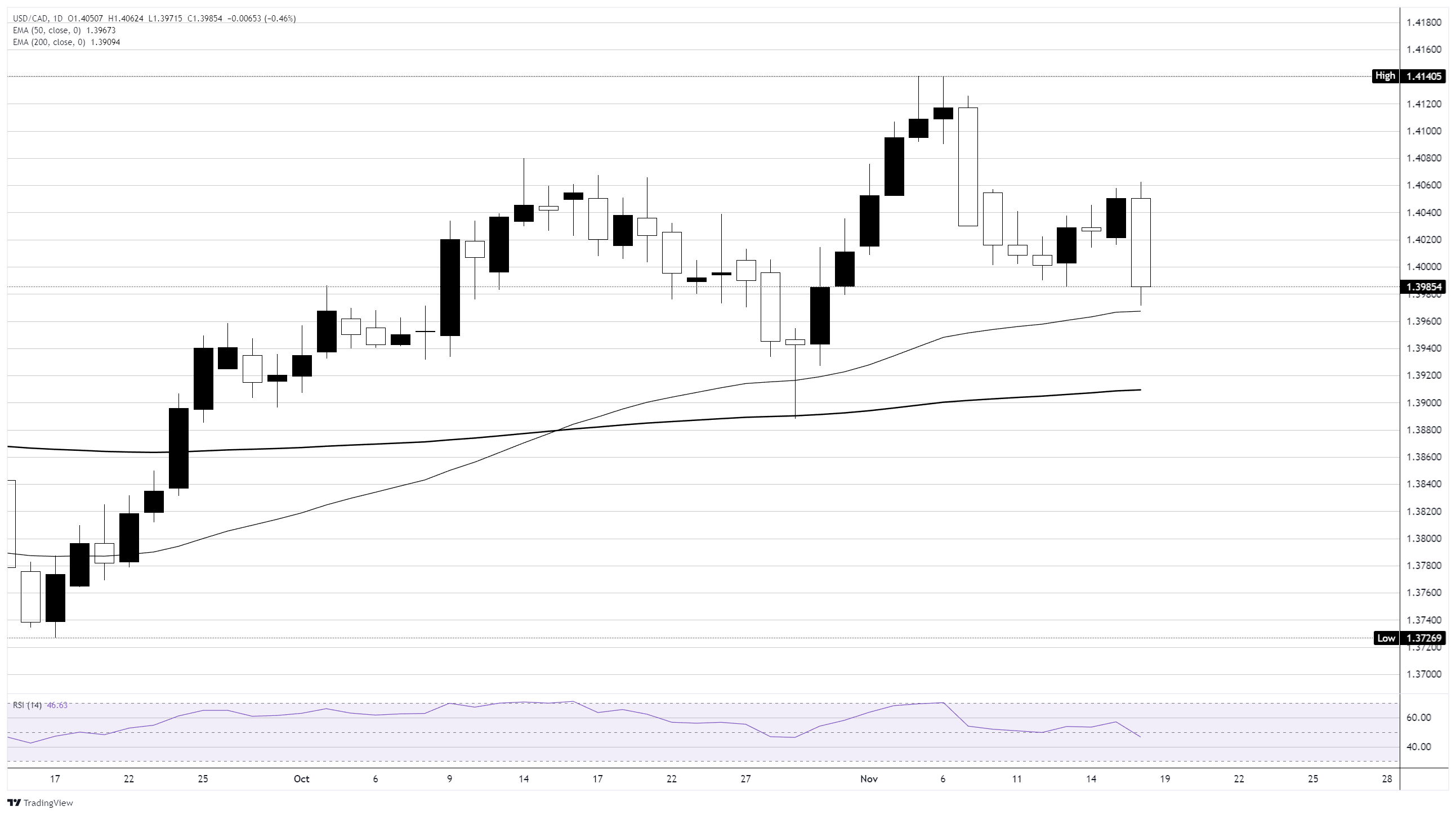
USD/CAD is retreating from the early November spike near 1.4140 as the Canadian Dollar reclaims lost ground against the US Dollar. The pair slipped back toward the mid-range and is now hovering just above 1.3980, close to the fifty day exponential moving average at 1.3967. The 200-day Exponential Moving Average (EMA) at 1.3909 remains intact below current price action.
The latest downswing pulled price into a familiar pocket that has acted as a pivot through October and November. Buyers responded on the dip, but follow-through has been limited. The candle action shows hesitation, with repeated tests of the 1.4000 handle failing to hold. Momentum on the 14-period Relative Strength Index (RSI) has cooled and sits in the mid-forties, matching the choppy tone.
If pressure continues, traders will watch the 1.3950 to 1.3900 zone for potential reaction. On the upside, clearing 1.4050 would be the first sign that buyers are regaining confidence.
USD/CAD daily chart
Canadian Dollar FAQs
The key factors driving the Canadian Dollar (CAD) are the level of interest rates set by the Bank of Canada (BoC), the price of Oil, Canada’s largest export, the health of its economy, inflation and the Trade Balance, which is the difference between the value of Canada’s exports versus its imports. Other factors include market sentiment – whether investors are taking on more risky assets (risk-on) or seeking safe-havens (risk-off) – with risk-on being CAD-positive. As its largest trading partner, the health of the US economy is also a key factor influencing the Canadian Dollar.
The Bank of Canada (BoC) has a significant influence on the Canadian Dollar by setting the level of interest rates that banks can lend to one another. This influences the level of interest rates for everyone. The main goal of the BoC is to maintain inflation at 1-3% by adjusting interest rates up or down. Relatively higher interest rates tend to be positive for the CAD. The Bank of Canada can also use quantitative easing and tightening to influence credit conditions, with the former CAD-negative and the latter CAD-positive.
The price of Oil is a key factor impacting the value of the Canadian Dollar. Petroleum is Canada’s biggest export, so Oil price tends to have an immediate impact on the CAD value. Generally, if Oil price rises CAD also goes up, as aggregate demand for the currency increases. The opposite is the case if the price of Oil falls. Higher Oil prices also tend to result in a greater likelihood of a positive Trade Balance, which is also supportive of the CAD.
While inflation had always traditionally been thought of as a negative factor for a currency since it lowers the value of money, the opposite has actually been the case in modern times with the relaxation of cross-border capital controls. Higher inflation tends to lead central banks to put up interest rates which attracts more capital inflows from global investors seeking a lucrative place to keep their money. This increases demand for the local currency, which in Canada’s case is the Canadian Dollar.
Macroeconomic data releases gauge the health of the economy and can have an impact on the Canadian Dollar. Indicators such as GDP, Manufacturing and Services PMIs, employment, and consumer sentiment surveys can all influence the direction of the CAD. A strong economy is good for the Canadian Dollar. Not only does it attract more foreign investment but it may encourage the Bank of Canada to put up interest rates, leading to a stronger currency. If economic data is weak, however, the CAD is likely to fall.
Author

Joshua Gibson
FXStreet
Joshua joins the FXStreet team as an Economics and Finance double major from Vancouver Island University with twelve years' experience as an independent trader focusing on technical analysis.