|

BNB/USD (Binance) Elliott Wave analysis – Turn higher taking place

Original content: BNB/USD (Binance) Elliott Wave analysis – Turn higher taking place

Binance Coin is the cryptocurrency issued by Binance exchange and carries BNB symbol. With a volume of $7.6 billion, as of Q2 2022, Binance Exchange was the largest cryptocurrency exchange in the world. One-fifth of Binance exchange’s profits are used to repurchase and permanently destroy, or “burn,” Binance coins held in its treasury. Binance was created as a utility token for discounted trading fees in 2017, but now it’s used for other things as well such as entertainment, travel bookings, financial services, online services etc.  In this article, we will look at the long-term Elliott wave analysis of Binance Coin (BNBUSD) and what is expected next in cryptocurrency.

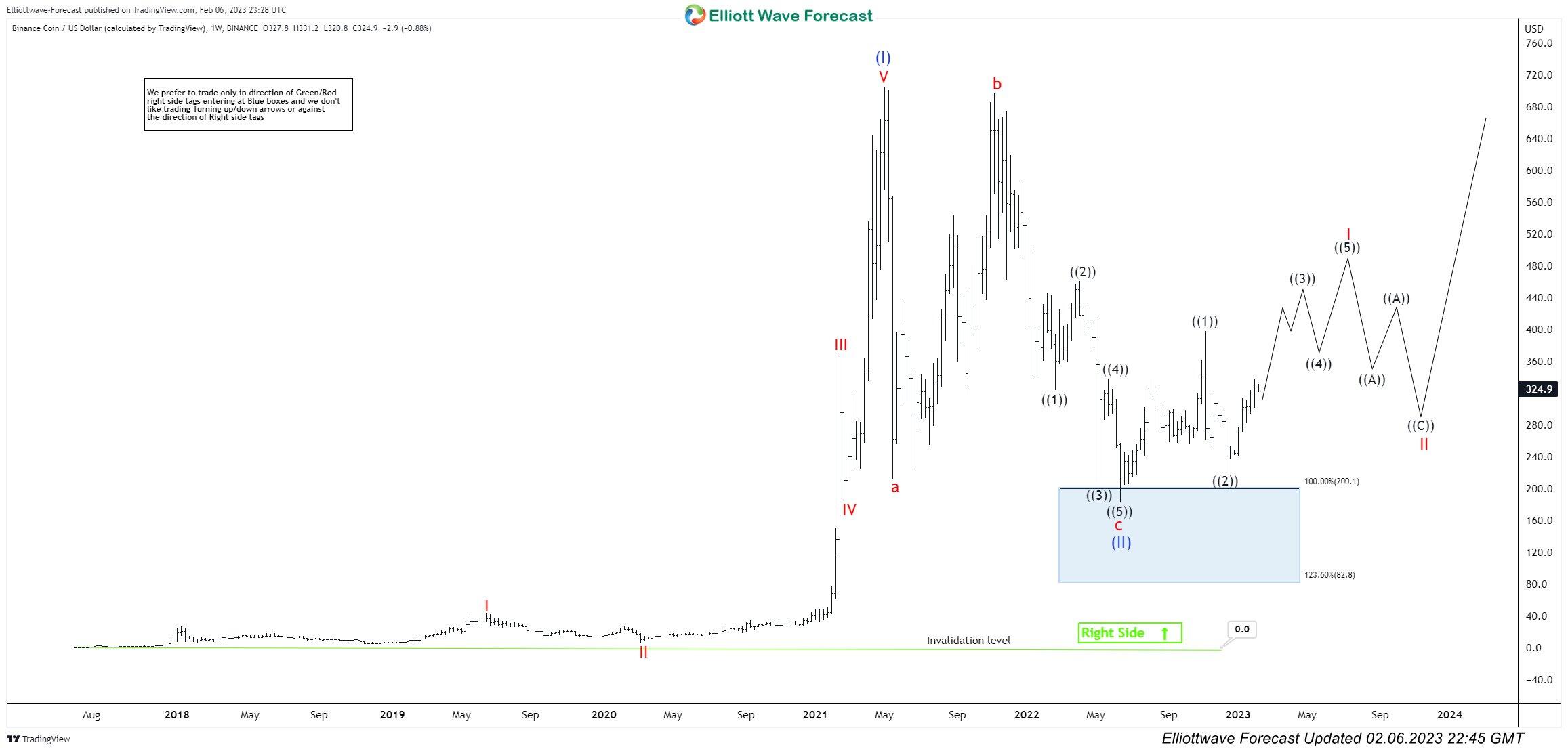
BNB/USD Elliott Wave analysis – Weekly chart – 6 February 2023
BNPUSD

Weekly chart below shows super cycle wave (I) completed at 704.6 in May 2021. Within this super cycle, wave I ended at 43.2, wave II pull back ended at 6.5, wave III ended at 368.2, wave IV ended at 184.7 and wave V ended at 704.6. This was followed by a 3 waves pull back within which wave a completed at 255.6, wave b completed at 696.1 and wave c completed at 183.4, this was just below 100% Fibonacci extension of a-b at 200.1. Cycle from wave b high is confirmed to be over s the logical call is for wave (II) pull back to be called completed at 183.4 low and expecting a turn higher to take place. As dips hold above 220.1 and more importantly while above 183.4, expect continuation higher. A break below 183.4 low will make it 5 swings down from May 2021 peak and would then result in a larger abc lower or extension lower within wave c to make it 7 swings. Break above November 2021 peak will expose 438,4  571.9 area to end 3 waves up from 183.4 low.

Author

Elliott Wave Forecast Team

Elliott Wave Forecast Team

ElliottWave-Forecast.com

More from Elliott Wave Forecast Team
Share:

Editor's Picks

GBP/USD: Daily gains remain capped by 1.3650

GBP/USD leaves behind Monday’s pessimism and advances marginally on Tuesday. Cable’s humble gains, however, appear to have met quite a decent resistance in the 1.3650 zone for now, in a context of a slight selling pressure hovering around the Greenback.

EUR/USD struggles to regain pace; gyrates around 1.1670

EUR/USD clinches humble gains around 1.1670 following Tuesday’s close on Wall Street. Indeed, marginal losses in the US Dollar encourages spot to set aside two dauly pullbacks in a row and maintain the 1.1700 barrier on the cross-hairs for now. Moving forward, US inflation tracked by the PCE and another revision of Q2 GDP data should keep investors entertained on Wednesday.

$4700 back on Gold buyers’ radar as US core PCE inflation data looms

Gold is heading back toward the fresh 15-week highs of $4,697 in Wednesday’s Asian trades, reversing a brief dip below the $4,650 level. Gold buyers find renewed strength from a broadly subdued US Dollar (USD), as they look to reposition ahead of the US core Personal Consumption Expenditures (PCE) Price Index data for July.

Bitcoin pauses near $80,000, Ethereum at $2,500, XRP below $1.50
Bitcoin (BTC), Ethereum (ETH), and Ripple (XRP) are facing downside pressure near key psychological thresholds as last week's double-digit rally loses momentum. The pullback reflects near-term corrective measures as traders book profits. Bitcoin trades near $78,760 at press time on Wednesday, maintaining its bullish bias after last week's 23% rally.
America’s self‑inflicted trade wound
I’m conflicted about the trade war that the U.S. has started with Canada. Let’s be clear: any representation that Canada has been taking unfair advantage of the U.S. or that they have been treating us badly for years is a bogus characterization. In reality, the shoe is on the other foot. It’s the U.S. that has been behaving badly.
Canada hits US goods with tariffs; The rate market sees a problem
On September 8, Canada begins charging its own importers 15%, 25% and 50% on roughly 700 lines of American goods. The measure is billed as dollar for dollar, and on the arithmetic of covered trade it is. What it is not is a tax on the United States.















