|

BLNK Stock Price: Blink Charging Company moves another 8.16% higher

  • Blink Charging Company pushes another 8.44% higher on Tuesday. 
  • Yet another deal was announced again today this time with Cushman & Wakefield.

BLNK stock rises again after more good news

Blink Charging Co. (Nasdaq: BLNK) announced today that it has signed an agreement with leading global real estate services firm Cushman & Wakefield (NYSE: CWK) for the marketing and potential deployment of Blink charging stations, including its Blink IQ 200 units, and related services to Cushman & Wakefield clients throughout the United States.Michael D. Farkas, Founder, Chairman and Chief Executive Officer of Blink, commented:

Cushman & Wakefield is a preeminent leader in property, facilities and project management, and we’re excited about this opportunity to partner with them to enhance the EV charging capabilities at the properties they represent. As drivers increasingly embrace EV technology, the demand for convenient charging alternatives is growing. We’re pleased to work with Cushman & Wakefield to contribute a greener future while enhancing tenant and visitor experience at their clients’ properties

Blink Charging Company 1-hour chart

The chart below shows some bullishness in the stock price. Now it seems that the USD 10 per share level is the major psychological support area if the price does start to fall back. On the topside, the USD 14.56 per share wave high is the level the bulls need to break to keep the great run going.

From the low to the high on the chart, the share price has risen around 480% which is some going in such a short period of time. Looking forward, a break of the black trendline could be a great trend continuation signal. Then beyond that the aforementioned high will need to be taken out for the stock price to hit its most recent high. We must still remember that the share price is quite some way away from its all-time high of  USD 3750.00. 
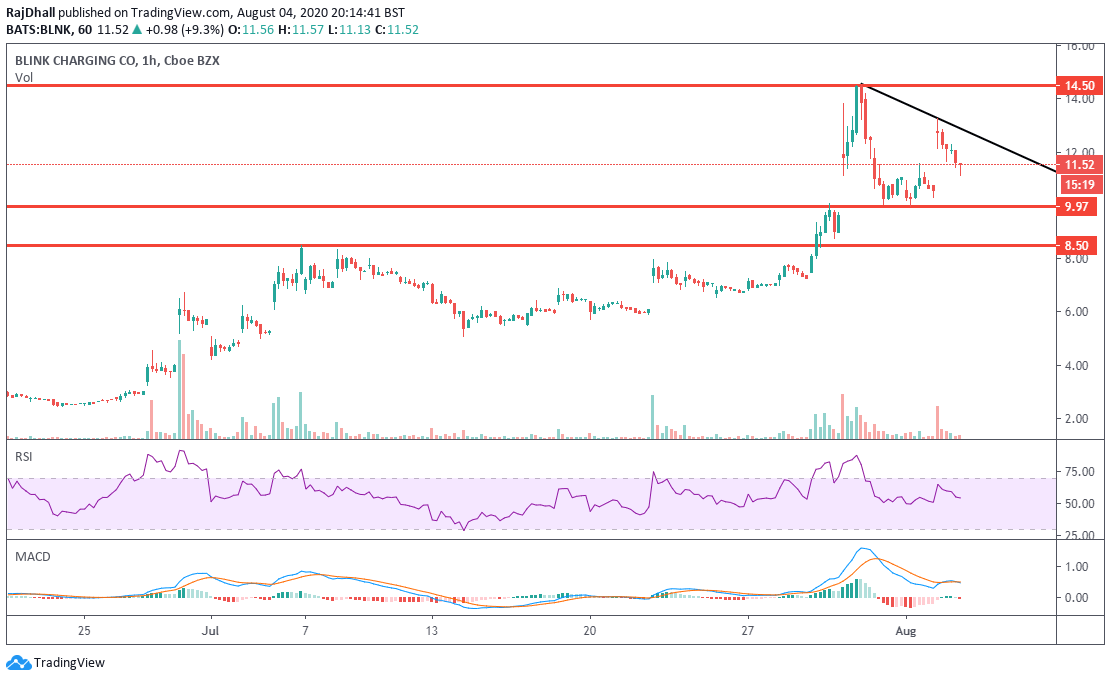
Blink Charging Company analysis

Author

More from FXStreet Team
Share:

Editor's Picks

EUR/USD slumps below 1.1750 as USD benefits from risk-aversion

EUR/USD comes under renewed bearish pressure in the European session and trades below 1.1750 following a recovery attempt earlier in the day. The US Dollar gathers strength and weighs on the pair as investors seek refuge in the wake of Israel and the United States' joint attack on Iran.

GBP/USD targets 1.3500 barrier near moving averages

GBP/USD rebounds from the daily losses, trading around 1.3450 during the Asian hours on Monday. The technical analysis of the daily chart indicates an ongoing bearish bias, as the pair trades within a descending channel pattern.

Gold surges on safe-haven demand, rises above $5,400

Gold benefits from intense risk-aversion on Monday and climbs above $5,400, setting a fresh monthly-high in the process. Tensions in the Middle East remain high as Israel and Hezbollah continue to exchange strikes following the US-Israel joint attack on Iran over the weekend.

Bitcoin, Ethereum and Ripple under pressure as key supports face breakdown risk

Bitcoin, Ethereum, and Ripple prices trade on the back foot at the start of this week on Monday, after extending losses in the previous week. BTC is on the brink of a breakdown, ETH is capped below key resistance, and XRP risks a crack of the trendline.

The market is paying for insurance, not apocalypse

As expected, this morning felt less like a Monday market open and more like a fire drill. Futures screens flickered red. S&P contracts down almost 1%. Nasdaq off 1.2%. Brent leaped 13% through $80. Gold rose 1.6% toward $5350 before paring some gains. The dollar is strutting mildly. The Swiss franc is quietly doing what it always does in a storm, catching some safe-haven flows.

Pi Network Price Forecast: Core team offloads supply, weighing on PI recovery

Pi Network  hovers below $0.1700, broadly steady at press time on Monday, attempting a recovery after a 2% loss the previous day. Sunday’s decline aligned with nearly 49 million PI tokens offloaded by the Pi Foundation, implying a spike in supply pressure that capped the prevailing four-day recovery.