Bank of America breaks support after policy shock

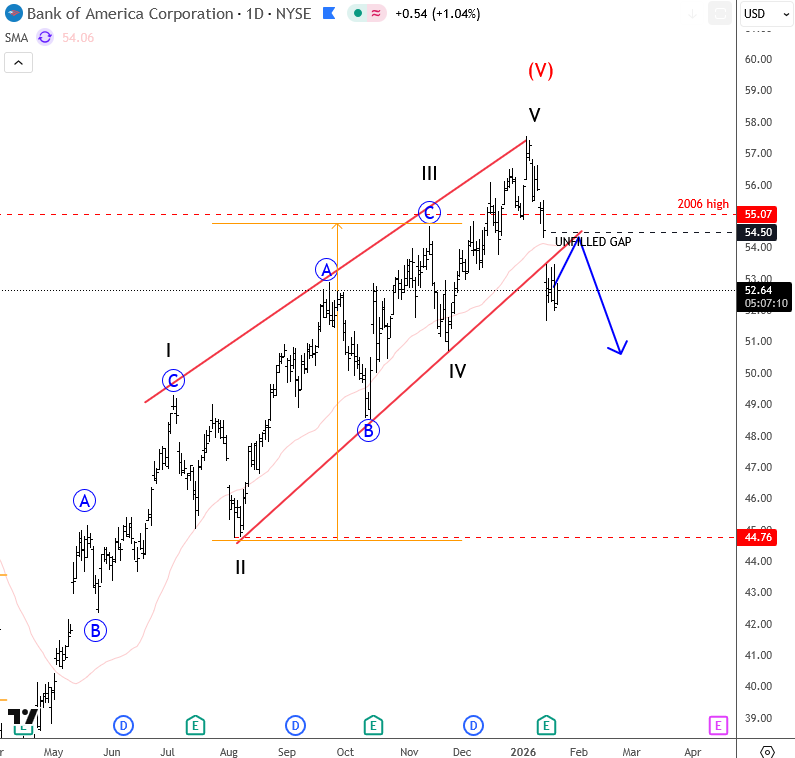
Bank of America is reversing sharply to the downside since the start of the year, with price gapping through the lower trendline support. The move accelerated after President Trump imposed a 10% cap on credit card loans, which triggered a sharp reversal from the all time highs. This price action suggests that we could see much more weakness ahead. If the ending diagonal is indeed complete, then any rebound toward the previously unfilled gap around 54.50 could turn into an attractive resistance zone for the next sell off, potentially targeting the 50 area on the downside.
We’ve added educational post at the end about ending diagonals, enjoy!
On the bigger picture, the stock is running into serious resistance after moving above the 2006 highs. This does not necessarily mean an immediate multi year downtrend, but higher time frame resistance combined with an ending diagonal on the daily chart is clearly a reason for caution.
Highlights
- Sharp reversal from all time highs signals trend exhaustion.
- Gap through lower trendline support confirms downside pressure.
- Resistance zone on rebounds near the unfilled gap around 54.50.
- Downside risk toward the 50 area if weakness resumes.
Educational post
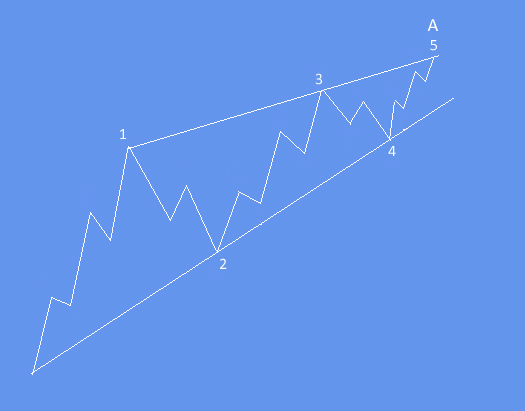
Ending Diagonal — Quick summary
What it is
- Terminal Elliott Wave pattern that appears at the end of a trend.
- Usually forms in Wave 5 of an impulse or Wave C of an A–B–C correction.
- Signals trend exhaustion and often precedes a sharp reversal.
Structural rules
- Consists of five waves (1–2–3–4–5).
- All waves subdivide into threes.
- Wave 4 overlaps Wave 1 (required condition).
- Price action forms a contracting or expanding wedge.
Typical behavior
- Momentum weakens even as price makes new highs or lows.
- Wave 5 often accelerates, trapping late entrants.
- After completion, price usually reverses sharply, often retracing the whole pattern.
Key Fibonacci relationships
Wave 5 failures are common and strengthen reversal signals.
Wave 3 ≈ 61.8% or 100% of Wave 1.
Wave 5 ≈ 61.8% of Wave 3, or sometimes equals Wave 1.
Post-completion retracement typically 61.8%–78.6% of the entire diagonal.
Wave 4 retraces 38.2%–61.8% of Wave 3.
Get Full Access To Our Premium Elliott Wave Analysis For 14 Days. Click here.
Author

Gregor Horvat
Wavetraders
Experience Grega is based in Slovenia and has been in the Forex market since 2003.


![How Wall Street rigs the game [Video]](https://editorial.fxsstatic.com/images/i/market-chaos-01.jpg)