Gold nears $5,000 amid safe-haven demand and a softer US Dollar
- Gold extends its record-breaking run after shrugging off intraday weakness.
- Mixed US data fails to lift the US Dollar, leaving Bullion well supported.
- Technicals point to early signs of exhaustion as bulls eye the $5,000 mark.

Gold (XAU/USD) regains ground on Friday, notching yet another record high after coming under brief pressure earlier in the day. At the time of writing, XAU/USD is trading around $4,980, rebounding from an intraday low near $4,899, and remains on track for a third consecutive weekly gain.
Meanwhile, a mixed batch of US economic data failed to offer meaningful support to the US Dollar (USD), allowing Gold to extend its advance.
Bullion is up more than 8% this week, supported by strong safe-haven demand after renewed trade rhetoric from US President Donald Trump over the Greenland dispute unsettled global markets, reviving “Sell America” sentiment.
However, some of these tensions eased on Wednesday after Trump backed away from earlier threats to impose tariffs on several European nations following the announcement of a future-framework agreement on Greenland.
The move did little to cool Gold’s bullish momentum, as investors remain unconvinced that tensions are fully resolved, with the framework agreement lacking concrete details. At the same time, broader geopolitical and economic uncertainties continue to underpin demand for safe-haven assets, keeping the precious metal well bid.
Market movers: US data, Fed leadership and policy credibility concerns
- Preliminary S&P Global Purchasing Managers Index (PMI) data showed Manufacturing PMI rising to 51.9 in January from 51.8, below expectations of 52.1, while Services PMI came in at 52.5, unchanged from December but below the 52.8 forecast.
- University of Michigan survey data for January showed the Consumer Expectations Index climbed to 57, above forecasts and the previous reading of 55. The Consumer Sentiment Index improved to 56.4, beating expectations and rising from 54. One-year Consumer Inflation Expectations eased to 4.0% from 4.2%, while five-year Inflation Expectations slipped to 3.3% from 3.4%.
- Economic data released on Thursday showed the US economy expanded at an annualized pace of 4.4% in the third quarter, beating market expectations of 4.3% and accelerating from 3.8% in Q2. Core Personal Consumption Expenditures (PCE) inflation held steady at 2.9% QoQ, while Initial Jobless Claims rose to 200,000 from 199,000 the prior week.
- The US Dollar Index (DXY), which tracks the greenback against a basket of six major currencies, is trading around 98.36, near two-week lows, and is on track for its first weekly decline in three weeks.
- US President Donald Trump’s disruptive trade agenda and repeated use of tariffs as a policy weapon are eroding investor confidence in US assets, fueling debasement concerns and driving demand for traditional safe-haven assets.
- President Donald Trump said on Thursday that he has completed interviews for the next Federal Reserve (Fed) Chair and confirmed he has made his selection, adding that a formal announcement is likely before the end of January. Media reports suggest the shortlist includes Kevin Hassett, Rick Rieder, Christopher Waller, and Kevin Warsh, although Trump indicated last week that he may keep National Economic Council Director Kevin Hassett in his current role.
- Markets remain wary that President Trump’s choice for the next Fed Chair could push the central bank toward a more dovish policy path, following his repeated criticism of current Fed Chair Jerome Powell for not cutting interest rates more aggressively.
- On the monetary policy front, recent US economic data have reinforced the view that the Fed is likely to stick to a gradual easing path rather than aggressive rate cuts. Markets are almost fully pricing in no change at the upcoming January 27-28 meeting and broadly expect the central bank to remain on hold through the first quarter.
Technical analysis: Bulls pause below $5,000
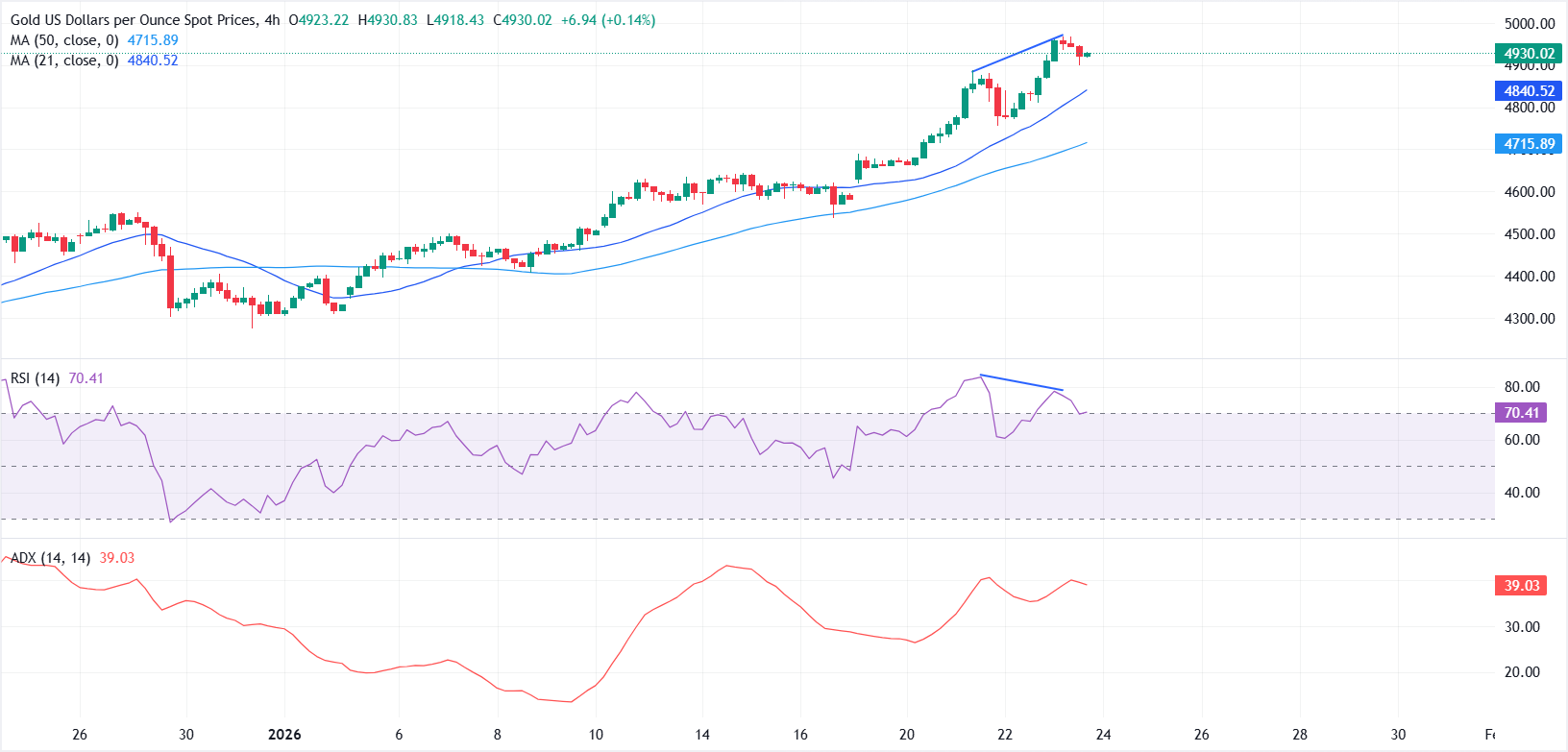
From a technical perspective, trend conditions remain firm, with XAU/USD holding well above the 21-period and 50-period Simple Moving Averages (SMAs). The Average Directional Index (ADX) is hovering around 39, signaling a strong trend environment despite emerging signs of near-term exhaustion.
The risk of a pullback is rising as overbought conditions persist across multiple timeframes. On the 4-hour chart, the Relative Strength Index (RSI) has eased back toward the 70 level and is printing a bearish divergence, signaling early signs of fading upside momentum.
On the downside, immediate support is seen at the $4,900 psychological level. A sustained break below this zone shifts focus to the 21-period SMA near $4,828, followed by the 50-period SMA around $4,709. On the upside, the $5,000 psychological mark remains the key resistance.
Central banks FAQs
Central Banks have a key mandate which is making sure that there is price stability in a country or region. Economies are constantly facing inflation or deflation when prices for certain goods and services are fluctuating. Constant rising prices for the same goods means inflation, constant lowered prices for the same goods means deflation. It is the task of the central bank to keep the demand in line by tweaking its policy rate. For the biggest central banks like the US Federal Reserve (Fed), the European Central Bank (ECB) or the Bank of England (BoE), the mandate is to keep inflation close to 2%.
A central bank has one important tool at its disposal to get inflation higher or lower, and that is by tweaking its benchmark policy rate, commonly known as interest rate. On pre-communicated moments, the central bank will issue a statement with its policy rate and provide additional reasoning on why it is either remaining or changing (cutting or hiking) it. Local banks will adjust their savings and lending rates accordingly, which in turn will make it either harder or easier for people to earn on their savings or for companies to take out loans and make investments in their businesses. When the central bank hikes interest rates substantially, this is called monetary tightening. When it is cutting its benchmark rate, it is called monetary easing.
A central bank is often politically independent. Members of the central bank policy board are passing through a series of panels and hearings before being appointed to a policy board seat. Each member in that board often has a certain conviction on how the central bank should control inflation and the subsequent monetary policy. Members that want a very loose monetary policy, with low rates and cheap lending, to boost the economy substantially while being content to see inflation slightly above 2%, are called ‘doves’. Members that rather want to see higher rates to reward savings and want to keep a lit on inflation at all time are called ‘hawks’ and will not rest until inflation is at or just below 2%.
Normally, there is a chairman or president who leads each meeting, needs to create a consensus between the hawks or doves and has his or her final say when it would come down to a vote split to avoid a 50-50 tie on whether the current policy should be adjusted. The chairman will deliver speeches which often can be followed live, where the current monetary stance and outlook is being communicated. A central bank will try to push forward its monetary policy without triggering violent swings in rates, equities, or its currency. All members of the central bank will channel their stance toward the markets in advance of a policy meeting event. A few days before a policy meeting takes place until the new policy has been communicated, members are forbidden to talk publicly. This is called the blackout period.
Author

Vishal Chaturvedi
FXStreet
I am a macro-focused research analyst with over four years of experience covering forex and commodities market. I enjoy breaking down complex economic trends and turning them into clear, actionable insights that help traders stay ahead of the curve.














