Australian Dollar extends losses as US Dollar gains on Fed hawkish signs
- Australian Dollar declines as trade surplus widened to AUD 3,373M in December 2025.
- Australia’s exports rose 1.0% MoM, while monthly imports declined 0.8% in December.
- The US Dollar remains steady after registering modest gains in the previous session.
The Australian Dollar (AUD) extends its losses against the US Dollar (USD) on Thursday following the release of Australia’s Trade Balance data, which showed the trade surplus widened to AUD 3,373M in December 2025, up from a downwardly revised AUD 2,597M in November and slightly above market expectations of AUD 3,300M.
Australia’s Exports grew 1.0% month-on-month (MoM) in December, rebounding from an upwardly revised 4.0% drop in November, largely driven by metal ores and minerals. Imports fell 0.8% MoM, steeper than the downwardly revised 0.2% decline previously, weighed down by other merchandise goods.
China's Services Purchasing Managers' Index (PMI) rose to 52.3 in January from 52.0 in December. This figure came in stronger than the expectations of 51.8. China is a key trading partner of Australia, so any changes in the Chinese economy could impact the AUD.
The AUD rose after the release of seasonally adjusted S&P Global Purchasing Managers’ Index (PMI) data, which showed Australia’s Composite PMI rising to 55.7 in January from 51.0 in December. The expansion was the strongest in 45 months. Meanwhile, Services PMI climbed to 56.3 from 51.1, marking its highest level since February 2022. The reading beat the flash estimate of 56.0 and remained above the 50.0 threshold, extending the run of expanding services activity to two years.
The Reserve Bank of Australia (RBA) raised the Official Cash Rate (OCR) by 25 basis points (bps) to 3.85% on Tuesday, citing stronger-than-expected growth and a sticky inflation outlook. As the tightening cycle begins, markets have lifted the probability of a May hike to 80% and now price in roughly 40 bps of further tightening over the rest of the year.
RBA Governor Michele Bullock said during the post-meeting press conference that inflation pressures remain too strong, warning it will take longer to return to target and is no longer acceptable. She stressed the board will stay data-dependent and avoid forward guidance.
US Dollar holds ground after registering modest gains
- The US Dollar Index (DXY), which measures the value of the US Dollar against six major currencies, steadied after registering modest gains in the previous session and is trading near 97.60 at the time of writing. The Greenback advances as markets price in a slower pace of potential Federal Reserve (Fed) rate cuts.
- Fed Governor Lisa Cook said she would not back another cut without clearer evidence that inflation is easing, stressing greater concern over stalled disinflation than labor market weakness.
- Investors also weighed the implications of Kevin Warsh’s nomination as Fed chair, citing his preference for a smaller balance sheet and a less aggressive approach to rate reductions. Meanwhile, US President Donald Trump said he would not have nominated Warsh if he favored rate hikes. Trump further stated that there was “not much” doubt the US central bank would lower rates because “we’re way high in interest,” but now “we’re a rich country again.”
- ADP Employment Change showed private payrolls increased by just 22K in January, well below market expectations for a stronger 48K reading and 37K (revised from 41K) prior. The weak print carried extra weight given the postponement of official government data.
- Institute for Supply Management (ISM) remained unchanged in January, with the ISM Services PMI holding steady at 53.8. The print, however, came in above analysts' expectations of 53.5.
- An unexpected rebound in US factory activity underscores economic resilience, as the Institute for the ISM Manufacturing Purchasing Managers' Index (PMI) rose to 52.6 from 47.9 in December, beating market expectations of 48.5.
- Australia’s RBA Trimmed Mean inflation increased to 0.2% month-over-month (MoM) and 3.3% year-over-year (YoY). The monthly CPI rose 1.0% in December, up from 0% previously and above the 0.7% forecast.
- China's RatingDog Manufacturing Purchasing Managers' Index (PMI) rose to 50.3 in January from 50.1 in December. This figure came in line with the expectations. The latest reading indicated a slight expansion in factory activity, but the fastest growth since last October.
- Australia’s TD-MI Inflation Gauge rose 3.6% year-over-year (YoY) in January, up from 3.5% previously. The Monthly Inflation Gauge increased by 0.2%, slowing sharply from December’s two-year high of 1% and marking the weakest pace since August.
- ANZ Job Advertisements jumped 4.4% month-over-month (MoM) in December 2025, rebounding from a revised 0.8% decline and posting the first increase since July. The rise was also the strongest monthly gain since February 2022, signaling renewed momentum in hiring toward year-end.
Australian Dollar tests 0.7100 support near lower ascending channel boundary
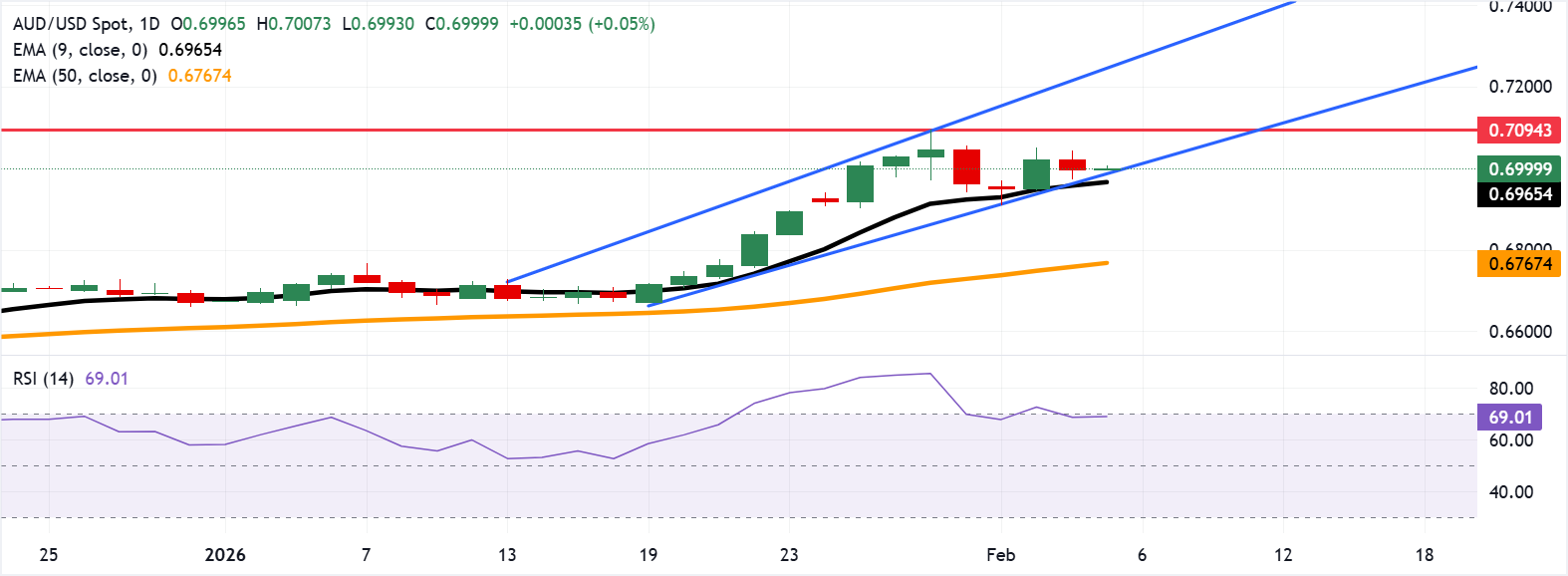
The AUD/USD pair is trading around 0.7000 on Thursday. Daily chart analysis indicates that the pair remains within the ascending channel pattern, indicating a persistent bullish bias. The 14-day Relative Strength Index (RSI) is at 69; it typically signals bullish momentum.
The AUD/USD pair may target 0.7094, the highest level since February 2023, which was recorded on January 29. A break above this level would support the pair to test the upper ascending channel boundary around 0.7250. On the downside, the primary support lies at the lower boundary of the channel around 0.6990, followed by the nine-day Exponential Moving Average (EMA) of 0.6965. Further declines would put downward pressure on the pair to navigate the region around the 50-day EMA at 0.6767.
Australian Dollar FAQs
One of the most significant factors for the Australian Dollar (AUD) is the level of interest rates set by the Reserve Bank of Australia (RBA). Because Australia is a resource-rich country another key driver is the price of its biggest export, Iron Ore. The health of the Chinese economy, its largest trading partner, is a factor, as well as inflation in Australia, its growth rate and Trade Balance. Market sentiment – whether investors are taking on more risky assets (risk-on) or seeking safe-havens (risk-off) – is also a factor, with risk-on positive for AUD.
The Reserve Bank of Australia (RBA) influences the Australian Dollar (AUD) by setting the level of interest rates that Australian banks can lend to each other. This influences the level of interest rates in the economy as a whole. The main goal of the RBA is to maintain a stable inflation rate of 2-3% by adjusting interest rates up or down. Relatively high interest rates compared to other major central banks support the AUD, and the opposite for relatively low. The RBA can also use quantitative easing and tightening to influence credit conditions, with the former AUD-negative and the latter AUD-positive.
China is Australia’s largest trading partner so the health of the Chinese economy is a major influence on the value of the Australian Dollar (AUD). When the Chinese economy is doing well it purchases more raw materials, goods and services from Australia, lifting demand for the AUD, and pushing up its value. The opposite is the case when the Chinese economy is not growing as fast as expected. Positive or negative surprises in Chinese growth data, therefore, often have a direct impact on the Australian Dollar and its pairs.
Iron Ore is Australia’s largest export, accounting for $118 billion a year according to data from 2021, with China as its primary destination. The price of Iron Ore, therefore, can be a driver of the Australian Dollar. Generally, if the price of Iron Ore rises, AUD also goes up, as aggregate demand for the currency increases. The opposite is the case if the price of Iron Ore falls. Higher Iron Ore prices also tend to result in a greater likelihood of a positive Trade Balance for Australia, which is also positive of the AUD.
The Trade Balance, which is the difference between what a country earns from its exports versus what it pays for its imports, is another factor that can influence the value of the Australian Dollar. If Australia produces highly sought after exports, then its currency will gain in value purely from the surplus demand created from foreign buyers seeking to purchase its exports versus what it spends to purchase imports. Therefore, a positive net Trade Balance strengthens the AUD, with the opposite effect if the Trade Balance is negative.
Australian Dollar FAQs
One of the most significant factors for the Australian Dollar (AUD) is the level of interest rates set by the Reserve Bank of Australia (RBA). Because Australia is a resource-rich country another key driver is the price of its biggest export, Iron Ore. The health of the Chinese economy, its largest trading partner, is a factor, as well as inflation in Australia, its growth rate and Trade Balance. Market sentiment – whether investors are taking on more risky assets (risk-on) or seeking safe-havens (risk-off) – is also a factor, with risk-on positive for AUD.
The Reserve Bank of Australia (RBA) influences the Australian Dollar (AUD) by setting the level of interest rates that Australian banks can lend to each other. This influences the level of interest rates in the economy as a whole. The main goal of the RBA is to maintain a stable inflation rate of 2-3% by adjusting interest rates up or down. Relatively high interest rates compared to other major central banks support the AUD, and the opposite for relatively low. The RBA can also use quantitative easing and tightening to influence credit conditions, with the former AUD-negative and the latter AUD-positive.
China is Australia’s largest trading partner so the health of the Chinese economy is a major influence on the value of the Australian Dollar (AUD). When the Chinese economy is doing well it purchases more raw materials, goods and services from Australia, lifting demand for the AUD, and pushing up its value. The opposite is the case when the Chinese economy is not growing as fast as expected. Positive or negative surprises in Chinese growth data, therefore, often have a direct impact on the Australian Dollar and its pairs.
Iron Ore is Australia’s largest export, accounting for $118 billion a year according to data from 2021, with China as its primary destination. The price of Iron Ore, therefore, can be a driver of the Australian Dollar. Generally, if the price of Iron Ore rises, AUD also goes up, as aggregate demand for the currency increases. The opposite is the case if the price of Iron Ore falls. Higher Iron Ore prices also tend to result in a greater likelihood of a positive Trade Balance for Australia, which is also positive of the AUD.
The Trade Balance, which is the difference between what a country earns from its exports versus what it pays for its imports, is another factor that can influence the value of the Australian Dollar. If Australia produces highly sought after exports, then its currency will gain in value purely from the surplus demand created from foreign buyers seeking to purchase its exports versus what it spends to purchase imports. Therefore, a positive net Trade Balance strengthens the AUD, with the opposite effect if the Trade Balance is negative.
Author

Akhtar Faruqui
FXStreet
Akhtar Faruqui is a Forex Analyst based in New Delhi, India. With a keen eye for market trends and a passion for dissecting complex financial dynamics, he is dedicated to delivering accurate and insightful Forex news and analysis.