Australian Dollar remains stronger following RBA Bullock's cautious remarks
- Australian Dollar rises as the RBA decided to keep its interest rate unchanged at 3.6% in September.
- China’s NBS Manufacturing PMI rose to 49.8, while Non-Manufacturing PMI inched lower to 50.0 in September.
- The US Dollar may face challenges as the government nears a funding freeze and possible shutdown.

The Australian Dollar (AUD) gains ground on Tuesday, with the AUD/USD pair extending its gains for the third successive session. The AUD remains stronger following the release of the NBS Purchasing Managers’ Index (PMI) data from China and Australia’s Building Permits.
The Reserve Bank of Australia (RBA) announced on Tuesday that it held the Official Cash Rate (OCR) steady at 3.6% after concluding the September monetary policy meeting. The decision matched market expectations of a steady policy stance, following a strong Q2 GDP report and elevated monthly inflation, both pointing to a cautious approach to easing. Swaps now imply a 40% chance of a rate cut in November, down from 50%.
RBA Governor Michele Bullock said at a post-meeting press conference that components of the monthly CPI little higher than expected, and inflation is not running away. Not giving forward guidance, will have more data in November, Bullock added.
China’s NBS Manufacturing PMI improved to 49.8 in September, following August’s 49.4. The reading came in above the market consensus of 49.6 in the reported month. The NBS Non-Manufacturing PMI inched lower to 50.0 in September, from August’s 50.3 figure and missed the expectations of 50.3.
Australia’s Building Permits fell 6% month-over-month in August, following July’s 8.2% drop and surpassing the forecast decline of 5.5%.
Australian Dollar advances despite a stable US Dollar
- The US Dollar Index (DXY), which measures the value of the US Dollar (USD) against six major currencies, is hovering around 98.00 at the time of writing. The Greenback may further weaken as traders tread cautiously amid concerns that the upcoming US jobs report may not be released this week, with the government nearing a funding freeze and possible shutdown.
- US President Donald Trump has warned of mass federal job cuts if Congress fails to pass a funding bill, effectively putting his own government at risk and threatening further disruptions to federal operations.
- The Greenback weakens after the US August inflation report boosted the likelihood that the US Federal Reserve (Fed) will likely deliver another interest rate cut in October. Markets are now pricing in nearly an 88% chance of a Fed rate cut in October and a 65% possibility of another reduction in December, according to the CME FedWatch Tool.
- The US Personal Consumption Expenditures (PCE) Price Index climbed 2.7% year-over-year in August, compared to 2.6% prior. This figure was in line with analyst forecasts. The core PCE, which excludes food and energy prices, came in at 2.9% YoY during the same period, also matching expectations.
- President Trump shared plans to impose a 100% tariff on imports of branded or patented pharmaceutical products from October 1, unless a pharmaceutical company is building a manufacturing plant in the US. Trump also unveiled tariffs of 50% on kitchen cabinets and bathroom vanities and 25% on trucks.
- The US Gross Domestic Product (GDP) Annualized grew 3.8% in the second quarter (Q2), coming in above the previous estimate and the estimation of 3.3%. Meanwhile, the GDP Price Index rose 2.1% in the same period, as compared to the expected and previous 2.0% growth.
- The White House announced that Australian Prime Minister Anthony Albanese and US President Donald Trump will hold their first in-person meeting in Washington, D.C. on October 20 to discuss the Aukus nuclear submarine pact.
- Australia posted a budget deficit of nearly A$10 billion (approximately $6.55 billion) for the year ending June 2025, marking the end of two consecutive years of surpluses. The shortfall was far smaller than the Treasury’s A$27.9 billion forecast.
- Australia’s Monthly Consumer Price Index (CPI), which climbed by 3.0% year-over-year in August, following a 2.8% increase reported in July. The ASX 30 Day Interbank Cash Rate Futures indicate that markets now price just a 4% chance of a September rate cut. According to Reuters, prospects for a Reserve Bank of Australia (RBA) rate reduction at its November meeting faded to 50% from almost 70% before the data.
Australian Dollar tests nine-day EMA barrier near 0.6600
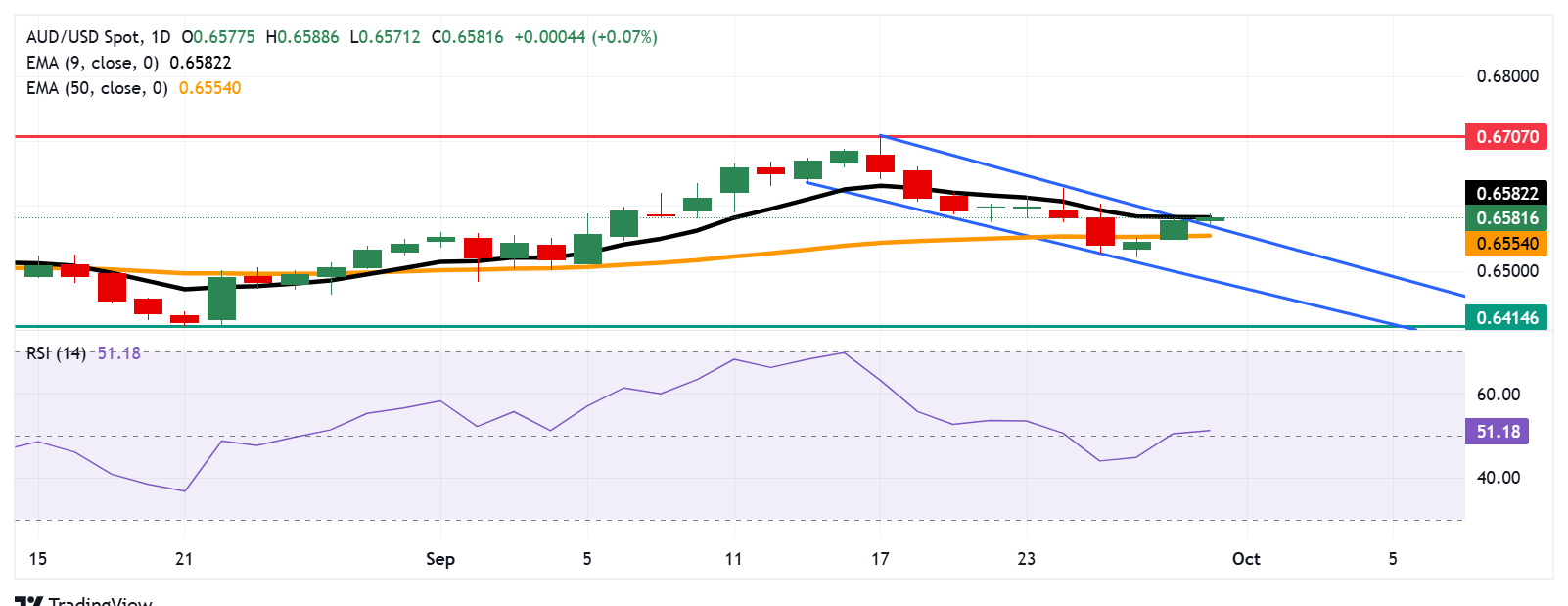
The AUD/USD pair is trading around 0.6580 on Tuesday. Technical analysis on the daily chart shows that the pair has breached above the descending channel pattern, indicating a market shift to bullish from bearish bias. Additionally, the 14-day Relative Strength Index (RSI) is positioned on the 50 level, indicating a neutral market sentiment. Further movements will likely offer a clear directional trend.
The initial resistance lies at the nine-day Exponential Moving Average (EMA) of 0.6582. A break above the level would improve the short-term price momentum and support the pair to explore the region around the 11-month high of 0.6707, recorded on September 17.
On the downside, the AUD/USD pair may retreat to the descending channel and find immediate support at the 50-day EMA at 0.6554. A break below this level would dampen the medium-term price momentum and prompt the pair to test the channel’s lower boundary around 0.6490.
AUD/USD: Daily Chart
Australian Dollar Price Today
The table below shows the percentage change of Australian Dollar (AUD) against listed major currencies today. Australian Dollar was the strongest against the Canadian Dollar.
| USD | EUR | GBP | JPY | CAD | AUD | NZD | CHF | |
|---|---|---|---|---|---|---|---|---|
| USD | -0.07% | -0.03% | -0.27% | 0.01% | -0.38% | -0.18% | -0.05% | |
| EUR | 0.07% | 0.02% | -0.21% | 0.06% | -0.32% | -0.11% | 0.05% | |
| GBP | 0.03% | -0.02% | -0.20% | 0.06% | -0.35% | -0.13% | 0.03% | |
| JPY | 0.27% | 0.21% | 0.20% | 0.25% | -0.12% | 0.26% | 0.26% | |
| CAD | -0.01% | -0.06% | -0.06% | -0.25% | -0.40% | -0.16% | -0.04% | |
| AUD | 0.38% | 0.32% | 0.35% | 0.12% | 0.40% | 0.22% | 0.38% | |
| NZD | 0.18% | 0.11% | 0.13% | -0.26% | 0.16% | -0.22% | 0.17% | |
| CHF | 0.05% | -0.05% | -0.03% | -0.26% | 0.04% | -0.38% | -0.17% |
The heat map shows percentage changes of major currencies against each other. The base currency is picked from the left column, while the quote currency is picked from the top row. For example, if you pick the Australian Dollar from the left column and move along the horizontal line to the US Dollar, the percentage change displayed in the box will represent AUD (base)/USD (quote).
RBA FAQs
The Reserve Bank of Australia (RBA) sets interest rates and manages monetary policy for Australia. Decisions are made by a board of governors at 11 meetings a year and ad hoc emergency meetings as required. The RBA’s primary mandate is to maintain price stability, which means an inflation rate of 2-3%, but also “..to contribute to the stability of the currency, full employment, and the economic prosperity and welfare of the Australian people.” Its main tool for achieving this is by raising or lowering interest rates. Relatively high interest rates will strengthen the Australian Dollar (AUD) and vice versa. Other RBA tools include quantitative easing and tightening.
While inflation had always traditionally been thought of as a negative factor for currencies since it lowers the value of money in general, the opposite has actually been the case in modern times with the relaxation of cross-border capital controls. Moderately higher inflation now tends to lead central banks to put up their interest rates, which in turn has the effect of attracting more capital inflows from global investors seeking a lucrative place to keep their money. This increases demand for the local currency, which in the case of Australia is the Aussie Dollar.
Macroeconomic data gauges the health of an economy and can have an impact on the value of its currency. Investors prefer to invest their capital in economies that are safe and growing rather than precarious and shrinking. Greater capital inflows increase the aggregate demand and value of the domestic currency. Classic indicators, such as GDP, Manufacturing and Services PMIs, employment, and consumer sentiment surveys can influence AUD. A strong economy may encourage the Reserve Bank of Australia to put up interest rates, also supporting AUD.
Quantitative Easing (QE) is a tool used in extreme situations when lowering interest rates is not enough to restore the flow of credit in the economy. QE is the process by which the Reserve Bank of Australia (RBA) prints Australian Dollars (AUD) for the purpose of buying assets – usually government or corporate bonds – from financial institutions, thereby providing them with much-needed liquidity. QE usually results in a weaker AUD.
Quantitative tightening (QT) is the reverse of QE. It is undertaken after QE when an economic recovery is underway and inflation starts rising. Whilst in QE the Reserve Bank of Australia (RBA) purchases government and corporate bonds from financial institutions to provide them with liquidity, in QT the RBA stops buying more assets, and stops reinvesting the principal maturing on the bonds it already holds. It would be positive (or bullish) for the Australian Dollar.
Author

Akhtar Faruqui
FXStreet
Akhtar Faruqui is a Forex Analyst based in New Delhi, India. With a keen eye for market trends and a passion for dissecting complex financial dynamics, he is dedicated to delivering accurate and insightful Forex news and analysis.