Australian Dollar advances as RBA may raise rates again if needed
- The Australian Dollar appreciates as the RBA may increase rates again if needed.
- The safe-haven flows may limit the upside of the AUD amid escalated Middle-East tensions.
- Fed Governor Michelle Bowman suggested that the US central bank may not be prepared to cut rates in September.

The Australian Dollar (AUD) retraces its recent losses against the US Dollar (USD) on Monday. The AUD/USD pair appreciates due to the hawkish sentiment surrounding the Reserve Bank of Australia (RBA). Additionally, the upbeat inflation in China, a close trade partner with Australia, might have provided support for the Aussie Dollar.
RBA Governor Michele Bullock highlighted last week the importance of remaining cautious regarding inflation risks and expressed that the central bank will not hesitate to raise rates again to combat inflation if needed. Those comments came just days after the RBA held rates steady at 4.35% for the sixth straight meeting.
On the USD front, market expectations for a potential interest rate cut by the Federal Reserve (Fed) in September could put pressure on the US Dollar (USD), potentially providing support for the AUD/USD pair.
Investors will likely focus on US producer inflation data set to be released on Tuesday and consumer inflation figures on Wednesday. Traders are looking for confirmation that price growth remains stable.
Daily Digest Market Movers: Australian Dollar rises due to a hawkish RBA
- On Monday, Reserve Bank of Australia (RBA) Deputy Governor Andrew Hauser attributed persistent inflation to weaker supply and a tight labor market. Hauser also noted that economic forecasts are surrounded by significant uncertainty.
- The upside of the risk-sensitive AUD could be restrained due to safe-haven flows amid increased geopolitical tensions in the Middle East. On Sunday, Defense Minister Yoav Gallant informed US Defense Secretary Lloyd Austin that Iran's military activities indicate preparations for a significant strike on Israel, as reported by Axios writer Barak Ravid.
- On Sunday, Federal Reserve Governor Michelle Bowman stated that she continues to see upside risks for inflation and ongoing strength in the labor market. This suggests that the Fed may not be prepared to cut rates at their next meeting in September, according to Bloomberg.
- China's Consumer Price Index (CPI) rose 0.5% year-on-year in July, exceeding the expected 0.3% and previous 0.2% readings. Meanwhile, the monthly index also increased 0.5%, swinging from the previous decline of 0.2%.
- Westpac updated its RBA forecast, now predicting the first rate cut will occur in February 2025, a shift from the previously anticipated November 2024. They also revised their terminal rate forecast to 3.35%, up from the previous 3.10%. The RBA is now viewed as more cautious, needing stronger evidence before considering rate cuts.
- On Thursday, Kansas City Fed President Jeffrey Schmid stated that reducing monetary policy could be "appropriate" if inflation remains low. Schmid noted that the current Fed policy is "not that restrictive" and that while the Fed is close to its 2% inflation goal, it has not yet fully achieved it, per Reuters.
- Last week, Treasurer Jim Chalmers contested the RBA's view that the economy remains too robust and that large government budgets are contributing to prolonged inflation, according to Macrobusiness.
- RBA Governor Michele Bullock mentioned that the board had seriously considered increasing the cash rate from 4.35% to 4.6% due to ongoing concerns about excess demand in the economy. Additionally, RBA Chief Economist Sarah Hunter noted that the Australian economy is performing somewhat stronger than previously anticipated by the RBA.
Technical Analysis: Australian Dollar hovers around 0.6600, aligns with throwback support
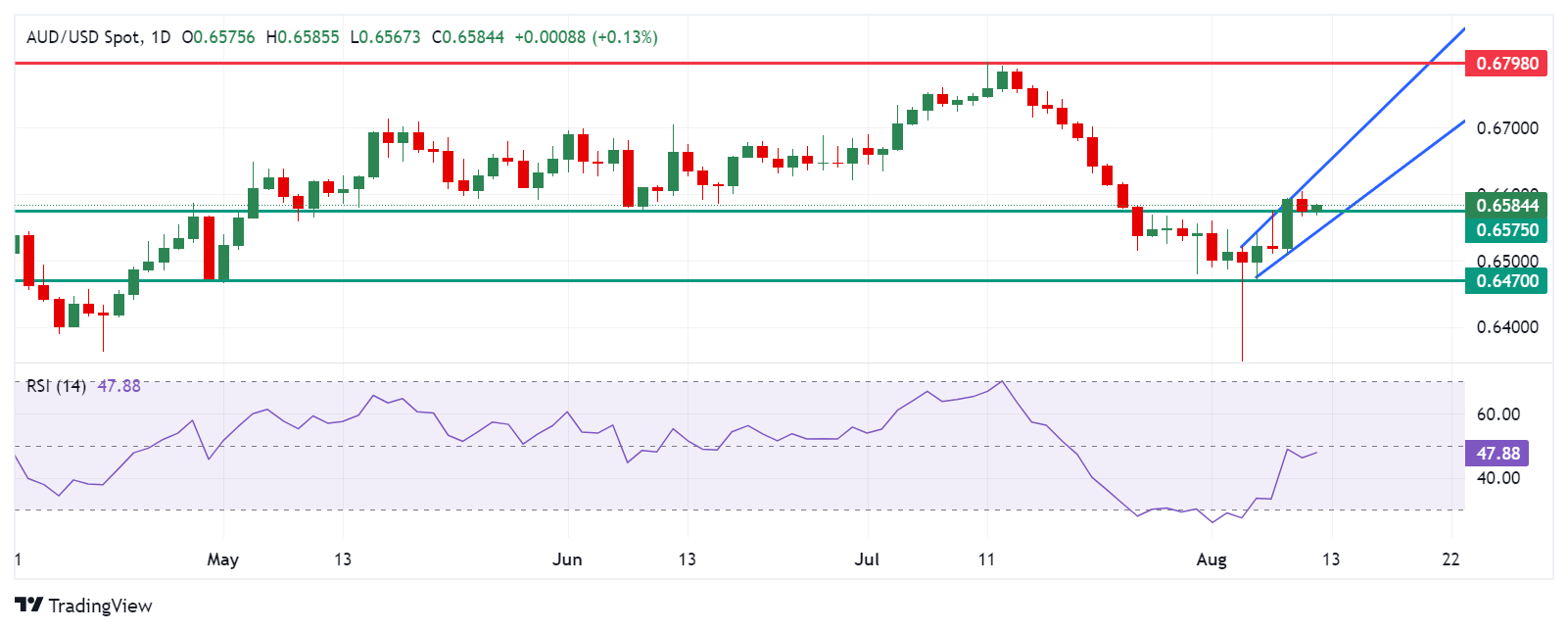
The Australian Dollar trades around 0.6590 on Monday. The daily chart analysis shows that the AUD/USD pair is positioned within an ascending channel, indicating a bullish bias. Meanwhile, the 14-day Relative Strength Index (RSI) is consolidating below the 50 level. A move above this level could suggest a strengthening of bullish momentum.
In terms of resistance, the AUD/USD pair may test the upper boundary of the ascending channel at the 0.6630 level. A breakout above this level could propel the pair toward the region near its six-month high of 0.6798.
On the downside, the AUD/USD pair may find immediate support at the throwback level of 0.6575. A drop below this level could reinforce a bearish bias, potentially pushing the pair toward the lower boundary of the ascending channel around 0.6540. Additional support is seen at the throwback level of 0.6470.
AUD/USD: Daily Chart
Australian Dollar PRICE Today
The table below shows the percentage change of Australian Dollar (AUD) against listed major currencies today. Australian Dollar was the strongest against the Japanese Yen.
| USD | EUR | GBP | JPY | CAD | AUD | NZD | CHF | |
|---|---|---|---|---|---|---|---|---|
| USD | -0.03% | -0.08% | 0.37% | -0.02% | -0.11% | -0.20% | 0.22% | |
| EUR | 0.03% | -0.02% | 0.39% | 0.00% | -0.20% | -0.16% | 0.26% | |
| GBP | 0.08% | 0.02% | 0.66% | 0.03% | -0.18% | -0.15% | 0.29% | |
| JPY | -0.37% | -0.39% | -0.66% | -0.38% | -0.55% | -0.57% | -0.18% | |
| CAD | 0.02% | -0.01% | -0.03% | 0.38% | -0.14% | -0.17% | 0.26% | |
| AUD | 0.11% | 0.20% | 0.18% | 0.55% | 0.14% | 0.03% | 0.46% | |
| NZD | 0.20% | 0.16% | 0.15% | 0.57% | 0.17% | -0.03% | 0.43% | |
| CHF | -0.22% | -0.26% | -0.29% | 0.18% | -0.26% | -0.46% | -0.43% |
The heat map shows percentage changes of major currencies against each other. The base currency is picked from the left column, while the quote currency is picked from the top row. For example, if you pick the Australian Dollar from the left column and move along the horizontal line to the US Dollar, the percentage change displayed in the box will represent AUD (base)/USD (quote).
Australian Dollar FAQs
One of the most significant factors for the Australian Dollar (AUD) is the level of interest rates set by the Reserve Bank of Australia (RBA). Because Australia is a resource-rich country another key driver is the price of its biggest export, Iron Ore. The health of the Chinese economy, its largest trading partner, is a factor, as well as inflation in Australia, its growth rate and Trade Balance. Market sentiment – whether investors are taking on more risky assets (risk-on) or seeking safe-havens (risk-off) – is also a factor, with risk-on positive for AUD.
The Reserve Bank of Australia (RBA) influences the Australian Dollar (AUD) by setting the level of interest rates that Australian banks can lend to each other. This influences the level of interest rates in the economy as a whole. The main goal of the RBA is to maintain a stable inflation rate of 2-3% by adjusting interest rates up or down. Relatively high interest rates compared to other major central banks support the AUD, and the opposite for relatively low. The RBA can also use quantitative easing and tightening to influence credit conditions, with the former AUD-negative and the latter AUD-positive.
China is Australia’s largest trading partner so the health of the Chinese economy is a major influence on the value of the Australian Dollar (AUD). When the Chinese economy is doing well it purchases more raw materials, goods and services from Australia, lifting demand for the AUD, and pushing up its value. The opposite is the case when the Chinese economy is not growing as fast as expected. Positive or negative surprises in Chinese growth data, therefore, often have a direct impact on the Australian Dollar and its pairs.
Iron Ore is Australia’s largest export, accounting for $118 billion a year according to data from 2021, with China as its primary destination. The price of Iron Ore, therefore, can be a driver of the Australian Dollar. Generally, if the price of Iron Ore rises, AUD also goes up, as aggregate demand for the currency increases. The opposite is the case if the price of Iron Ore falls. Higher Iron Ore prices also tend to result in a greater likelihood of a positive Trade Balance for Australia, which is also positive of the AUD.
The Trade Balance, which is the difference between what a country earns from its exports versus what it pays for its imports, is another factor that can influence the value of the Australian Dollar. If Australia produces highly sought after exports, then its currency will gain in value purely from the surplus demand created from foreign buyers seeking to purchase its exports versus what it spends to purchase imports. Therefore, a positive net Trade Balance strengthens the AUD, with the opposite effect if the Trade Balance is negative.
Author

Akhtar Faruqui
FXStreet
Akhtar Faruqui is a Forex Analyst based in New Delhi, India. With a keen eye for market trends and a passion for dissecting complex financial dynamics, he is dedicated to delivering accurate and insightful Forex news and analysis.

















