AUD/USD strengthens ahead of the Fed rate decision, Australian employment
- AUD/USD firms on US Dollar weakness ahead of the Fed rate decision and SEP projections.
- Analysts are currently pricing in a rate cut in September; a hawkish or dovish shift in narrative will likely influence the Aussie pair.
- Australia will release its employment data for May on Thursday, setting the tone for the Reserve Bank of Australia.

The Australian Dollar (AUD) is gaining ground against the US Dollar (USD) on Wednesday, supported by a softer Greenback as market participants await the outcome of the Federal Reserve’s (Fed) policy decision.
At the time of writing, AUD/USD is testing the 10-day Simple Moving Average (SMA) near 0.6506, posting intraday gains of approximately 0.60%.
The pair remains sensitive to shifts in risk sentiment and USD fluctuations as market participants assess the timing of a potential Fed rate cut.
The Federal Open Market Committee (FOMC) is widely expected to leave its benchmark interest rate unchanged in the 4.25%–4.50% range.
However, attention will be squarely on the updated Summary of Economic Projections (SEP), which will provide fresh guidance on the Fed’s policy outlook, including projections for inflation, growth and the future path of interest rates.
According to the CME FedWatch Tool, markets currently price a 56.4% chance of a 25-basis-point rate cut by September. If the projections indicate fewer cuts or a more gradual timeline, the USD could strengthen, which would pressure AUD/USD lower. Conversely, dovish revisions or downward adjustments to inflation expectations could reinforce bets on a sooner-than-expected policy shift, supporting the Aussie.
Fed Chair Jerome Powell’s press conference at 18:30 GMT will be crucial for market sentiment. His remarks on the progress of disinflation and global economic risks will influence expectations for any policy shift later this year.
What to expect from Australia’s Employment data
Traders will also be closely watching Thursday’s release of Australia’s May employment report. Consensus forecasts point to a jobs gain of 25,000, down from April’s strong 89,000. The unemployment rate is expected to remain steady at 4.1%. Any upside surprise in hiring or a drop in unemployment could fuel speculation that the Reserve Bank of Australia (RBA) may consider a more hawkish stance in upcoming meetings.
AUD/USD remains steady above 0.6500
AUD/USD is currently trading near 0.6522, just below resistance at the 61.8% Fibonacci retracement level at 0.6549. Momentum has slowed, and the pair is now testing short-term support at the lower boundary of a wedge pattern. The 10-day Simple Moving Average (SMA) at 0.6507 provides immediate support.
A decisive break below this zone, particularly below the 50% Fibonacci retracement at 0.6428, which aligns with the 200-day SMA, would confirm a bearish reversal and open the door toward deeper support at 0.6307 (38.2% Fib level).
AUD/USD Daily Chart
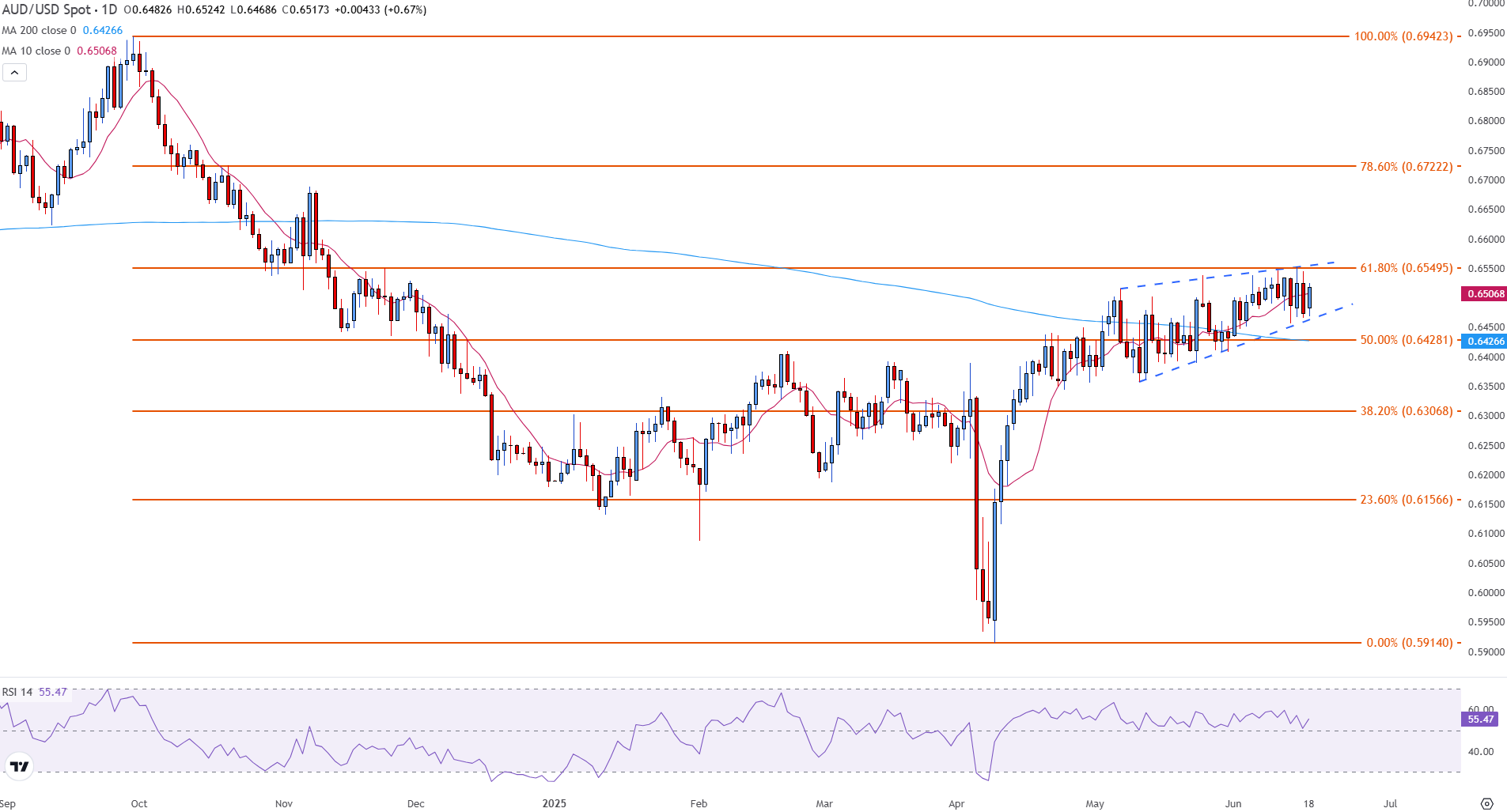
On the upside, a daily close above 0.6550 is needed to shift momentum back in favor of the bulls, with the next major resistance at 0.6722 (78.6% retracement). The Relative Strength Index (RSI) at 56 indicates neutral momentum, suggesting consolidation or a directional breakout may follow, depending on the Fed's tone and upcoming data releases.
Central banks FAQs
Central Banks have a key mandate which is making sure that there is price stability in a country or region. Economies are constantly facing inflation or deflation when prices for certain goods and services are fluctuating. Constant rising prices for the same goods means inflation, constant lowered prices for the same goods means deflation. It is the task of the central bank to keep the demand in line by tweaking its policy rate. For the biggest central banks like the US Federal Reserve (Fed), the European Central Bank (ECB) or the Bank of England (BoE), the mandate is to keep inflation close to 2%.
A central bank has one important tool at its disposal to get inflation higher or lower, and that is by tweaking its benchmark policy rate, commonly known as interest rate. On pre-communicated moments, the central bank will issue a statement with its policy rate and provide additional reasoning on why it is either remaining or changing (cutting or hiking) it. Local banks will adjust their savings and lending rates accordingly, which in turn will make it either harder or easier for people to earn on their savings or for companies to take out loans and make investments in their businesses. When the central bank hikes interest rates substantially, this is called monetary tightening. When it is cutting its benchmark rate, it is called monetary easing.
A central bank is often politically independent. Members of the central bank policy board are passing through a series of panels and hearings before being appointed to a policy board seat. Each member in that board often has a certain conviction on how the central bank should control inflation and the subsequent monetary policy. Members that want a very loose monetary policy, with low rates and cheap lending, to boost the economy substantially while being content to see inflation slightly above 2%, are called ‘doves’. Members that rather want to see higher rates to reward savings and want to keep a lit on inflation at all time are called ‘hawks’ and will not rest until inflation is at or just below 2%.
Normally, there is a chairman or president who leads each meeting, needs to create a consensus between the hawks or doves and has his or her final say when it would come down to a vote split to avoid a 50-50 tie on whether the current policy should be adjusted. The chairman will deliver speeches which often can be followed live, where the current monetary stance and outlook is being communicated. A central bank will try to push forward its monetary policy without triggering violent swings in rates, equities, or its currency. All members of the central bank will channel their stance toward the markets in advance of a policy meeting event. A few days before a policy meeting takes place until the new policy has been communicated, members are forbidden to talk publicly. This is called the blackout period.
Author

Tammy Da Costa, CFTe®
FXStreet
Tammy is an economist and market analyst with a deep passion for financial markets, particularly commodities and geopolitics.