AUD/USD rises to YTD high as Trump pressures Powell to cut rates, US Dollar falls
- AUD/USD rises to its highest level since last November as bullish momentum builds.
- Improved risk sentiment continued to support demand for risk-sensitive currencies such as the Australian Dollar.
- President Trump and Fed Chair Powell clash over rates, raising concerns over Fed independence.


The Australian Dollar (AUD) is extending its gains against the US Dollar (USD) and hit a year-to-date high as the greenback weakens and global risk appetite improves.
At the time of writing, renewed optimism in financial markets is supporting demand for risk-sensitive assets, with AUD/USD holding firm above the 0.6500 level after reaching 0.6564, its highest level since November.
US President Donald Trump has publicly pushed for a faster easing of monetary policy to support growth. Meanwhile, the Chairman of the Federal Reserve (Fed), Jerome Powell, has signaled a more cautious approach, citing the need for clearer inflation data.
While Friday’s Personal Consumption Expenditure (PCE) data, the Fed’s preferred measure of inflation, may provide a clearer picture of the latest inflation trends, Powell has argued that the risks posed by tariffs to inflation will likely only be reflected in later reports.
The Fed’s reluctance to cut interest rates has been publicly criticized by Trump, who has already named potential candidates to replace Powell, whose official term is set to end in May 2026.
The dispute has raised fresh concerns about the central bank’s independence, prompting a reassessment of the US monetary policy outlook. This has also resulted in analysts pricing in more aggressive rate cuts in the last quarter of the year, which has pushed US Treasury yields lower.
At the same time, a de-escalation in Middle East tensions has reduced demand for safe-haven flows, boosting risk-sensitive currencies like the Australian Dollar. Supportive commodity trade with China and stable guidance from the Reserve Bank of Australia have further underpinned AUD/USD.
AUD/USD tests wedge resistance as bulls target 0.6600 resistance
AUD/USD is currently testing the upper boundary of a rising wedge pattern on the daily chart, as prices edge above the 61.8% Fibonacci retracement of the September–April decline, offering immediate support near 0.6550.
Thursday’s high at 0.6564 marks the next level of resistance, aligning closely with wedge trendline resistance. A decisive break above this zone could pave the way for a retest of the key psychological level at 0.6600.
AUD/USD daily chart
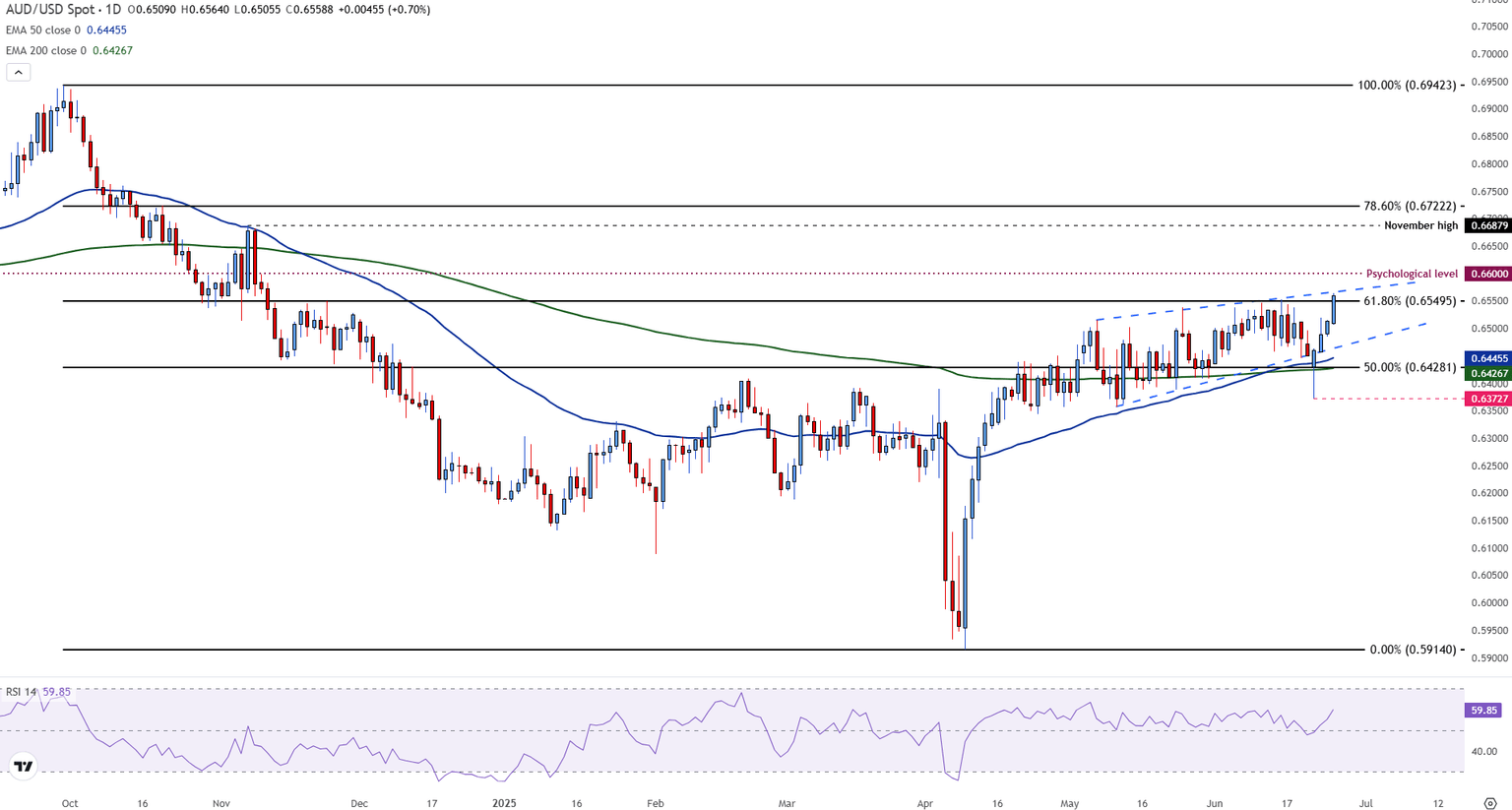
Beyond that, bulls may target the November swing high at 0.6688, followed by the 78.6% Fibonacci retracement at 0.6722.
Despite the bullish tone, price action remains within the wedge structure, with support reinforced by the 50-day and 200-day Exponential Moving Averages (EMA) at 0.6455 and 0.6427, respectively. The Relative Strength Index at 60 reflects steady upward momentum without signaling overbought conditions, though a rejection at resistance could trigger a pullback toward 0.6500 or deeper support at 0.6450.
US Dollar PRICE Today
The table below shows the percentage change of US Dollar (USD) against listed major currencies today. US Dollar was the strongest against the Euro.
| USD | EUR | GBP | JPY | CAD | AUD | NZD | CHF | |
|---|---|---|---|---|---|---|---|---|
| USD | -0.38% | -0.52% | -0.53% | -0.64% | -0.62% | -0.40% | -0.58% | |
| EUR | 0.38% | -0.08% | -0.20% | -0.23% | -0.20% | -0.01% | -0.18% | |
| GBP | 0.52% | 0.08% | -0.10% | -0.15% | -0.12% | 0.10% | -0.09% | |
| JPY | 0.53% | 0.20% | 0.10% | -0.10% | -0.05% | 0.14% | -0.02% | |
| CAD | 0.64% | 0.23% | 0.15% | 0.10% | 0.04% | 0.15% | 0.06% | |
| AUD | 0.62% | 0.20% | 0.12% | 0.05% | -0.04% | 0.12% | 0.00% | |
| NZD | 0.40% | 0.01% | -0.10% | -0.14% | -0.15% | -0.12% | -0.09% | |
| CHF | 0.58% | 0.18% | 0.09% | 0.02% | -0.06% | -0.00% | 0.09% |
The heat map shows percentage changes of major currencies against each other. The base currency is picked from the left column, while the quote currency is picked from the top row. For example, if you pick the US Dollar from the left column and move along the horizontal line to the Japanese Yen, the percentage change displayed in the box will represent USD (base)/JPY (quote).
US Dollar FAQs
The US Dollar (USD) is the official currency of the United States of America, and the ‘de facto’ currency of a significant number of other countries where it is found in circulation alongside local notes. It is the most heavily traded currency in the world, accounting for over 88% of all global foreign exchange turnover, or an average of $6.6 trillion in transactions per day, according to data from 2022. Following the second world war, the USD took over from the British Pound as the world’s reserve currency. For most of its history, the US Dollar was backed by Gold, until the Bretton Woods Agreement in 1971 when the Gold Standard went away.
The most important single factor impacting on the value of the US Dollar is monetary policy, which is shaped by the Federal Reserve (Fed). The Fed has two mandates: to achieve price stability (control inflation) and foster full employment. Its primary tool to achieve these two goals is by adjusting interest rates. When prices are rising too quickly and inflation is above the Fed’s 2% target, the Fed will raise rates, which helps the USD value. When inflation falls below 2% or the Unemployment Rate is too high, the Fed may lower interest rates, which weighs on the Greenback.
In extreme situations, the Federal Reserve can also print more Dollars and enact quantitative easing (QE). QE is the process by which the Fed substantially increases the flow of credit in a stuck financial system. It is a non-standard policy measure used when credit has dried up because banks will not lend to each other (out of the fear of counterparty default). It is a last resort when simply lowering interest rates is unlikely to achieve the necessary result. It was the Fed’s weapon of choice to combat the credit crunch that occurred during the Great Financial Crisis in 2008. It involves the Fed printing more Dollars and using them to buy US government bonds predominantly from financial institutions. QE usually leads to a weaker US Dollar.
Quantitative tightening (QT) is the reverse process whereby the Federal Reserve stops buying bonds from financial institutions and does not reinvest the principal from the bonds it holds maturing in new purchases. It is usually positive for the US Dollar.
Author
Tammy Da Costa, CFTe®
FXStreet
Tammy is an economist and market analyst with a deep passion for financial markets, particularly commodities and geopolitics.