AUD/USD Price Forecast: Strives to hold 0.6500 for fresh rally
- AUD/USD gives up some of its initial gains. Still, the pair trades 0.3% high around 0.6500.
- US President Trump postponed 50% tariffs imposed on the EU until July 9.
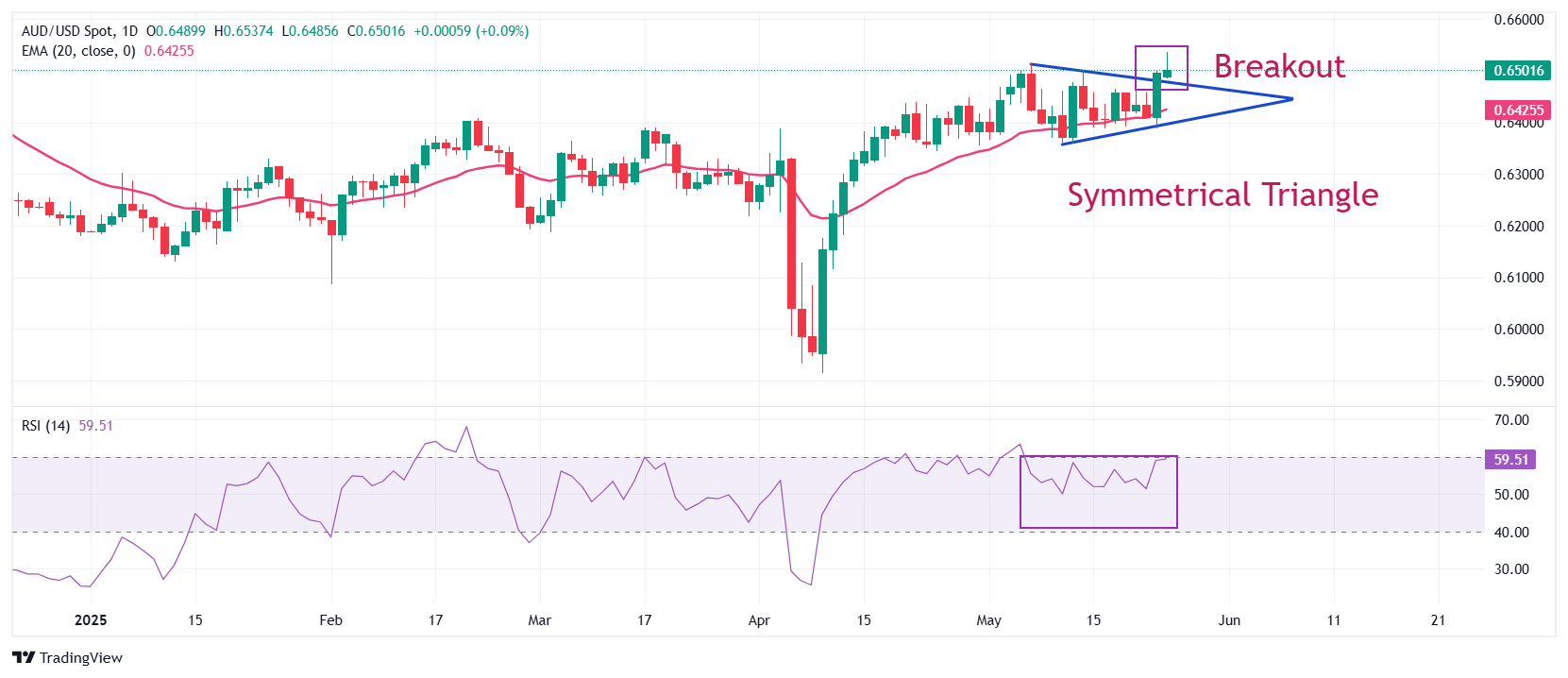
- AUD/USD strengthens on a symmetrical triangle breakout on a daily timeframe.

The AUD/USD pair surrenders significant intraday gains after posting a fresh six-month high near 0.6540 on Monday. The Aussie pair gives back a majority of gains as the US Dollar (USD) recoups its early losses. The US Dollar Index (DXY), which gauges the Greenback’s value against six major currencies, recovers to near 99.00 from its monthly low of 98.70 posted earlier in the day.
The Australian Dollar (AUD) performs strongly as the market sentiment turns favorable for risk-perceived assets after United States (US) President Donald Trump suspended proposed 50% tariffs on the European Union (EU) until July 9.
Trump postponed proposed EU tariffs after the old continent urged Washington for some time to reach a good deal.
This week, investors will pay close attention to the inflation from both Australia and the United States (US), which will be published on Wednesday and Friday, respectively.
AUD/USD delivers a breakout of the Symmetrical Triangle formation formed on a daily timeframe. A breakout of the above-mentioned chart pattern results in a volatility expansion, which leads to wider ticks on the upside and an increase in volume.
The 20-day Exponential Moving Average (EMA) slopes higher around 0.6426, indicating a strong uptrend.
The 14-day Relative Strength Index (RSI) strives to break above 60.00. Bulls would come into action if the RSI breaks above the 60.00 level.
More upside would appear towards the November 25 high of 0.6550 and the round-level resistance of 0.6600 if the pair if the pair breaks above the May 7 high of 0.6515.
On the flip side, a downside move below the March 4 low of 0.6187 will expose it towards the February low of 0.6087, followed by the psychological support of 0.6000.
AUD/USD daily chart
Australian Dollar FAQs
One of the most significant factors for the Australian Dollar (AUD) is the level of interest rates set by the Reserve Bank of Australia (RBA). Because Australia is a resource-rich country another key driver is the price of its biggest export, Iron Ore. The health of the Chinese economy, its largest trading partner, is a factor, as well as inflation in Australia, its growth rate and Trade Balance. Market sentiment – whether investors are taking on more risky assets (risk-on) or seeking safe-havens (risk-off) – is also a factor, with risk-on positive for AUD.
The Reserve Bank of Australia (RBA) influences the Australian Dollar (AUD) by setting the level of interest rates that Australian banks can lend to each other. This influences the level of interest rates in the economy as a whole. The main goal of the RBA is to maintain a stable inflation rate of 2-3% by adjusting interest rates up or down. Relatively high interest rates compared to other major central banks support the AUD, and the opposite for relatively low. The RBA can also use quantitative easing and tightening to influence credit conditions, with the former AUD-negative and the latter AUD-positive.
China is Australia’s largest trading partner so the health of the Chinese economy is a major influence on the value of the Australian Dollar (AUD). When the Chinese economy is doing well it purchases more raw materials, goods and services from Australia, lifting demand for the AUD, and pushing up its value. The opposite is the case when the Chinese economy is not growing as fast as expected. Positive or negative surprises in Chinese growth data, therefore, often have a direct impact on the Australian Dollar and its pairs.
Iron Ore is Australia’s largest export, accounting for $118 billion a year according to data from 2021, with China as its primary destination. The price of Iron Ore, therefore, can be a driver of the Australian Dollar. Generally, if the price of Iron Ore rises, AUD also goes up, as aggregate demand for the currency increases. The opposite is the case if the price of Iron Ore falls. Higher Iron Ore prices also tend to result in a greater likelihood of a positive Trade Balance for Australia, which is also positive of the AUD.
The Trade Balance, which is the difference between what a country earns from its exports versus what it pays for its imports, is another factor that can influence the value of the Australian Dollar. If Australia produces highly sought after exports, then its currency will gain in value purely from the surplus demand created from foreign buyers seeking to purchase its exports versus what it spends to purchase imports. Therefore, a positive net Trade Balance strengthens the AUD, with the opposite effect if the Trade Balance is negative.
Author

Sagar Dua
FXStreet
Sagar Dua is associated with the financial markets from his college days. Along with pursuing post-graduation in Commerce in 2014, he started his markets training with chart analysis.