|

AUD/USD Price Analysis: Bears again attack 0.6850 key support zone

  • AUD/USD takes offers to extend Friday’s pullback from one-week high.
  • Downbeat oscillators, U-turn from 100-DMA keep sellers hopeful.
  • 78.6% Fibonacci retracement may test bears before highlighting the yearly low.

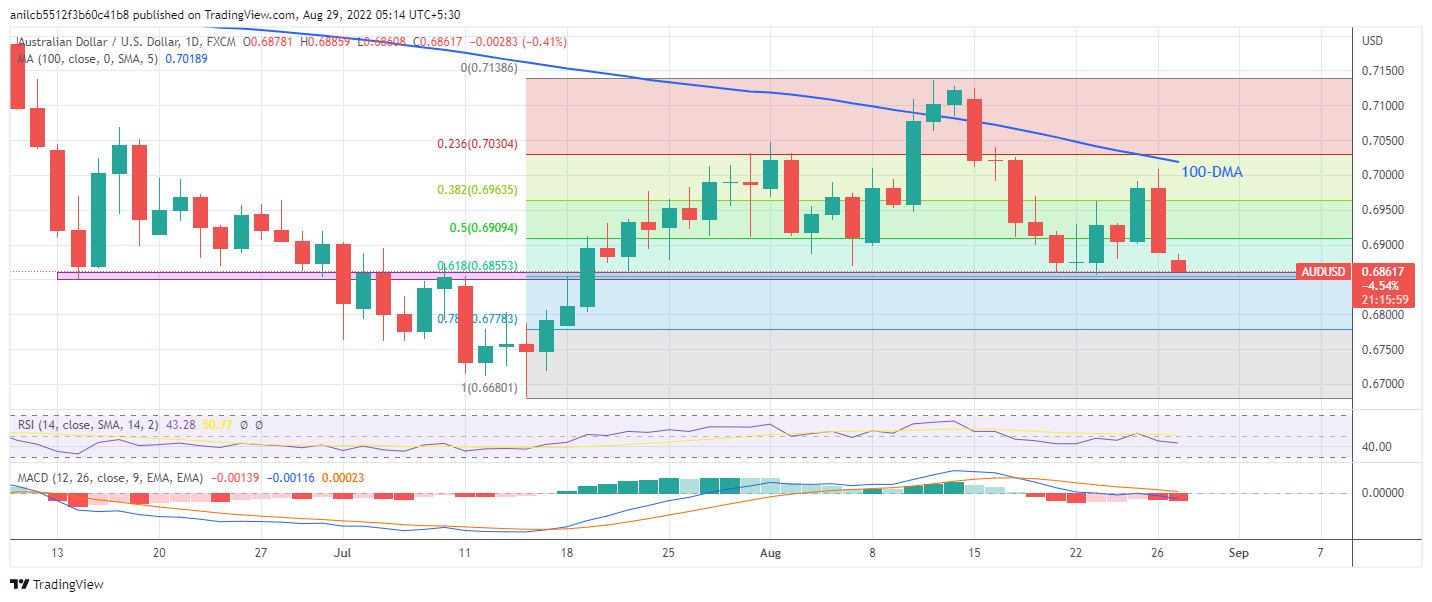
AUD/USD remains on the back foot at 0.6861, extending Friday’s south-run while attacking a 2.5-month-old horizontal support area amid Monday’s Asian session. In doing so, the Aussie pair marks another attempt to conquer the key support zone, after failing the last week.

It’s worth noting that the oscillators like RSI (14) and the MACD appear more bearish during this time and can help the quote to conquer the aforementioned key support zone around 0.6855-50.

Following that, the 78.6% Fibonacci retracement level of July-August upside, near 0.6780, may act as an intermediate halt during the expected south-run targeting the yearly low surrounding 0.6680 marked in July.

On the contrary, the 50% Fibonacci retracement level near 0.6910 guards the quote’s immediate recovery ahead of the 100-DMA resistance close to 0.7020.

Should the quote crosses the 0.7020 hurdle, the early August high near 0.7050 may test the AUD/USD bulls before highlighting the monthly peak of 0.7136.

Overall, AUD/USD bears keep the reins but the quote’s further downside hinges on its ability to conquer the 0.6850 support.

AUD/USD: Daily chart
Trend: Further weakness expected

Additional important levels

Overview
Today last price0.6864
Today Daily Change-0.0048
Today Daily Change %-0.69%
Today daily open0.6912
 
Trends
Daily SMA200.697
Daily SMA500.6916
Daily SMA1000.7028
Daily SMA2000.7133
 
Levels
Previous Daily High0.701
Previous Daily Low0.6888
Previous Weekly High0.701
Previous Weekly Low0.6855
Previous Monthly High0.7033
Previous Monthly Low0.668
Daily Fibonacci 38.2%0.6934
Daily Fibonacci 61.8%0.6963
Daily Pivot Point S10.6863
Daily Pivot Point S20.6814
Daily Pivot Point S30.6741
Daily Pivot Point R10.6985
Daily Pivot Point R20.7059
Daily Pivot Point R30.7108

Author

Anil Panchal

Anil Panchal

FXStreet

Anil Panchal has nearly 15 years of experience in tracking financial markets. With a keen interest in macroeconomics, Anil aptly tracks global news/updates and stays well-informed about the global financial moves and their implications.


More from Anil Panchal
Share:

Editor's Picks

AUD/USD extends decline to fresh monthly lows below 0.7100

AUD/USD trades south of 0.7100 early in the Asian session on Thursday, as the US Dollar soared following the Federal Reserve's monetary policy announcement. The Fed delivered a 25 bps rate hike as expected, while policymakers expressed concerns about inflation leading to bets of additional hikes before year-end.

USD/JPY flirts with 156.00 after Fed's hawkish hike

USD/JPY trades at fresh weekly highs around 156.00 early on Thursday, as the US Dollar soared following the Federal Reserve's monetary policy announcement. The US central bank hiked the benchmark rate by 25 bps as expected, while Chair Kevin Warsh delivered quite hawkish comments in the press conference that followed the decision.

Gold dips towards $4,250 in the Fed's aftermath

Gold erased intraday gains and turned negative following the Federal Reserve's decision to hike rates by 25 bps as expected. The XAU/USD pair briefly surpassed the $4,360 level, now accelerating its slide towards the $4,250 price zone. Hawkish words from Chair Kevin Warsh fueled bets for additional hikes before year-end.

Fed raises 2026 interest rate forecast to 4.1%, lifts PCE inflation projections
The Federal Reserve's (Fed) latest dot plot projections, released by the Federal Open Market Committee (FOMC) on Wednesday, show policymakers now expect interest rates to stand at 4.1% by the end of 2026, up from 3.8% in June.
Fed recap: One hike down, more to come? The Fed’s new rate path says yes
The Federal Reserve (Fed) raised its Fed Fund Target Range (FFTR) range by 25 basis points to 3.75%-4.00% in a unanimous decision, saying the move would support a timelier return to its 2% inflation goal.
How Japan became the World's Banker and why that era may be ending

Japan's ultra-low interest rates helped finance trillions of dollars in global investments for more than a decade, making the Japanese Yen one of the world’s cheapest sources of funding. With the Bank of Japan expected to tighten policy again this week, that advantage may be entering a new phase. While most major economies raised interest rates, Japan remained the world's outlier.














