AUD/USD bears moving in on critical daily support structure
- AUD/USD bulls tiring as US dollar firms on central bank divergences.
- Daily support is under pressure and bears await confirmation.
- US CPI will be an important event on Wednesday and US stocks are closely monitored.


At the time of writing, AUD/USD is better offered, losing some 0.18% on the day.
However, trading at 0.7338, the pair is off from the lows of the day at 0.7328 but bears are closing in on a critical support structure.
AUD/USD fell to a post-US jobs report low of 0.7328 on Monday, extending the lows from a resurgent USD on Friday which rose alongside US yields.
The market reacted positively to the strong Nonfarm Payrolls data, with a risk-on move that sent US stocks higher which gave the Aussie a relatively softer landing than had stocks not moved higher.
This is where the Aussie could be vulnerable to a full-blown sell-off.
The robustness of a risk-on theme and the correlation to the US stock market will be important to Aussie traders for the week ahead.
With that being said, there has been a divergence in the correlation between the US stock market and AUD since May of this year.
This could be an indication that stocks are about to struggle in a hawkish Fed environment.
-637641323772091075.png)
The daily chart above illustrates the S&P 500 compared to the AUD/USD on a daily basis and shows the corrosion of the positive correlation between the ebbs and flow of both markets.
Tracking back over time, however, when the correlation turns negative, the Aussie has led to a bearish decline for stocks.
This could indicate more downside to come in AUD/USD if stocks move into a bearish trend.
In this context, a higher rates environment will not be enjoyed by the stock markets overall.
The US jobs data made rates markets consider the potential timeline of a Federal Reserve’s taper.
The 10-year US Treasury yields were rising to 1.324% on Monday, their highest since mid-July which is supporting the financial shares and it is the interest rate sensitives that are celebrating.
Overall, the strength of US data gives credence to the Fed’s view that the labour market will maintain momentum through the summer, even with the concerns around the Delta variant.
Federal Reserve's Jerome Powell put a particular focus on employment.
Although there is still a long way to go towards reaching full employment, the outcome of Friday's data will have at least offset some of the pessimism that had been building.
Comments from Atlanta Fed President Bostic on Monday were important.
Bostic noted the strong jobs print for July, saying that if data comes out this strong “for the next month or two” then “substantial progress” would have been made on the Fed’s goals.
However, it might not be until later on in the week where stock markets start to reflect the prospects of tighter monetary conditions.
This will be depending on the outcome of the US inflation readings (CPI) which could offer more hints about the path of Federal Reserve policy ahead of the Jackson Hole, Wyoming, later this month.
This is an event that is expected to clarify the central bank's potential plan to begin tapering its bond-purchase plan.
''The CPI probably rose strongly again, but not nearly as strong as in recent months,'' analysts at TD Securities argued.
''Strengthening in airfares, lodging and new vehicles prices probably continued, and rents likely rose solidly again, but used vehicle prices were probably close to flat after huge gains.''
''We expect more slowing in coming months as airfares, lodging and new vehicle prices slow and used vehicle prices reverse some of their earlier surge; wholesale prices for used vehicles have started to decline.''
Meanwhile, the other dominant US market narrative is the spread of the COVID-19 delta variant, which has forced investors to question the pace of the economic recovery in the second half of the year.
From a domestic front, by the end of 2023, the Reserve Bank of Australia now sees unemployment falling to 4%, with wages growth picking up to 2¾% and inflation at 2¼%.
This is going to be central to the direction of monetary policy in Australia.
''We are more bullish on wages and inflation, which is why we expect the RBA to lift the cash rate in the second half of 2023,'' analysts at ANZ bank said,
''But this positive medium-term outlook is moot for now given the risks posed by the surge in COVID cases and the associated lockdown of more than half of Australia. The RBA’s estimate of Q3 GDP falling by around 1% already looks out of date.''
AUD/USD technical analysis
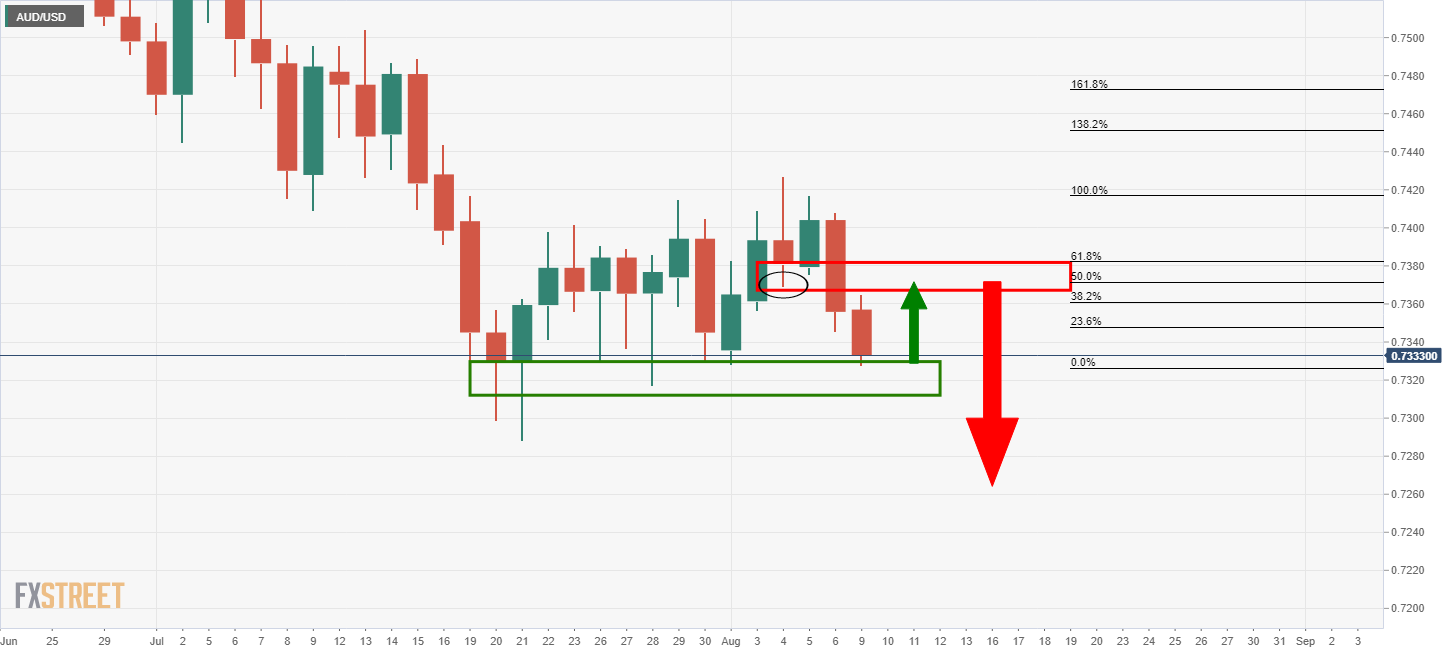
The price is testing a support structure on a daily basis and a break of which would be expected to lead to further and sustained losses for the foreseeable future.
With that being said, there are prospects of a bullish correction, at least to the 38.2% Fibonacci retracement of the prevailing bearish daily impulse.
If the M-formation theory plays out, which is a reversion pattern, then the neckline of the stricture, at 0.7370, would be expected to attract the market for a restest of the level before the neck downside extension.
If the price manages to rebound, then a break of 0.7370 and subsequent hold would be then expected to act as a support base from which bulls can build.
Author
Ross J Burland
FXStreet
Ross J Burland, born in England, UK, is a sportsman at heart. He played Rugby and Judo for his county, Kent and the South East of England Rugby team.

















