Amazon stock gains as jobs data surprises to the upside, dockworker strike ends
- New US hiring comes in 81% above expectations for September.
- Dockworker strike largely ends as automation negotiations get pushed into next year.
- Market loses interest with 50 bps November cut, 25 bps becomes gospel.
- Amazon hiring 250K seasonal jobs for Christmas season.

Amazon (AMZN) stock rose 2.5% on Friday after US jobs data overshot the Wall Street consensus by leaps and bounds.
The US Nonfarm Payrolls (NFP) for September reached 254K, according to the US Bureau of Labor Statistics. That figure for hiring was well above consensus of 140K, and the US Unemployment Rate also dropped by a tenth of a percentage point to 4.1%.
What’s more, the pathetic NFP released a month ago was revised up from 142K to 159K. And this positive economic turn comes on the heels of a sudden end to the dockworkers strike, which was resolved with a 62% wage hike over six years.
Both news items on Friday are tailwinds for Amazon stock, as well as other growth stocks. The Dow Jones Industrial Average (DJIA) rose 0.8% by the close, while the NASDAQ tacked on 1.2%.
Amazon stock news: Labor market improves, dockworker strike ends
Amazon will benefit by reducing the backlog of imports to its fulfillment network. Dozens of ships, maybe 54 at last check, were queued up at more than 30 ports stretching from Maine to Texas. The three-day strike by the International Longshoremen's Association may have pushed trade behind schedule, but it won’t be enough to delay Amazon imports for the heavy Christmas buying season.
However, the union’s master labor contract will be enforced through January 15, 2025, but the port operators continue to want to increase automation at the ports, a strategy that would likely lead to job losses. The union opposes any turn toward automation, so that subject will continue into negotiations next year.
Growth-oriented companies like Amazon also stand to benefit from lower interest rates. The NFP report on Friday was robust enough that the market is now discounting its prior prediction of another 50 bps cut at the Federal Reserve’s (Fed) November meeting. All bets now point to a smaller 25 bps cut followed by the same at December’s meeting.
This means that the market now expects continued rate cuts throughout 2025 but maybe a little slower than expected. The central bank began its cutting cycle in September with a large 50 bps cut since the labor market appeared to be souring.
Noted Fed dove Austan Goolsbee, the President of the Chicago Fed, said that most Fed governors favor “a lot” of cutting over the next 18 months. That should be a boon to stock investors, broadly speaking.
On Thursday, Amazon said it was in the process of hiring 250,000 seasonal workers for the coming holiday season. This is the same level as last year, and Amazon said in a statement that a fair amount of the seasonal workers would likely stay on as full or part-time employees into 2025.
During the fourth quarter last year, Amazon saw sales spike to nearly $170 billion. If the YoY growth rate of recent quarters stays the same (between 10% and 14%), then this Q4 could top $190 billion.
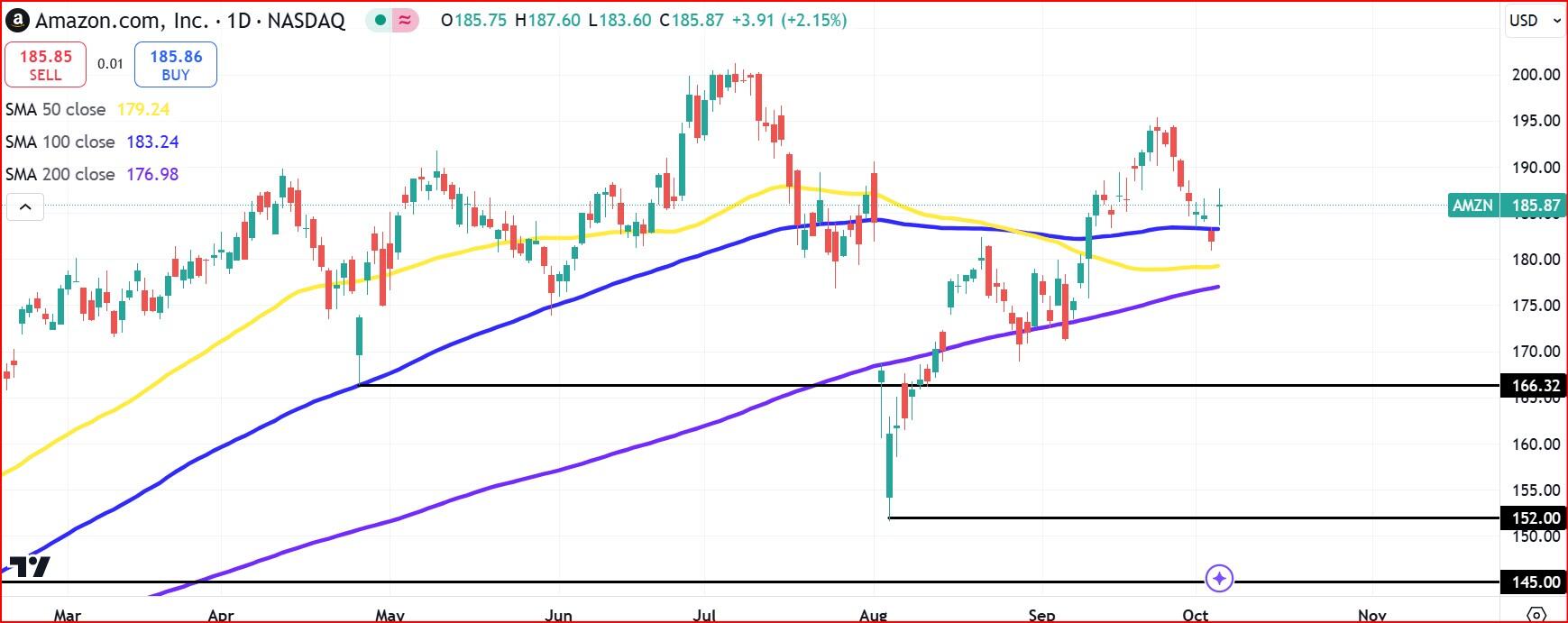
Amazon stock chart
Amazon stock fell for seven straight sessions through Thursday, so holding onto Friday's gains was a big deal. AMZN closed the week at $186.51. The obvious thought is whether AMZN stock can overtake September resistance at $195 next week and reach July resistance just above $200.
Author

Clay Webster
FXStreet
Clay Webster grew up in the US outside Buffalo, New York and Lancaster, Pennsylvania. He began investing after college following the 2008 financial crisis.














