Amazon Q3 2025 earnings preview: Three scenarios that could shape AMZN’s next big move

Amazon’s quarterly earnings are due tomorrow, and the stakes couldn’t be higher. After a volatile year marked by strong growth in cloud and advertising but persistent questions around AI spending and margins, the market is looking for clarity.
Let’s break down what happened last quarter, what Wall Street expects this time, and three potential paths for Amazon’s stock—ranging from a bullish breakout to a deeper correction.
Last quarter’s snapshot (Q2 2025)
Amazon’s previous earnings report in late July painted a picture of robust top-line growth but a muted reaction from investors.
- Net sales: $167.7B (+13% YoY)
- Operating income: $19.2B (vs. $14.7B a year earlier)
- EPS: $1.68 per share
- AWS revenue: $30.9B (+17.5% YoY)
- Advertising: $15.7B (+22–23% YoY)
Despite these strong numbers, shares dipped after the release as the company guided for slower AWS growth and flagged rising AI-related capital expenditures. The market’s takeaway was simple: great results, but higher expectations.
For the current quarter, Amazon guided for:
- Net sales: $174B–$179.5B (+10–13% YoY)
- Operating income: $15.5B–$20.5B
What Wall Street expects for Q3 2025
Consensus expectations are tightly aligned with Amazon’s own guidance range:
- Revenue: Around $177–$178B, or roughly +12% YoY
- Earnings per share (EPS): Approximately $1.57
- Key focus areas:
1) AWS acceleration: Can growth re-expand toward 18–20% YoY?
2) Ad revenue: Will Prime Video ads and DSP demand keep momentum above 20% growth?
3) Operating income: Will results land near the upper end of guidance?
4) Holiday quarter commentary: Guidance for Q4 will heavily influence sentiment heading into year-end.
If Amazon clears these hurdles, the stock could be set for a major repricing to the upside. If not, short-term corrections or a larger rotation could be on the horizon.
Three possible scenarios for AMZN’s stock
Below are three distinct scenarios combining fundamental catalysts with technical structures (from your attached charts).
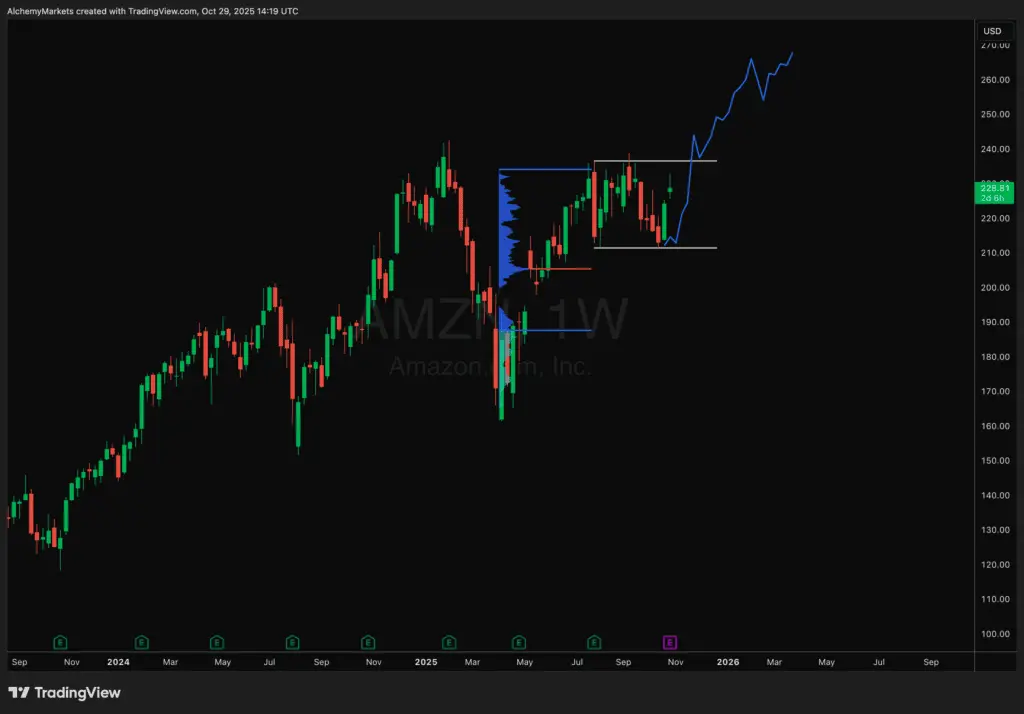
1.Bullish base then breakout — “Short-term consolidation before re-rating higher”
Fundamental Setup:
- Revenue and operating income both hit or exceed the upper end of guidance ($179B+ and $20B+).
- AWS growth surprises to the upside (≥18–20% YoY) with commentary around AI backlog acceleration.
- Advertising remains strong at >20% YoY, supported by Prime Video ads and retail network expansion.
- Capex commentary focuses on return on investment and efficiency, not overspending.
- Holiday-quarter guidance comes in stronger than expected.
Narrative:
If Amazon nails the quarter and outlines a profitable path to scale its AI ambitions, investors could reward it with a valuation re-rate. A clean beat on both top and bottom lines could drive renewed institutional flows and a break above recent resistance—aligning with your “consolidation then breakout” technical setup.
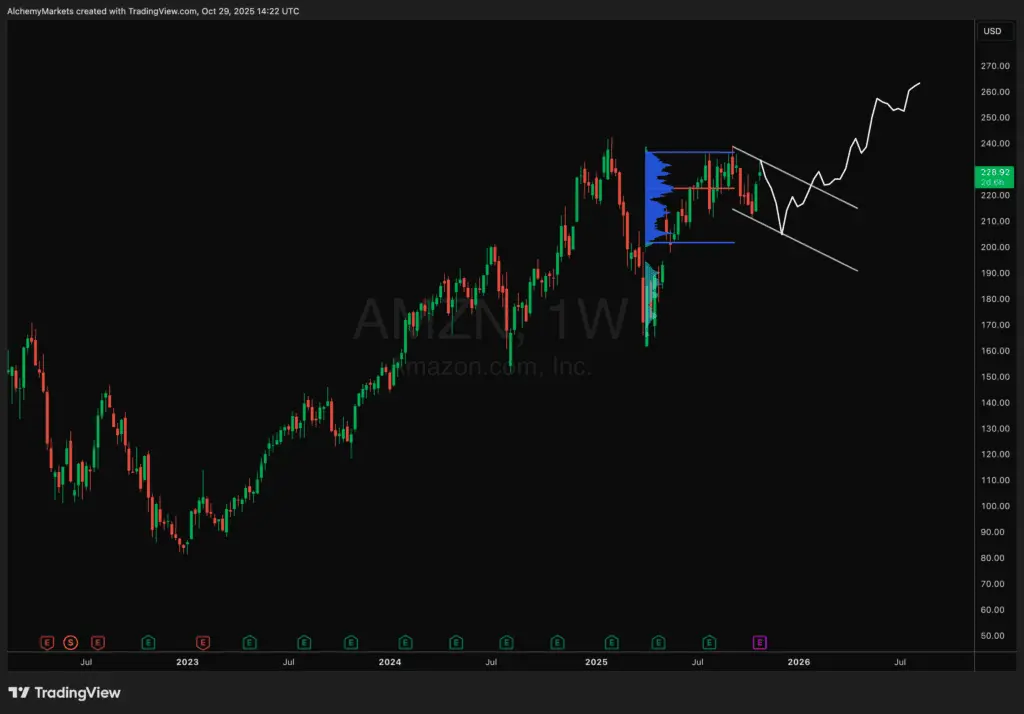
2. Base case — “Short-term correction before continuation higher”
Fundamental Setup:
- Amazon delivers in-line results near the midpoint of guidance ($177B revenue, $18B operating income).
- AWS growth is steady (~17–18%) but not accelerating.
- Ad revenue moderates slightly to the high-teens.
- Commentary around AI spending suggests higher capex, but also hints at long-term profitability.
Narrative:
This kind of result might not excite the Street, leading to a short-term pullback—potentially toward your Point of Control (POC) from the previous leg. But the longer-term structure remains bullish. Investors could view any dip as a buying opportunity once Amazon reaffirms strong fundamentals into the holiday season.
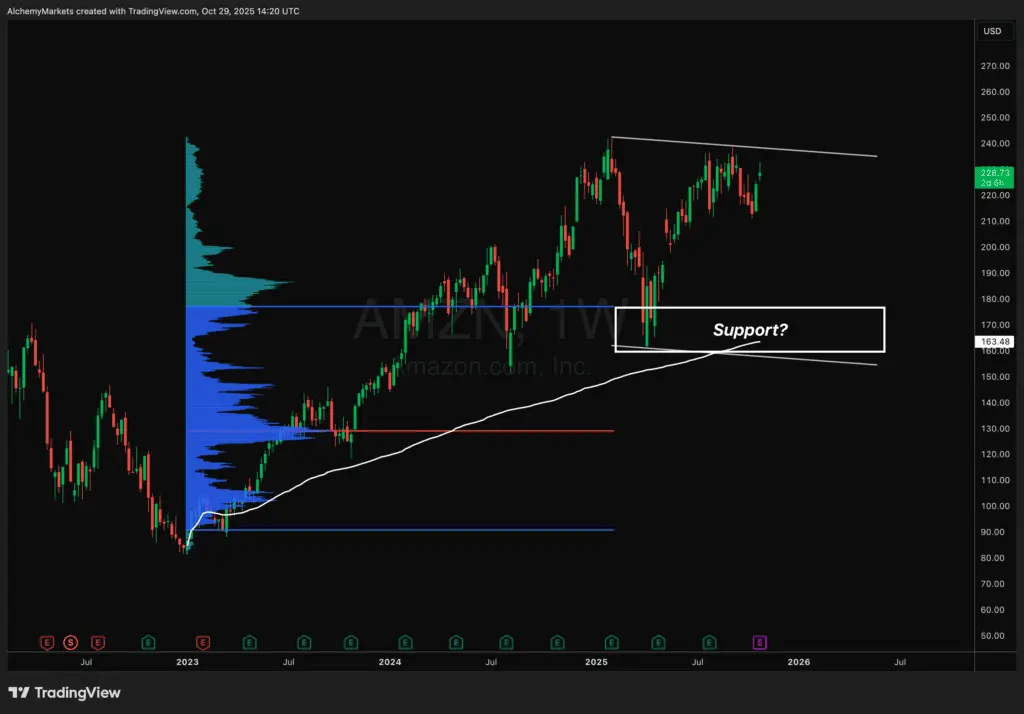
3. Bearish case — “Deeper correction toward $160 support”
Fundamental Setup:
- Results fall below the lower end of guidance (<$175B revenue, <$16B operating income).
- AWS disappoints (<16% YoY) or shows margin compression.
- Ad growth slows sharply (<15% YoY), suggesting consumer or competitive headwinds.
- Q4 guidance comes in weak, and AI capex rises again—raising free cash flow concerns.
Narrative:
A miss on both top and bottom lines combined with weaker guidance could cause a re-rating to the downside. In that case, Amazon might revisit deeper support zones—around $160, which aligns with your horizontal support, POC from the larger volume profile, anchored VWAP, and lower trend channel.
This would likely represent a long-term accumulation zone, but only after the market digests the disappointment.
Bottom Line
Tomorrow’s Amazon earnings report is less about whether growth continues—it almost certainly will—and more about the quality and sustainability of that growth.
The market wants to see AWS and Ads maintaining momentum while AI investments deliver a path to margin expansion rather than contraction.
If Amazon can deliver on those fronts, the path of least resistance remains higher. Otherwise, traders should prepare for a brief or deeper correction depending on the tone of the outlook.
Author

Zorrays Junaid
Alchemy Markets
Zorrays Junaid has extensive combined experience in the financial markets as a portfolio manager and trading coach. More recently, he is an Analyst with Alchemy Markets, and has contributed to DailyFX and Elliott Wave Forecast in the past.

















