Alphabet’s Kodak moment? Why Google could lose its search dominance in the AI age


Key points
- Google’s search dominance may be eroding: Apple executive Eddy Cue’s testimony confirmed Safari search volumes are falling as users shift to AI tools like ChatGPT and Perplexity—signaling structural pressure on Google’s core business.
- AI threatens Google’s monetization model: Traditional search relies on ad clicks; AI offers direct answers with fewer monetizable touchpoints. Google’s new features haven’t yet proven they can replace that revenue stream.
- Investor confidence hinges on Google I/O: The May 20–21 developer event will be critical for clarity on monetization, product traction, and whether Alphabet can lead—rather than follow—in the AI-driven search era.
Alphabet’s dominance in digital search has long been considered unshakable. But a confluence of rising AI competition, legal scrutiny, and shifting user habits is challenging the tech giant's core business in a way not seen in decades.
On May 7, 2025, Alphabet stock plunged over 7% following a bombshell report from Bloomberg. Apple’s senior vice president of services, Eddy Cue, testified in the Department of Justice’s ongoing antitrust trial against Google, stating that searches through Apple’s browser had declined for the first time—a drop attributed to users turning to AI tools like ChatGPT and Perplexity for search-like queries.
A blow to Google’s core business
Cue’s comments sparked immediate investor anxiety. For years, Alphabet has paid billions to Apple to maintain its dominant position as the default search engine on iPhones. Now, with consumer behavior shifting toward generative AI tools like ChatGPT, Perplexity, and Meta AI, the foundations of that dominance appear increasingly unstable.
Cue added that while Apple still wants Google as the default in Safari, the company has been in discussions with Perplexity AI about bringing its services onboard. He sees AI search providers like OpenAI, Perplexity AI and Anthropic PBC eventually replacing standard search engines like Alphabet’s Google. The signal is clear: AI-native search alternatives are no longer fringe—they’re becoming part of the mainstream.
Why this matters?
- Search remains Alphabet’s core revenue engine, contributing $198 billion in 2024—over 57% of total revenue and an even greater share of profits.
- The model relies on intent capture and monetization through sponsored results placed above organic links—driving high volumes of paid clicks and strong cost-per-click (CPC) rates.
- Eddy Cue’s testimony confirmed search volumes are falling on Apple devices, as users increasingly shift to AI tools like ChatGPT and Perplexity for quick answers.
- While CPC remains elevated, paid click volumes are declining, raising concerns over the sustainability of advertiser demand if ad efficiency continues to deteriorate.
- AI tools pose a structural threat, offering direct, conversational responses that bypass the traditional need to scroll through ad-heavy pages.
- Google’s responses—AI Overviews, Circle to Search, AI Mode—are promising, but so far unproven in terms of matching the monetization power of its legacy model.
The monopoly premium is now at risk, with multiple forces converging:
- The DOJ’s antitrust case,
- Apple exploring rival AI search partnerships,
- OpenAI integrations across iOS and macOS,
- And fast-changing user habits disrupting the ad click ecosystem.
In short, Alphabet’s once-defensible search position now appears vulnerable on multiple fronts: legal, technological, and behavioral.
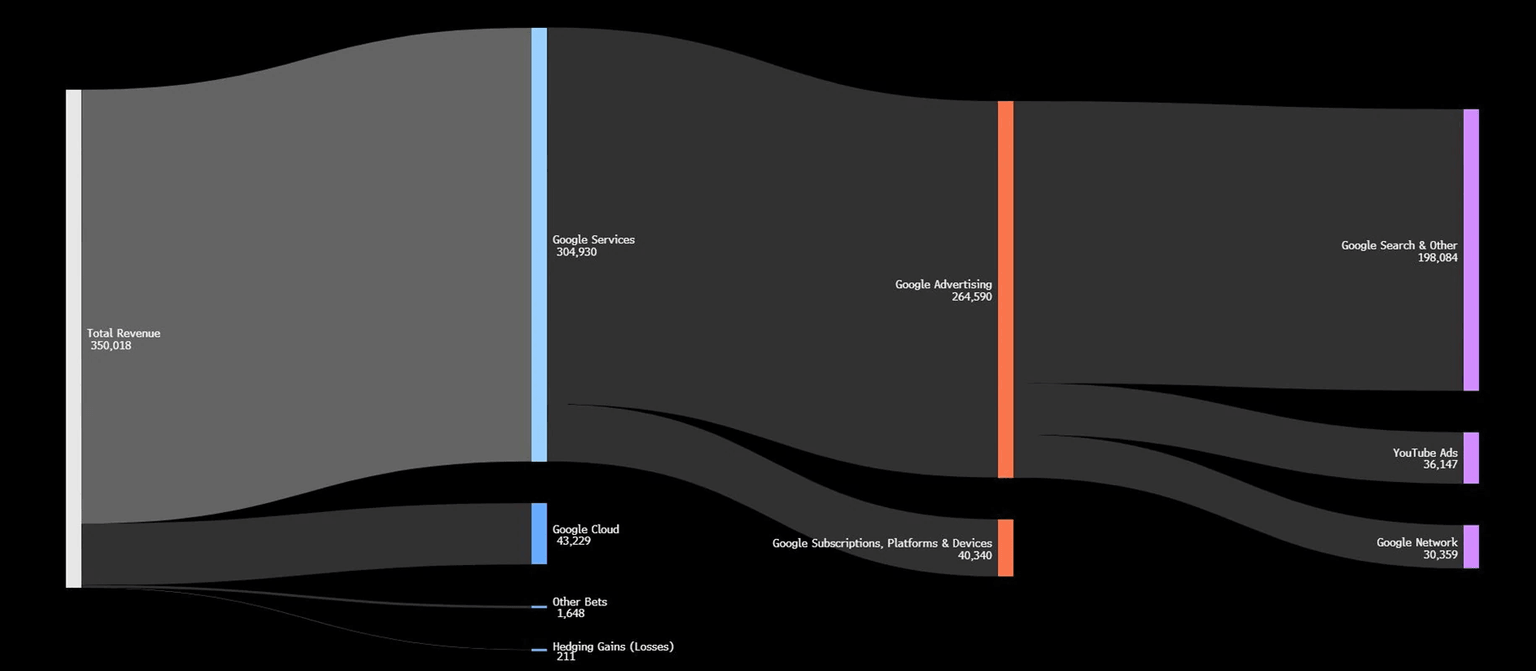
Alphabet's 2024 revenue breakdown. Source: Bloomberg
Could this be Google’s Kodak moment?
Much like Kodak, which saw the digital camera coming but failed to adapt its business model in time, Google sees AI search coming—but hasn’t yet shown how it can monetize it at scale.
Yes, Google is innovating. But it’s also heavily incentivized to protect the ad model. That tension—between adaptation and preservation—mirrors the innovator’s dilemma.
What the market is pricing in —And what it might be missing
From a tactical perspective, investors are grappling with two opposing forces:
Bear case:
- Behavioral shift is real: Eddy Cue’s testimony provides rare confirmation that user behavior is changing.
- Monetization gap remains unproven: Even as Google rolls out AI features, it's unclear how they'll be monetized.
- Valuation premium may unwind: If monopoly status is lost and revenue growth decelerates, multiples could compress.
Bull case:
- Disruption may be overstated: Google retains deep integration across Android, Chrome, Gmail, and Maps—touchpoints that anchor user habits.
- AI rollout is accelerating: Google’s AI Overviews and Gemini integrations may yet prove defensible and monetizable.
- Valuation already reflects concern: Alphabet trades at a discount to peers like Microsoft and Amazon, suggesting some risks are priced in.
Current analyst projections expect Google Search to grow at a 6% CAGR over the next five years, versus 10% for the broader digital ad market—reflecting structural headwinds, but not collapse.
What to watch: Google I/O as a pivotal moment
Google I/O developer conference, scheduled for May 20-21, could be a critical opportunity for Alphabet to reshape the narrative. Investors will look for:
- Detailed AI monetization strategies,
- Traditional search trends,
- Progress on Gemini user metrics and product traction,
- Integration updates across Android and Chrome,
- Evidence that Alphabet is moving from defensive to offensive in the AI race.
As AI-native platforms reshape how people access information, Alphabet’s ability to evolve from its traditional ad-driven model will determine whether it remains a leader—or joins the list of tech titans overtaken by disruption.
Read the original analysis: Alphabet’s Kodak moment? Why Google could lose its search dominance in the AI age
Author
Saxo Research Team
Saxo Bank
Saxo is an award-winning investment firm trusted by 1,200,000+ clients worldwide. Saxo provides the leading online trading platform connecting investors and traders to global financial markets.