Alibaba Stock News and Forecast: BABA advances in Hong Kong on new data products
- Alibaba stock advanced 1.2% in Hong Kong on Monday.
- BABA stock is not trading in the US on Monday due to the July 4 holiday.
- Alibaba has introduced an enterprise data company, Lingyang Intelligent Service.

Alibaba (BABA) stock is not trading on Monday due to the July 4 Independence Day in the United States, but its Hong Kong counterpart (9988.HK) closed up 1.2% at 113.20 Hong Kong dollars to start the week. This is good news for BABA shareholders as a mixed bag of news made the rounds over the weekend.
Also read: Meta Platforms (META) Stock Deep Dive: Facebook parent price target at $200 despite macro headwinds
Alibaba Stock News: Major cyber breach fails to overshadow new data offering
Chinese media over the weekend exploded with an account of what may be the largest data breach in Chinese history. An anonymous hacker stole identity information from as many as 1 billion Chinese citizens after breaching a Shanghai police server and offered the 23 terabytes of data for sale on a digital forum. The hacker asked for just 10 Bitcoins in exchange, an amount close to $200,000.
Various media figures have suggested the data breach may lead to an even more concerted effort to control customer data collected by digital giants like Alibaba and Tencent (TME). These two mega-caps are some of the largest providers of cloud services to both government and private sector institutions in China, and there are rumors that a major cloud provider will be blamed.
On a positive note, Alibaba has formally announced the creation of a data company focused on the enterprise market. A new offering, Lingyang Intelligent Service will present corporations with data as a service through 11 different products. Some products are primarily for manufacturers, while others are focused on marketing. Lingyang means "antelope" in Mandarin.
News on June 17 emerged that the People's Bank of China is allowing Ant Group to form a financial holding company that would allow it to IPO. Alibaba owns about 33% of the prominent fintech firm that it helped launch. As a major owner, BABA is a proxy for Ant's future IPO, which is expected to be possibly the largest in Chinese history.
Alibaba Stock Forecast: $120 remains stubborn resistance
We were excited on June 23 and 24 to see BABA stock posting a rare double Rising Window pattern. This pattern of bold green candles gapping up on one another typically forecast that a larger rally is in the works. Last week though saw that rally peter out at $120 once again. $120 has stopped BABA dead in its tracks on at least four occasions since the beginning of March. The 9-day moving average continues leading the 21-day counterpart, a chart event that lasted through the full month of June.
BABA stock did not fall far however. Shares continued to bounce around between $110 and $120. This means the ecommerce giant may take another stab at $120. If not though, expect it to resort to finding support once more. Short-term support sits at $102 to $105, and longer-term support is now at $85 from the gradually ascending trend line.
From there, our advice from last week's remains the same: "FXStreet thinks that BABA will make a run at $128 next. That is the resistance zone from the first two weeks of February. Right above there is more resistance at $130, which stems from that level acting as stiff support during the winter of 2018 and early 2019."
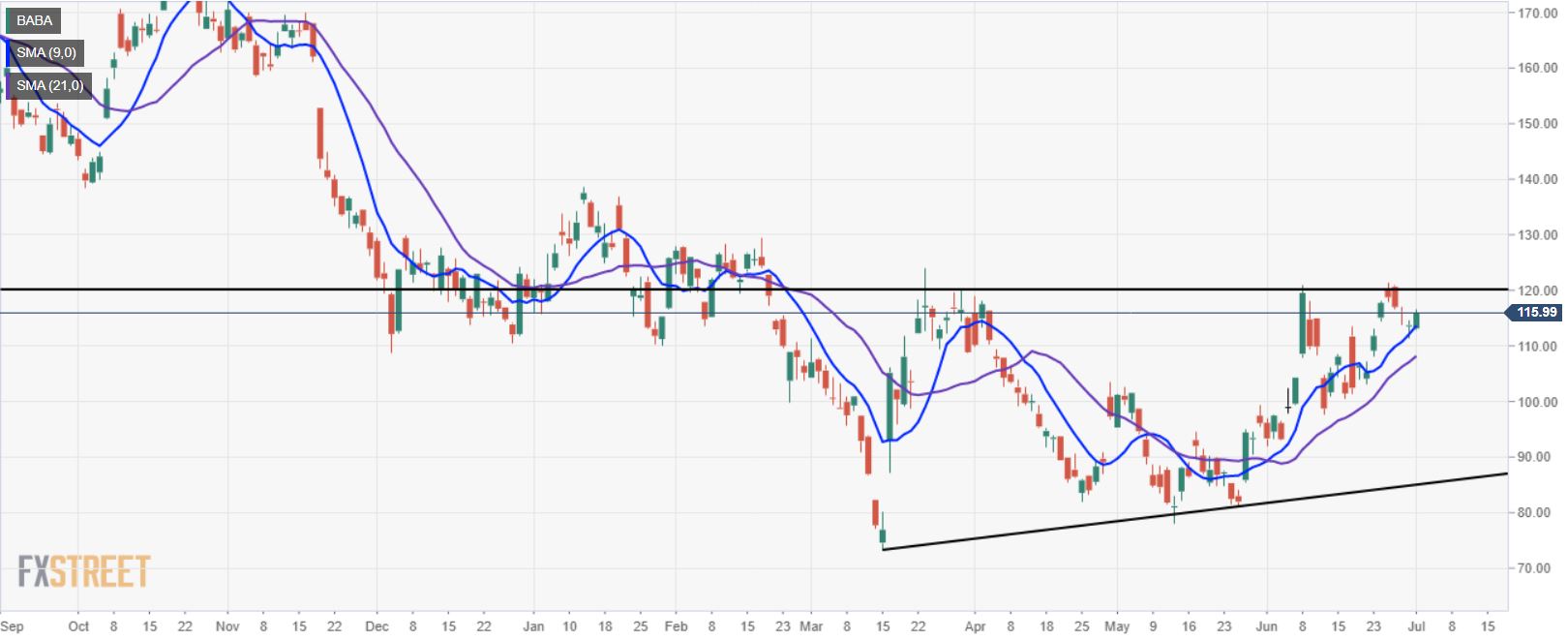
BABA daily stock chart
Like this article? Help us with some feedback by answering this survey:
Author

Clay Webster
FXStreet
Clay Webster grew up in the US outside Buffalo, New York and Lancaster, Pennsylvania. He began investing after college following the 2008 financial crisis.

















