Alibaba Stock Price and Forecast: BABA lower as China regulatory concerns hit home
- BABA shares tanked on Monday as China regulatory concerns resurface.
- Alibaba had earlier suffered when the ANT Group IPO was canceled.
- China is increasing scrutiny of its tech companies.

Alibaba shares took a decent hammering on Monday, closing down over 7% at $191.76 and in the process breaking the $200 psychological round number. The shares are showing no sign of a bounce just yet with further losses in Tuesday's pre-market trading. BABA stock is trading at $183.90 in Tuesday's early trading for a loss of 4%.
It is the third time unlucky for BABA shares. Fool me once, shame on me. Fool me twice, shame on you. Fool me three times ... not sure how that one goes, but it appears to be fool on bulls. First, it was the ANT Group IPO that caught the unwanted attention of China and sent shares in parent Alibaba tumbling. Then recently we had the DIDI saga (see more), which again hit Chinese shares. This time the IPO got away, but DIDI has been hammered since. Now it is the turn of education and real estate stocks. China over the weekend said it would not allow for-profit tutoring in some core subjects, and a host of China education stocks took a beating on Monday. TAL Education (TAL), New Oriental (EDU) and Gaotu (GOTU) dropped over 20%. Tencent Music (TME) also found itself in the crosshairs as it was forced to give up exclusive digital music rights. "Even when you think China risk is priced, it can get worse," Goldman Sachs wrote in a research note.
China and the US staged a high-level diplomatic meeting on Monday, and it is safe to say the outcome was less than stellar, with both sides disappointed with the meeting as China said the relationship was at a "stalemate" and the US talking tough, with Defence Secretary Austin saying, "The US does not desire confrontation with China, but it will not back down."
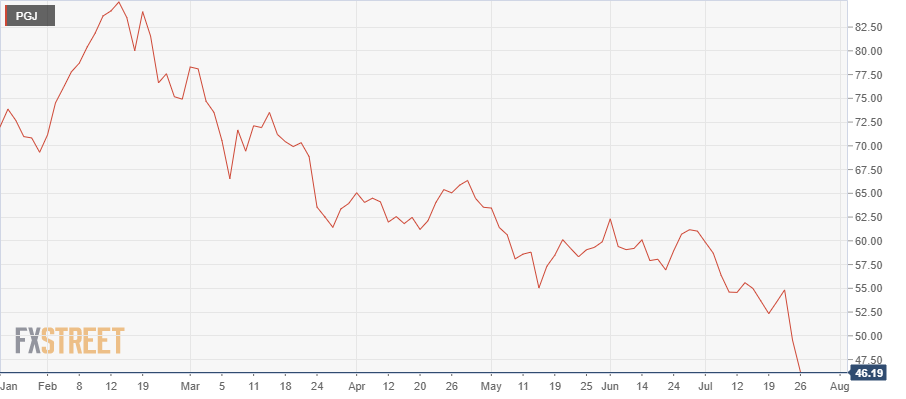
The Invesco Golden Dragon Index tracks top Chinese companies listed in the US and includes names such as NIO, JD, BABA, Baidu, XPEV, Trip.com, Bilibili etc. The index slumped nearly 7% on Monday and is now down nearly 22% in the last month.
Adding to the rush for the exit is Cathie Wood as her ARK Funds sold shares in BABA, JD and Pinduoduo (PDD), according to various news sources.
Alibaba (BABA) key statistics
| Market Cap | $572 billion |
| Price/Earnings | 25 |
| Price/Sales | 5.3 |
| Price/Book | 4 |
| Enterprise Value | $579 billion |
| Gross Margin | 0.43 |
| Net Margin |
0.21 |
| Average Wall Street Rating and Price Target | Buy $286 |
BABA stock forecast
The chart looks bleak, but on the weekly we can see one potential staging area for some longs. Given the background, please use a stop for this one. Always use a stop, of course, but especially in this case. The area around $180 is a nice volume staging point with plenty of volume to support the price. The point of control is at $180.93, this is the price with the highest level of volume since 2017. From here down to the 2020 lows at $170 is strong support. A break would mean volume starts to thin out, meaning prices could accelerate.
Breaking $211 was strongly negative as it created a new low in the trend and confirmed the bearishness. Now $170 is the next major low.
Resistance is initially at $204, which will fill the gap created from Monday's open. This will also get Alibaba stock back above the 9-day moving average.
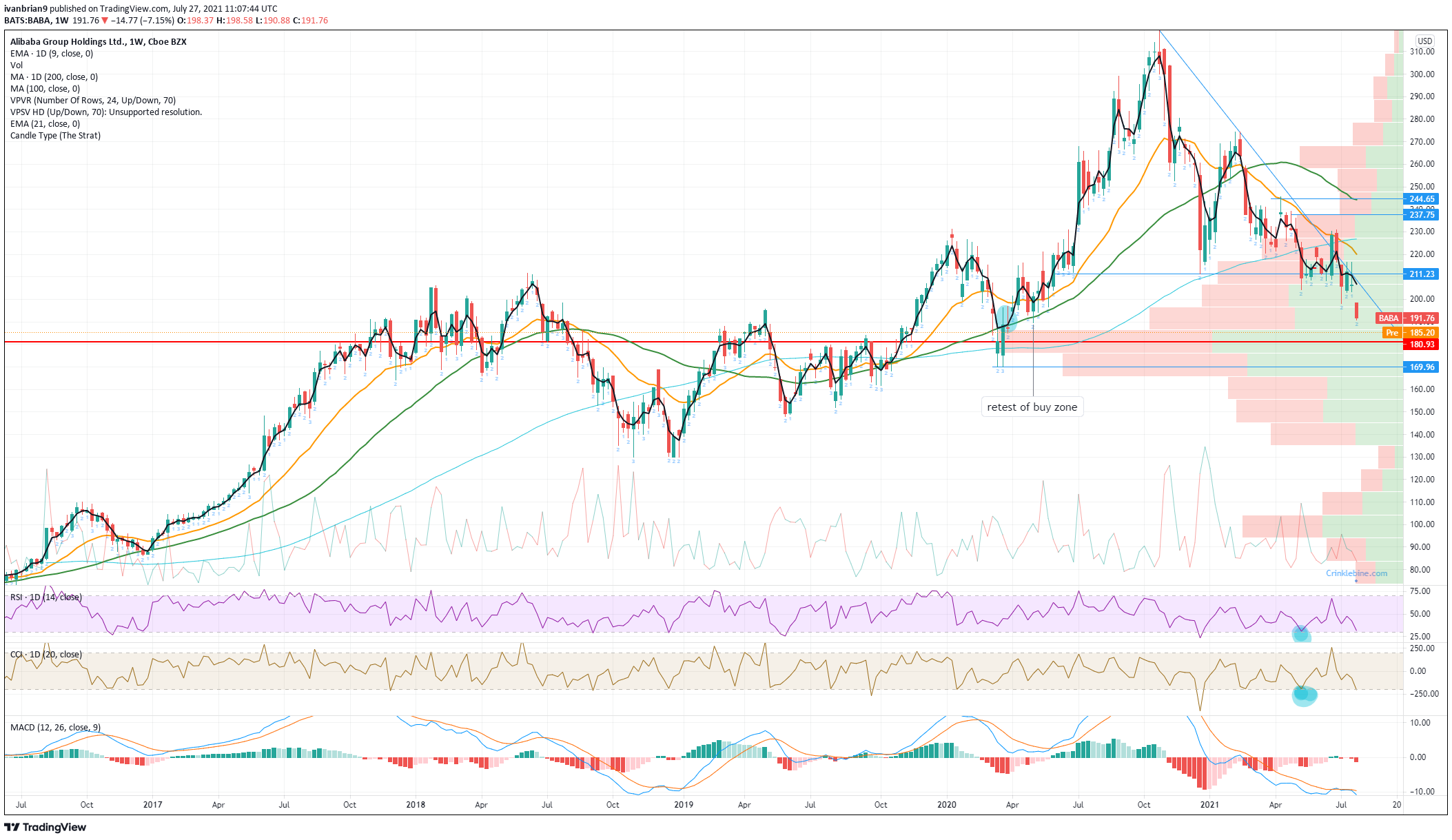
BABA 1-week chart
BABA releases earnings on August 3.
Like this article? Help us with some feedback by answering this survey:
Author

Ivan Brian
FXStreet
Ivan Brian started his career with AIB Bank in corporate finance and then worked for seven years at Baxter. He started as a macro analyst before becoming Head of Research and then CFO.