Advanced Micro Devices Stock Forecast: AMD advances 5% on technical breakout
- AMD stock shot up 5% on Friday.
- New Street Research analyst says Nvidia success is priced in.
- Analyst Pierre Ferragu sees much more room for share price growth in AMD.
- Higher Unemployment Rate in US leaves market gunning for Fed rate cuts.
Advanced Micro Devices (AMD) stock is leaving the rest of the semiconductor industry behind on Friday as its 5% gain stays well ahead of the Philadelphia Semiconductor Index’s slight advance. An analyst report that was skeptical of future gains for one of AMD’s competitors made the market turn its glance back toward the company run by CEO Lisa Su.
US indices benefited on Friday after US Nonfarm Payrolls showed that the early part of the year’s hiring gains are continuing to dissipate. Payrolls for June came in above consensus, but those of April and May were revised much lower, and the Unemployment Rate rose by a tenth to 4.1%. This lent credence to the view that the Federal Reserve (Fed) will soon cut interest rates, and hence the S&P 500 and NASDAQ rose 0.54% and 0.90% on the day.
AMD stock news
New Street Research analyst Pierre Ferragu scrapped his Buy rating on Nvidia (NVDA) this Friday in favor of a Neutral grade. Ferragu’s rating surprised the market as Nvidia has been the obvious leader in the present bull market that began nearly two years ago in October of 2022.
Ferragu is not really bearish on Nvidia’s artificial intelligence (AI) prospects — quite the opposite, in fact. Instead, he thinks Nvidia is correctly valued at present based on current guidance. As a top-ranked analyst who spent 10 years covering semiconductors at Bernstein, Ferragu told clients to focus instead on better-priced industry stalwarts like AMD and Taiwan Semiconductor (TSM).
Farragu gave AMD stock a $235, 12-month price target and $345 target by the end of 2026. He based his valuation on a prediction that AMD will churn out $10 in earnings per share by 2027.
AMD has underperformed investor sentiment for its AI chip business thus far this year, and Morgan Stanley recently downgraded the stock on that account.
Still, AMD’s continued gaining of market share within the CPU market for PCs has no reason to stop. It’s next generation Ryzen AI 300 processors are designed to better process AI workloads, and many analysts think they could help AMD to steal even more market share from Intel (INTC).
Additionally, investors are sizing up the runner-up fabless chipmaker as its AI-enabled data center GPUs are forecast to sell $4 billion worth this year alone.
AI stocks FAQs
First and foremost, artificial intelligence is an academic discipline that seeks to recreate the cognitive functions, logical understanding, perceptions and pattern recognition of humans in machines. Often abbreviated as AI, artificial intelligence has a number of sub-fields including artificial neural networks, machine learning or predictive analytics, symbolic reasoning, deep learning, natural language processing, speech recognition, image recognition and expert systems. The end goal of the entire field is the creation of artificial general intelligence or AGI. This means producing a machine that can solve arbitrary problems that it has not been trained to solve.
There are a number of different use cases for artificial intelligence. The most well-known of them are generative AI platforms that use training on large language models (LLMs) to answer text-based queries. These include ChatGPT and Google’s Bard platform. Midjourney is a program that generates original images based on user-created text. Other forms of AI utilize probabilistic techniques to determine a quality or perception of an entity, like Upstart’s lending platform, which uses an AI-enhanced credit rating system to determine credit worthiness of applicants by scouring the internet for data related to their career, wealth profile and relationships. Other types of AI use large databases from scientific studies to generate new ideas for possible pharmaceuticals to be tested in laboratories. YouTube, Spotify, Facebook and other content aggregators use AI applications to suggest personalized content to users by collecting and organizing data on their viewing habits.
Nvidia (NVDA) is a semiconductor company that builds both the AI-focused computer chips and some of the platforms that AI engineers use to build their applications. Many proponents view Nvidia as the pick-and-shovel play for the AI revolution since it builds the tools needed to carry out further applications of artificial intelligence. Palantir Technologies (PLTR) is a “big data” analytics company. It has large contracts with the US intelligence community, which uses its Gotham platform to sift through data and determine intelligence leads and inform on pattern recognition. Its Foundry product is used by major corporations to track employee and customer data for use in predictive analytics and discovering anomalies. Microsoft (MSFT) has a large stake in ChatGPT creator OpenAI, the latter of which has not gone public. Microsoft has integrated OpenAI’s technology with its Bing search engine.
Following the introduction of ChatGPT to the general public in late 2022, many stocks associated with AI began to rally. Nvidia for instance advanced well over 200% in the six months following the release. Immediately, pundits on Wall Street began to wonder whether the market was being consumed by another tech bubble. Famous investor Stanley Druckenmiller, who has held major investments in both Palantir and Nvidia, said that bubbles never last just six months. He said that if the excitement over AI did become a bubble, then the extreme valuations would last at least two and a half years or long like the DotCom bubble in the late 1990s. At the midpoint of 2023, the best guess is that the market is not in a bubble, at least for now. Yes, Nvidia traded at 27 times forward sales at that time, but analysts were predicting extremely high revenue growth for years to come. At the height of the DotCom bubble, the NASDAQ 100 traded for 60 times earnings, but in mid-2023 the index traded at 25 times earnings.
AMD stock forecast
AMD stock broke above the technical wedge (drawn in pink below) on Friday. Its rally stopped just short of the May 28 range high at $174.55 and matches another resistance area from April of this year. If that barrier is defeated in subsequent sessions in July, then bulls will push on toward the January 25 resistance point just below $185.
Support sits at $162.50 and $150, as well as the ascending bottom trendline from the wedge pattern.
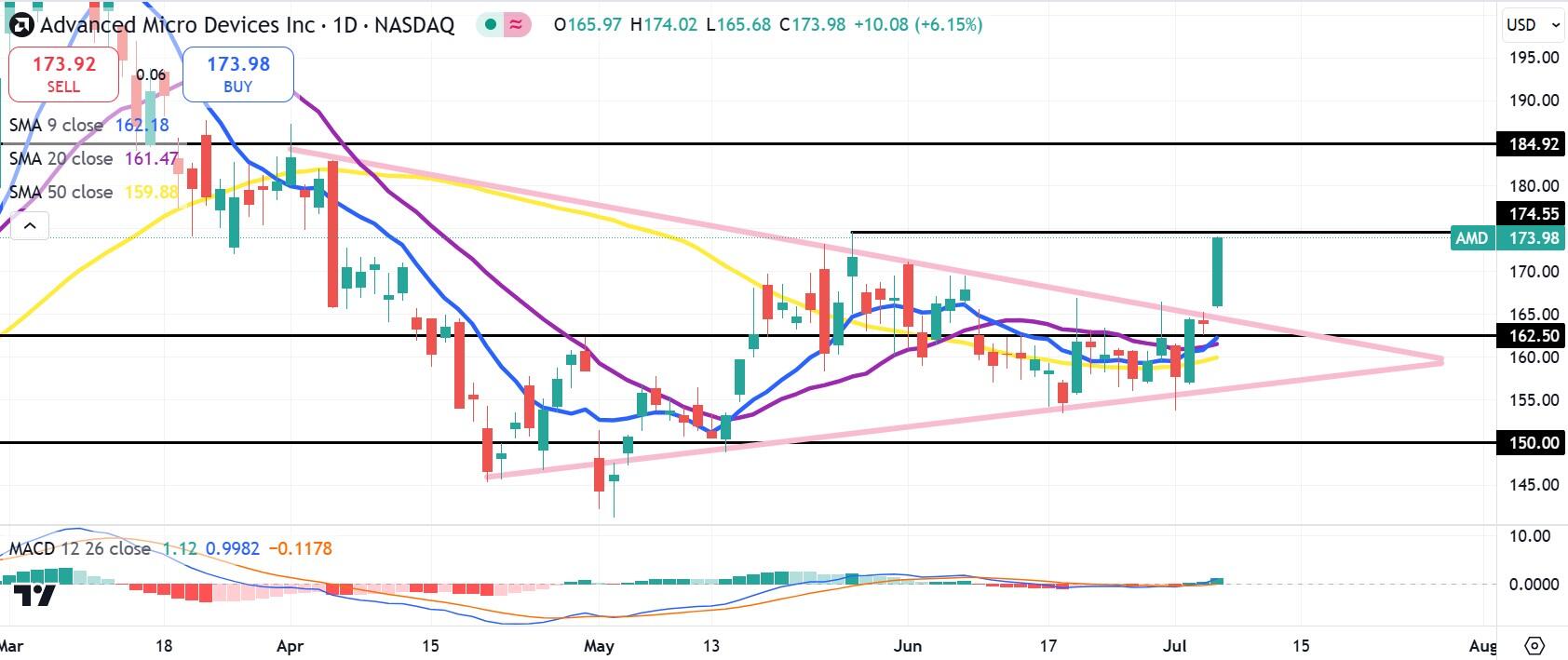
AMD daily chart
Author

Clay Webster
FXStreet
Clay Webster grew up in the US outside Buffalo, New York and Lancaster, Pennsylvania. He began investing after college following the 2008 financial crisis.