Interest rates remain the main driver of the Forex (foreign exchange) market. More than any other factor, it is the decisions of central banks that drive currency values.
In recent weeks, investor attention has focused on Jackson Hole, where Federal Reserve (Fed) Chair Jerome Powell opened the door to a first rate cut in 2025 as early as September. A strong signal that is already shaking up the US Dollar (USD) and the major Forex pairs.
Why interest rates dictate Forex
The mechanisms are relatively simple: higher interest rates attract foreign capital, as they offer a more attractive return on Bonds and deposits denominated in the currency concerned.
Conversely, lower interest rates make the currency less attractive. In this way, interest rate differentials explain why one currency strengthens or weakens against another.
In the case of the United States, the Fed's rate hikes in 2022 and 2023 propelled the Greenback, with the US Dollar Index (DXY) even reaching a twenty-year high.
But today, the cycle is reversing: inflation is falling, growth is showing signs of fatigue, and employment, the mainstay of the US economy, is weakening.
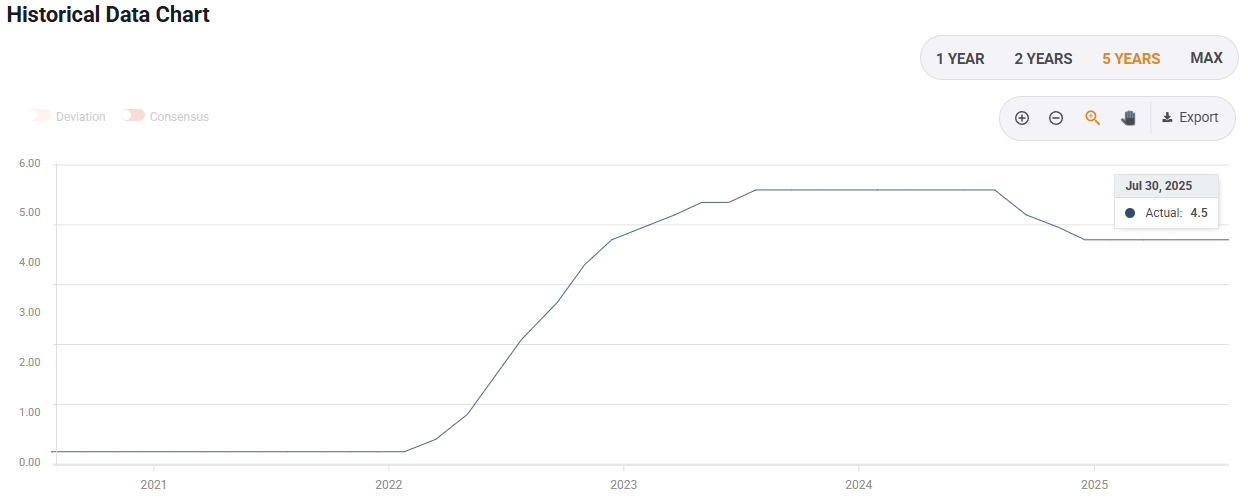
United States Fed interest rate. Source: FXStreet
Powell prepares markets for monetary easing
In his Jackson Hole speech, Jerome Powell acknowledged that US monetary policy remained "restrictive" and that the balance of risks was now shifting towards the labor market.
He mentioned the possibility of an adjustment as early as the September 17 meeting, confirming the expectations of many traders.
Markets were quick to react. Bond yields fell, and the US Dollar retreated against the Euro (EUR) and Japanese Yen (JPY).
According to the CME FedWatch Tool, the probability of a 25 basis point cut in September now exceeds 84%. Investors are even anticipating two further interest rate cuts between now and the end of the year.
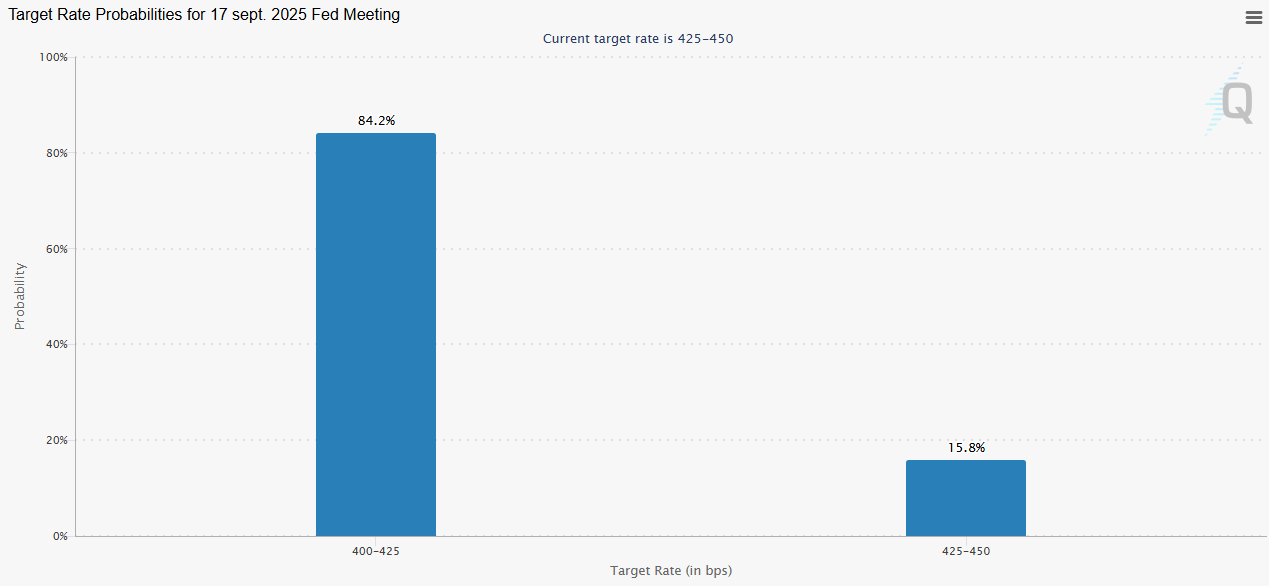
CME FedWatch Tool. Source: CME Group
A direct impact on the US Dollar and Forex
In practical terms, a fall in US interest rates reduces the yield differential with other currencies. If the Fed eases its policy faster than the European Central Bank (ECB) or the Bank of England (BoE), the Greenback will lose its appeal and could weaken against the Euro or the British Pound (GBP). This is what we have seen in recent weeks, with the EUR/USD back above 1.15.
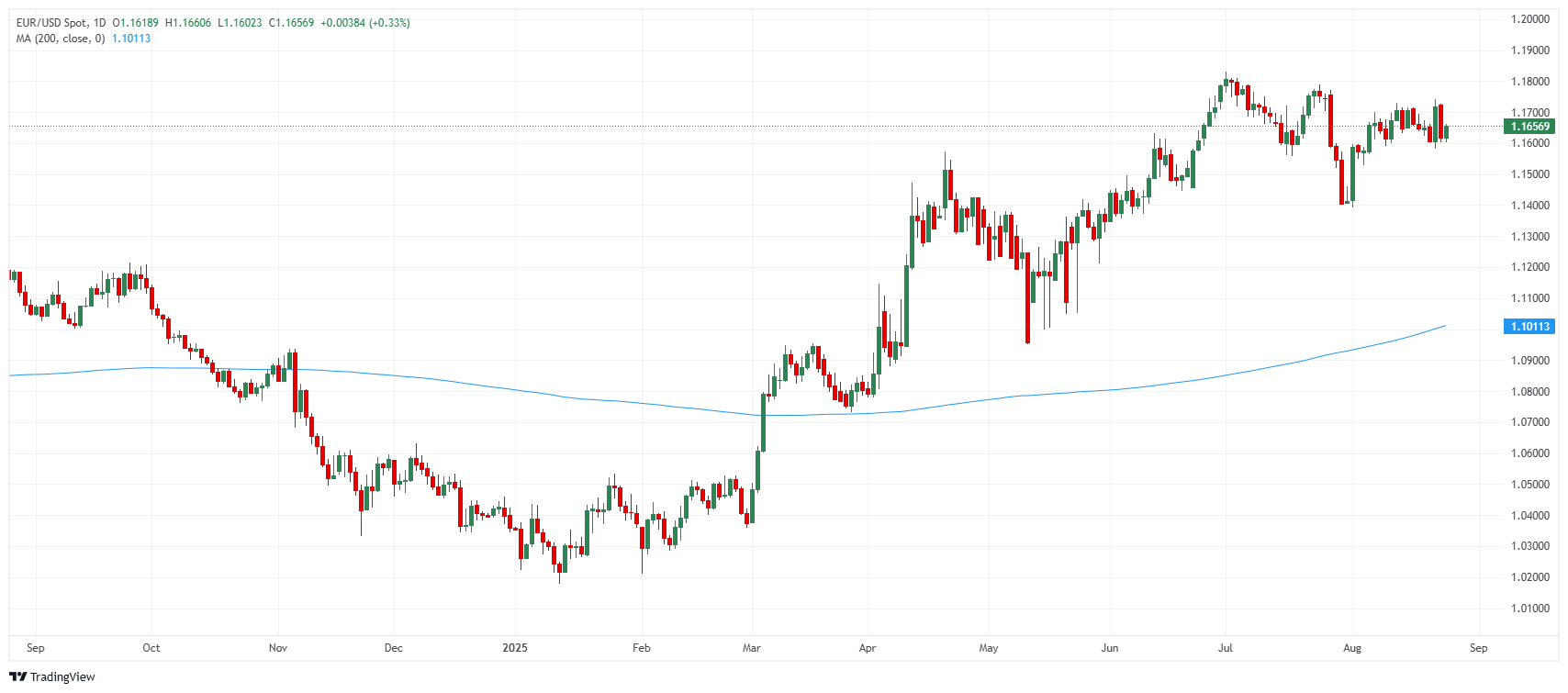
EUR/USD price daily chart. Source: FXStreet.
But the future remains uncertain. If inflation were to rise again, notably as a result of the US President Donald Trump administration's tariffs, the Fed could slow down its cuts, thereby supporting the US Dollar.
Conversely, a marked weakening in the labor market would prompt Jerome Powell to accelerate easing, to the detriment of the Greenback.
The role of expectations
It's important to remember that in Forex, it's not just the decisions themselves that count, but above all, expectations.
Forex traders adjust their positions even before the Fed announces a move. Thus, a speech by Powell that is deemed "dovish" (accommodating) may immediately weaken the US Dollar, even if interest rates remain unchanged for the time being.
Conversely, a hawkish tone may strengthen the Greenback, despite a status quo decision.
A strategic turning point for traders
For market operators, this autumn could mark a turning point. The prospect of Federal Reserve rate cuts is reshuffling the deck, creating new opportunities for major pairs.
If the US Dollar weakens, emerging currencies and those of higher-rate countries, such as the Canadian Dollar (CAD) and Australian Dollar (AUD), could benefit.
Beyond the immediate news, this sequence reminds us of a fundamental truth: interest rates, by dictating global capital flows, are Forex's number-one barometer.
For any investor, following Jerome Powell's and the Federal Reserve's announcements is not an option, but a necessity.
Information on these pages contains forward-looking statements that involve risks and uncertainties. Markets and instruments profiled on this page are for informational purposes only and should not in any way come across as a recommendation to buy or sell in these assets. You should do your own thorough research before making any investment decisions. FXStreet does not in any way guarantee that this information is free from mistakes, errors, or material misstatements. It also does not guarantee that this information is of a timely nature. Investing in Open Markets involves a great deal of risk, including the loss of all or a portion of your investment, as well as emotional distress. All risks, losses and costs associated with investing, including total loss of principal, are your responsibility. The views and opinions expressed in this article are those of the authors and do not necessarily reflect the official policy or position of FXStreet nor its advertisers. The author will not be held responsible for information that is found at the end of links posted on this page.
If not otherwise explicitly mentioned in the body of the article, at the time of writing, the author has no position in any stock mentioned in this article and no business relationship with any company mentioned. The author has not received compensation for writing this article, other than from FXStreet.
FXStreet and the author do not provide personalized recommendations. The author makes no representations as to the accuracy, completeness, or suitability of this information. FXStreet and the author will not be liable for any errors, omissions or any losses, injuries or damages arising from this information and its display or use. Errors and omissions excepted.
The author and FXStreet are not registered investment advisors and nothing in this article is intended to be investment advice.
Recommended content
Editors’ Picks

EUR/USD weakens below 1.1250, bearish tone prevails below 100-day SMA
The EUR/USD pair trades in negative territory around 1.1230 during the early European trading hours. Fiscal risks in France and political instability in Europe exert some selling pressure on the Euro against the US Dollar. European Central Bank Executive Board member Frank Elderson is set to speak later in the day.

GBP/USD bulls seem hesitant above 1.3300 as USD steadies on Fed, geopolitical risks
The GBP/USD pair bounces off the 1.3300 neighborhood at the start of a new week, stalling Friday's modest pullback from its highest level since September 23. Spot prices, however, lack follow-through and currently trade around the 1.3330 region, unchanged for the day as the US Dollar selling seems to have abated.

Gold rangebound as easing October Fed bets clash with firm December hike pricing
Gold attracts some buyers at the start of a new week, though it lacks bullish conviction and remains below the $4,200 mark. US Federal Reserve Chair Kevin Warsh’s unwillingness to provide any cues on further policy moves led to a reduction in odds for policy tightening later this month. Moreover, the recent sharp retracement slide in US government bond yields from multi-year highs, which dragged the US Dollar to a two-week low, acts as a tailwind for the bullion.

Cardano risks 15% downside as retail demand, bullish momentum wane
Cardano (ADA) is trading above $0.2200 at press time on Monday, holding steady after a 12% decline the previous week. The altcoin is losing retail interest as the notional value of active ADA futures positions declines. The technical outlook for ADA suggests a downside bias following the bearish breakout below a near-term support trendline last week.

What to expect in the week ahead
Investors are still digesting last week’s price action as we start a new week. US stocks sold off sharply, with the Swiss and UK indices attracting inflows as tech sold off. Sovereign bonds, particularly Treasuries, rallied and acted as a safe haven as the AI trade suffered another bout of volatility.

WTI hovers around $96.00 as Trump declines nuclear weapon use in Iran
West Texas Intermediate (WTI) oil price halts its six-day winning streak, trading around $96.10 per barrel during Asian hours on Friday. Crude oil prices eased following comments from US President Donald Trump, who stated that he would not use nuclear weapons in Iran and does not foresee deploying American ground troops to the Islamic Republic, according to a report by Reuters.