The Canadian Dollar (CAD) is proving fragile against a broadly supported US Dollar (USD), with the USD/CAD exchange rate hovering around 1.3830 on Thursday, up for the fourth consecutive day, ahead of the crucial release of employment figures on Friday.
The Canadian currency is suffering from persistent weakness in Oil prices, with the US crude Oil benchmark West Texas Intermediate (WTI) around $63, and renewed appetite for the US Dollar ahead of Nonfarm Payrolls (NFP) in the US.
CAD forex traders today will be looking ahead to Canada's employment statistics for August, which are expected to show a slight improvement, but which could once again weigh on the currency's trajectory.
Technical analysis of USD/CAD
USD/CAD is currently in a short-term uptrend. After finding support in the 1.3730 area last Friday, the currency pair has followed a bullish channel on the 1-hour chart and moved back above the 200-hour Simple Moving Average (SMA).
What's more, it is currently breaking through an important static resistance level at 1.3820, further reinforcing the short-term bullish bias. The next level to watch on the upside is 1.3860, where we find the upper limit of the bullish channel and the peaks of August 26.
However, a return below 1.3820 and a breakout from the bottom of the channel, whose lower bound is currently at 1.3810, could signal a short-term bearish reversal.
In this scenario, USD/CAD could fall back towards the 200-hour SMA at 1.3790 as a first step.
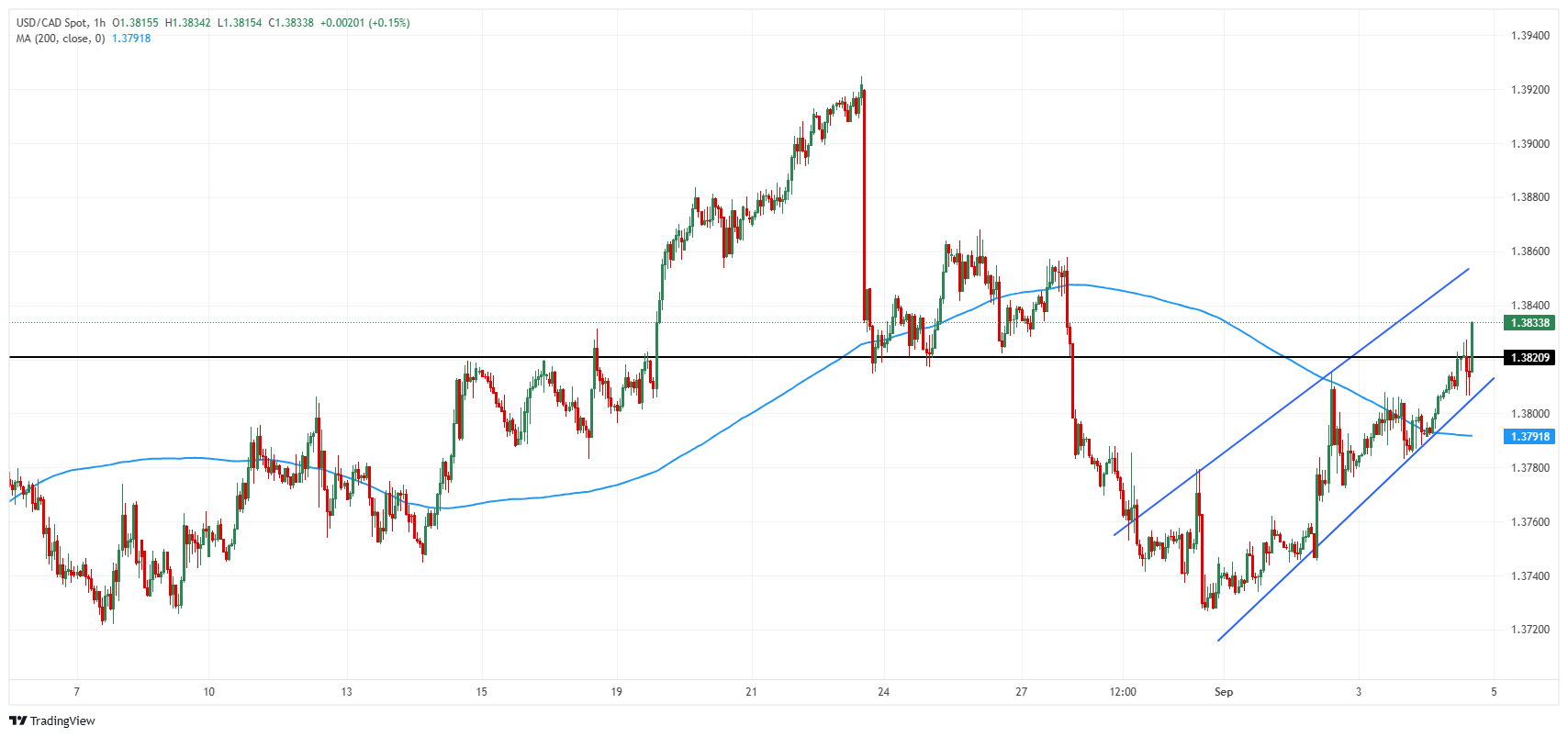
USD/CAD 1-hour chart. Source: FXStreet
The direction and scale of the next move on USD/CAD will depend heavily on the outcome of the NFP US employment report and the release of Canadian employment data, simultaneously on Friday at 12:30 GMT.
Canadian Dollar Price Today
The table below shows the percentage change of Canadian Dollar (CAD) against listed major currencies today. Canadian Dollar was the strongest against the New Zealand Dollar.
| USD | EUR | GBP | JPY | CAD | AUD | NZD | CHF | |
|---|---|---|---|---|---|---|---|---|
| USD | 0.22% | 0.10% | 0.46% | 0.35% | 0.53% | 0.61% | 0.35% | |
| EUR | -0.22% | -0.11% | 0.21% | 0.12% | 0.35% | 0.37% | 0.08% | |
| GBP | -0.10% | 0.11% | 0.40% | 0.23% | 0.46% | 0.50% | 0.18% | |
| JPY | -0.46% | -0.21% | -0.40% | -0.10% | 0.01% | 0.20% | -0.09% | |
| CAD | -0.35% | -0.12% | -0.23% | 0.10% | 0.15% | 0.26% | -0.05% | |
| AUD | -0.53% | -0.35% | -0.46% | -0.01% | -0.15% | 0.03% | -0.27% | |
| NZD | -0.61% | -0.37% | -0.50% | -0.20% | -0.26% | -0.03% | -0.26% | |
| CHF | -0.35% | -0.08% | -0.18% | 0.09% | 0.05% | 0.27% | 0.26% |
The heat map shows percentage changes of major currencies against each other. The base currency is picked from the left column, while the quote currency is picked from the top row. For example, if you pick the Canadian Dollar from the left column and move along the horizontal line to the US Dollar, the percentage change displayed in the box will represent CAD (base)/USD (quote).
Canadian job market under scrutiny
Canadian labor market data released by Statistics Canada will be the highlight of the week for the Canadian Dollar. The Net Change in Employment is expected to rise by 7,500 jobs in August, following a heavy loss of 40,800 jobs in July. The Unemployment Rate is expected to rise slightly, to 7% from 6.9% previously.
These figures are crucial, as employment trends directly influence domestic consumption, inflation and, in turn, the decisions of the Bank of Canada (BoC).
A better-than-expected report tends to support the CAD, while disappointment feeds its weakness.
As the Royal Bank of Canada (RBC) points out in a note published this week, "we don't expect the weakness in the Canadian labor market to have run its full course", and the bank expects employment to be virtually stable (+5,000), with unemployment rising slightly.
The role of Oil and trade tensions
The Canadian Dollar is also penalized by Oil prices, to which it is historically correlated. The announcement of a possible production increase by OPEC+ this weekend is putting further pressure on crude and, therefore, on the CAD.
In addition, trade tensions with the United States remain in the background. As RBC pointed out, around 10% of Canadian exports are still subject to tariffs, particularly in metals, which continues to weigh on certain segments of the manufacturing industry.
A double expectation: Fed and BoC
Finally, the CAD's trajectory will also depend on the North American monetary context. Markets are anticipating a probable rate cut by the US Federal Reserve (Fed) in September, on the back of weakening US data.
For the Bank of Canada, the question remains open. A resilient labor market would limit the scope for easing, while a further deterioration would increase the pressure to act.
In the meantime, the USD/CAD pair remains dominated by the greenback, in a climate of wait-and-see. Friday's employment figures should provide investors with a clearer direction and help them forecast whether the CAD is ready to rebound or sink further.
Information on these pages contains forward-looking statements that involve risks and uncertainties. Markets and instruments profiled on this page are for informational purposes only and should not in any way come across as a recommendation to buy or sell in these assets. You should do your own thorough research before making any investment decisions. FXStreet does not in any way guarantee that this information is free from mistakes, errors, or material misstatements. It also does not guarantee that this information is of a timely nature. Investing in Open Markets involves a great deal of risk, including the loss of all or a portion of your investment, as well as emotional distress. All risks, losses and costs associated with investing, including total loss of principal, are your responsibility. The views and opinions expressed in this article are those of the authors and do not necessarily reflect the official policy or position of FXStreet nor its advertisers. The author will not be held responsible for information that is found at the end of links posted on this page.
If not otherwise explicitly mentioned in the body of the article, at the time of writing, the author has no position in any stock mentioned in this article and no business relationship with any company mentioned. The author has not received compensation for writing this article, other than from FXStreet.
FXStreet and the author do not provide personalized recommendations. The author makes no representations as to the accuracy, completeness, or suitability of this information. FXStreet and the author will not be liable for any errors, omissions or any losses, injuries or damages arising from this information and its display or use. Errors and omissions excepted.
The author and FXStreet are not registered investment advisors and nothing in this article is intended to be investment advice.
Recommended content
Editors’ Picks

EUR/USD: US Dollar in trouble as Warsh chickens out
The EUR/USD pair closes July with modest gains near the 1.1500 mark, adding over 1.1% in the last trading week. Price action throughout the month was dull to say the least as investors remained clueless, although the pair managed to hit 1.1530 ahead of the close.

Gold: Bull hesitancy persists despite weaker US Dollar
Gold (XAU/USD) struggled to make a decisive move in either direction as the persistent US Dollar (USD) weakness was offset by a widening conflict in the Middle East. July employment data from the United States (US) could trigger a big reaction in Gold, while the near-term technical outlook highlights a lack of buyer interest.

Japanese Yen mid-year outlook: Why BoJ rate hikes aren't saving the Yen — and what actually would
The Japanese Yen (JPY) has experienced a pronounced downtrend since the beginning of 2026, hitting a series of multi-decade lows versus the US Dollar (USD) heading into the second half of the year.

Bitcoin: Bulls hold the line
Bitcoin (BTC) edges slightly lower, trading at $64,300 at the time of writing on Friday but holding firmly above a key support zone. US-listed spot Bitcoin Exchange Traded Funds (ETFs) support BTC as they continued to attract institutional flows through Thursday, pointing to the fourth consecutive week of net inflows.

US Dollar: Geopolitics, inflation and the Fed shape the outlook
The US Dollar (USD) has traded mostly lower throughout the week, briefly testing six-week lows despite prevailing risk aversion, which has been driven by unabated geopolitical tensions in the Middle East. That said, the US Dollar Index (DXY) dipped to the 99.90 zone for the first time since mid-June, just to recover some ground afterward toward the end of the North American session.

WTI holds losses around $82.50 on renewed US-Iran diplomatic hopes
West Texas Intermediate oil price remains in the negative territory for the second successive day, trading around $82.60 per barrel during the Asian hours on Friday. Crude oil prices have lost ground following renewed hopes for a diplomatic solution to the US-Iran conflict.