 Sam Seiden
Independent Analyst
Where price will turn next is everybody’s question and focus and that’s not a bad thing. The challenge and opportunity I am raising in this article is about the question I hardly ever hear, Where will price go? This is one of, if not the most important things to consider when putting your hard-earned money at risk in markets. Let’s look at a recent trade I setup in our live trading room for our members to illustrate the importance of the second question.
Where will price go we will call the Profit Zone. The profit zone is the distance in price between the entry point and the profit target price. Another way to say that is the distance between demand and supply. When looking for trading opportunities, people tend to focus on where the next big turn in price will happen.
As I often write about, these turns happen at price levels where supply and demand are out of balance. When looking at charts, you will find that there are many supply and demand levels. By no means are we interested in taking trading opportunities at all the levels we find. We only want to focus on big supply and demand imbalances, where banks and financial institutions are buying and selling. Our odds enhancers help us find these quality levels. When considering profit zone, we would ignore most of the supply and demand levels we find and narrow our focus down to the supply and demand levels that have large profit zones associated with them.
Sam Seiden – Live Trading Room: Gold Trade: 6/18/18
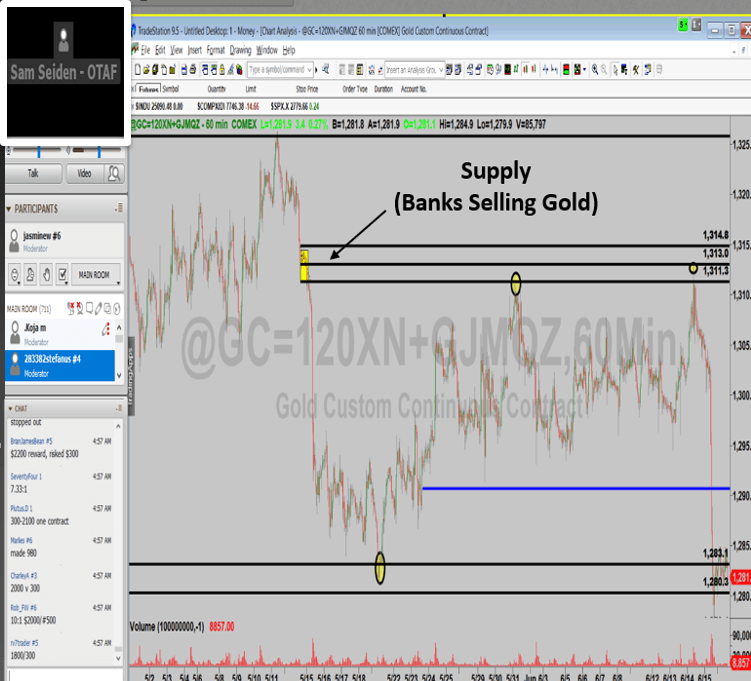
To explain the concept of profit zone and its importance in trading, let’s take a look at the trade above from the other day, a shorting opportunity in Gold. Notice the supply level above. This is where we expected there to be more supply than demand, where banks were heavy sellers of Gold. The distance between the supply zone and the demand zone below is the profit zone. The blue line was the profit target.
Notice the price action between the supply zone and the blue line. That price action represents filled orders, meaning that price will have a very easy time moving through that level once we enter our position. In other words, there are no fresh demand zones to stop price from moving through that area. The trading opportunity was to sell short at the supply level above (circle at supply) and profit from a move down through that area below the supply zone to the blue line.
The key element here is to identify where the demand and supply is, and where it isn’t. Then look at current price and determine the path of least resistance as that is where the next move in price is likely to go. Keep in mind a VERY important point here: I am coming to all these conclusions BEFORE I enter the trade. You must perform your analysis in advance and make your decisions before it’s time to push the button or this will never work. Remember, when you are able to identify where supply and demand is, you are also able to identify where it is not and that is the key to the profit zone, which is the key to properly assessing the complete opportunity.
As I mentioned earlier, there are many supply and demand levels on a chart and many large and small profit zones. The key for the astute trader is to be able to identify objective supply and demand levels. Then and only then will you be able to find supply and demand levels that have huge profit zones associated with them.
What I do is ignore most supply and demand levels on a chart and only focus on the ones that have a great distance between them. This does two things. First, it obviously offers an attractive risk /reward opportunity. Second and just as important, the larger the profit zone, the greater the probability of the trade working out. This is because when you have a big profit zone, by definition your supply and demand levels are far out on the supply and demand curve. Entering your trades at market price extremes increases the probability of success.
Note: All information on this page is subject to change. The use of this website constitutes acceptance of our user agreement. Please read our privacy policy and legal disclaimer. Opinions expressed at FXstreet.com are those of the individual authors and do not necessarily represent the opinion of FXstreet.com or its management. Risk Disclosure: Trading foreign exchange on margin carries a high level of risk, and may not be suitable for all investors. The high degree of leverage can work against you as well as for you. Before deciding to invest in foreign exchange you should carefully consider your investment objectives, level of experience, and risk appetite. The possibility exists that you could sustain a loss of some or all of your initial investment and therefore you should not invest money that you cannot afford to lose. You should be aware of all the risks associated with foreign exchange trading, and seek advice from an independent financial advisor if you have any doubts.
Editors’ Picks

EUR/USD: US Dollar to remain pressured until uncertainty fog dissipates
Unimpressive European Central Bank left monetary policy unchanged for the fifth consecutive meeting. The United States first-tier employment and inflation data is scheduled for the second week of February. EUR/USD battles to remain afloat above 1.1800, sellers moving to the sidelines.

GBP/USD reclaims 1.3600 and above
GBP/USD reverses two straight days of losses, surpassing the key 1.3600 yardstick on Friday. Cable’s rebound comes as the Greenback slips away from two-week highs in response to some profit-taking mood and speculation of Fed rate cuts. In addition, hawkish comments from the BoE’s Pill are also collaborating with the quid’s improvement.

USD/JPY gathers strength to near 157.50 as Takaichi’s party wins snap elections
The USD/JPY pair attracts some buyers to around 157.45 during the early Asian session on Monday. The Japanese Yen weakens against the US Dollar after Japan’s ruling Liberal Democratic Party won an outright majority in Sunday’s lower house election, opening the door to more fiscal stimulus by Prime Minister Sanae Takaichi.
Editors’ Picks
USD/JPY gathers strength to near 157.50 as Takaichi’s party wins snap elections
The USD/JPY pair attracts some buyers to around 157.45 during the early Asian session on Monday. The Japanese Yen weakens against the US Dollar after Japan’s ruling Liberal Democratic Party won an outright majority in Sunday’s lower house election, opening the door to more fiscal stimulus by Prime Minister Sanae Takaichi.
EUR/USD: US Dollar to remain pressured until uncertainty fog dissipates
Unimpressive European Central Bank left monetary policy unchanged for the fifth consecutive meeting. The United States first-tier employment and inflation data is scheduled for the second week of February. EUR/USD battles to remain afloat above 1.1800, sellers moving to the sidelines.

Gold: Volatility persists in commodity space
After losing more than 8% to end the previous week, Gold remained under heavy selling pressure on Monday and dropped toward $4,400. Although XAU/USD staged a decisive rebound afterward, it failed to stabilize above $5,000. The US economic calendar will feature Nonfarm Payrolls and Consumer Price Index data for January, which could influence the market pricing of the Federal Reserve’s policy outlook and impact Gold’s performance.

Week ahead: US NFP and CPI data to shake Fed cut bets, Japan election looms
US NFP and CPI data awaited after Warsh’s nomination as Fed chief. Yen traders lock gaze on Sunday’s snap election. UK and Eurozone Q4 GDP data also on the agenda. China CPI and PPI could reveal more weakness in domestic demand.
Three scenarios for Japanese Yen ahead of snap election Premium
The latest polls point to a dominant win for the ruling bloc at the upcoming Japanese snap election. The larger Sanae Takaichi’s mandate, the more investors fear faster implementation of tax cuts and spending plans.
RECOMMENDED LESSONS
Making money in forex is easy if you know how the bankers trade!

I’m often mystified in my educational forex articles why so many traders struggle to make consistent money out of forex trading. The answer has more to do with what they don’t know than what they do know. After working in investment banks for 20 years many of which were as a Chief trader its second knowledge how to extract cash out of the market.
5 Forex News Events You Need To Know

In the fast moving world of currency markets where huge moves can seemingly come from nowhere, it is extremely important for new traders to learn about the various economic indicators and forex news events and releases that shape the markets. Indeed, quickly getting a handle on which data to look out for, what it means, and how to trade it can see new traders quickly become far more profitable and sets up the road to long term success.
Top 10 Chart Patterns Every Trader Should Know

Chart patterns are one of the most effective trading tools for a trader. They are pure price-action, and form on the basis of underlying buying and selling pressure. Chart patterns have a proven track-record, and traders use them to identify continuation or reversal signals, to open positions and identify price targets.
7 Ways to Avoid Forex Scams

The forex industry is recently seeing more and more scams. Here are 7 ways to avoid losing your money in such scams: Forex scams are becoming frequent. Michael Greenberg reports on luxurious expenses, including a submarine bought from the money taken from forex traders. Here’s another report of a forex fraud. So, how can we avoid falling in such forex scams?
What Are the 10 Fatal Mistakes Traders Make
Trading is exciting. Trading is hard. Trading is extremely hard. Some say that it takes more than 10,000 hours to master. Others believe that trading is the way to quick riches. They might be both wrong. What is important to know that no matter how experienced you are, mistakes will be part of the trading process.
The challenge: Timing the market and trader psychology

Successful trading often comes down to timing – entering and exiting trades at the right moments. Yet timing the market is notoriously difficult, largely because human psychology can derail even the best plans. Two powerful emotions in particular – fear and greed – tend to drive trading decisions off course.