What Would Make You Impossibly Good At Trading?

Two scenarios to choose from if you want to become good at trading and anything else
1) Scenario 1
- Keep your head down
- Follow instructions
- Obey your boss
- Suck it up
2) Scenario 2
- Be persistent
- Follow your dream
- Be generous
- Be remarkable
Which scenario will you go after?
Is scenario 1 more appealing to you because you are used to follow the well-known track?
Doesn’t scenario 2 make more sense if you want to improve your results as a trader?
I believe that one should follow his/her own feeling about what is right or wrong. Why are there so many traders that fail in trading?
I believe that a big role of that plays their predisposition to Scenario 1. In other words, they don’t feel safe outside their comfort zone.
Imagine you were going to be replaced in your job by someone else in one week
Supply and Demand Zones
Would you have done the same amount of work?
Would you have stayed a bit later at night and gone this extra mile?
If you had the mental image of being replaceable, would you be so relaxed about your final results?
Most people in “secure” jobs believe that this is the only way ahead of them. They don’t plan for the “ifs” scenarios; they don’t consider the fact that they are just an easily replaceable number for their employer.
How much better you could be if this was the only way you were thinking:
What should I learn/do/improve if I was going to be replaced next year. Do I like what I am doing or I would better master a new skill and move on myself.
Whether you are working in a regular 9 to 5 job or are a day trader, it does not matter- the principle stays the same!
What would you have done yourself?
Would you dare improve?
Will mediocre results be still good enough for you
Shortcuts?
and then more
#shortcuts
#shortcuts
#shortcuts
You make all the choices, so in the end the one to blame is not the market or the bad weather, but YOU and only YOU!
You should not settle for average!
You should not be happy with just a “decent” profit.
You should be thinking, what if I could have made that much more money and I could donate half to a charity of my choice.
How much better would and could you become then?
Why do traders settle for just mediocre results? Trading is not much different than other professions in that aspect.
If you were in employment and your boss was offering you an appealing reward you could go the extra mile and try to improve and work harder.
Can’t you be your own employer offering yourself an imaginary reward? How much harder would you work for it then?
Learn a skill that will make you irreplaceable
Have you ever asked yourself the question why they never teach you at school how to:
- Lead
- Solve interesting problems
Why don’t you start by exploring new fields and new roads?
Sometimes, when you are too involved in trading you tend to forget that there is another parallel universe that exists out there, too.
It is great if you have a winning trading strategy, but boredom is a bad distractor.
Why don’t you improve your other skills and learn programming or improve your physical strength?
Anything outside of trading that could actually help you to become a better trader is welcome!
Never stop learning, even if that is nothing to do with trading. In this way, you will improve your cognitive powers, which in turn means better trading results and less overtrading.
Not necessarily a trading system
What can make you a better trader is not necessarily a better trading system.
A better version of yourself will certainly improve your trading results.
Work on your weak links.
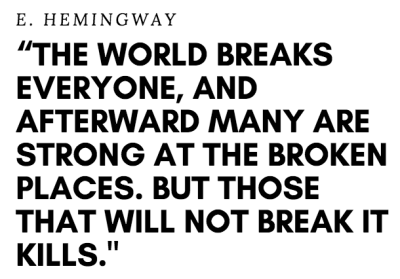
As Hemingway wrote in his great masterpiece Farewell to Arms:
“The world breaks everyone, and afterward many are strong at the broken places. But those that will not break it kills.
Becoming insanely good at trading requires much more flexibility than they teach us in school.
Good traders are good people more than anything else!
Learn how to be good to others and you will receive so much more in return…
Giving back… and then some more
It took me a while to appreciate the benefits of giving back.
If you want to become good at trading, you should give yourselves hard targets.
If you want to improve at trading, these targets should be bigger with each following year.
Don’t forget to be realistic, too!
Bigger targets does not mean unrealistic targets. Bigger targets equal more work and much more persistence.
Money should not be your sole motivation. Helping others, who can help others would give you immensely higher rate of satisfaction.
It takes practice and years, but it always starts with a very small first step.
If it is too late now, do it tomorrow. Promise yourselves to give back anything (no matter how small) to someone in need.
Trading should be perceived as a lonely job, but there is so much more about it and around it than just making money.
Being good to others is just a way to express your thankfulness for a good trading day. It is also a great way to stay humble and stay out of trading trouble.
Be grateful
ALWAYS be grateful!
I have only recently discovered the power of giving back and it really is life-changing.
Being thankful for where you are and who you are is probably one of the factors that will make you impossibly good at trading.
Never forget where you started from.
Always enjoy the small things in life.
Money should not be a goal, just a means of improving your life and the lives of the people around you/people in need.
The best traders I have known have also been the humblest ones.
Help others as you were helped once when you were just starting out.
Find someone who needs your support and become their mentor.
It is only through mentorship that we truly realise who we really are and where our weak links are, so we can work on them and become impossibly good at trading.
Always be humble!
Author

Colibri Trader
Colibri Trader
Colibri Trader, as he is known in the circles, is based in London, UK. He Started his career in one of the leading prop trading houses at the time and then has moved out to form his own company- Colibri Trader Limited.