 Markus Heitkoetter
Rockwell Trading
So let’s talk about “What Type of trader are you?”
This is a follow up to my previous article, “The Traders Journey.”
So here’s what I’m seeing. There are 2 extreme types of traders.
The Type of Trader Who Wants to Know Everything
1.) This type of trader can’t get enough information. They’re like a ‘knowledge vacuum’:
This type of trader thinks that by knowing EVERYTHING they can, this will inevitably lead to them making money in the markets.
So he keeps reading books, watching YouTube videos, attends webinars…knowledge, knowledge, knowledge.
… and he hasn’t placed a single trade yet.
So think about it this way:
Let’s say there’s somebody who wants to run a marathon. So he starts reading books about it and watches videos.
He knows all about pacing, how he should train and what he needs to eat. He know the best shoes for running a marathon, and the best clothing…
…. but he hasn’t run a single mile yet.
Now onto…
The Type of Trader Who Doesn’t Know Anything
Now here’s the other extreme.
The other extreme is the “trader” who doesn’t know anything, but they got a “hot stock tip from somebody.”
This trader buys a stock and doesn’t know anything.
Here’s an example:
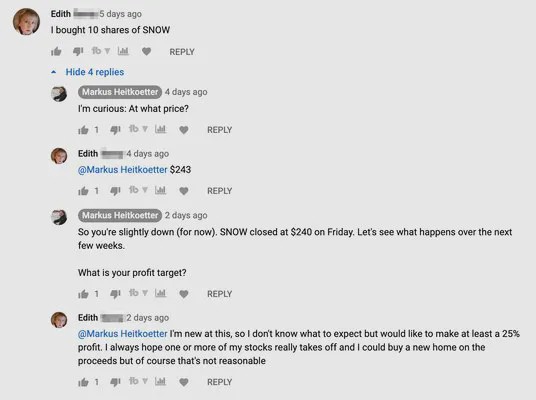
Edith has heard about SNOW, the biggest IPO of the year. It’s also the most hyped up IPO in a LONG time.
I wrote another article on this: “Should I Invest In Snowflake?”
It was originally priced at $85, then they raised the price to $110, and when it started trading, it jumped to $320!
So Edith bought some shares for $243.
And I asked her about the her profit target, and here’s her answer:
“I don’t know what to expect. I hope that one of my stocks really takes off and I could buy a new home.”
Wait…. What??? You bought 10 shares for $243, so that $2,430.
I don’t know what houses cost in your area, but let’s make it easy and say it’s $250,000.
So your shares would have to rise from $243 to $25,000 to make that happen!
And in the markets, obviously anything can happen…but do I see that happening. Well, not in my lifetime ;-)
Which type of trader is right?
Of these two different types of extreme traders, the question still remains:
What’s right? Which of these 2 approaches should you use?
The “I want to know it all” approach or the “Let’s buy some stocks and see what happens” approach?
I hope you’ve by now realized that it’s neither.
That’s why I released “The Traders Journey.” You should really check it out.
Here’s the right approach in a nutshell:
-
Find a strategy that makes sense to you (risk, time required, win %,). Examples: The PowerX Strategy, The Wheel. I made a video in which I compare these 2 strategies according to 5 criteria. It’s called “The Best Trading Strategy 2020“
-
Learn the rules of the strategy
-
Place at least 40 trades on a simulator.
-
What are the results?
-
If it’s good, start trading it. If it’s bad, what can you do to improve?
Now one more thing:
When it comes to trading, YOU WILL HAVE LOSSES. No matter what they say, you will have winning trades, and you will have losing trades.
There are no guarantees that you will make money as a trader.
They key is to keep your losses small.
Summary
Now again, there’s 2 types of traders here:
1.) That’s the trader with a $10,000 account who sees a loss of $100. That’s 1% of his account. But he’s freaking out:
2.) Then there’s the other type of trader who buys a stock, and it moves against him. But he doesn’t take action. He doesn’t control his loss.
Here’s an example:
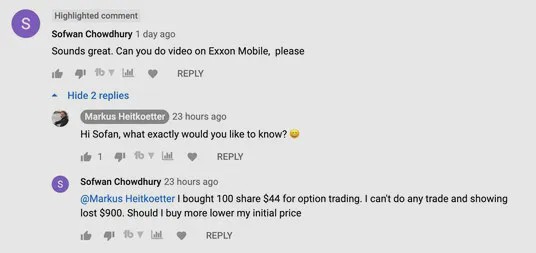
This trader invested $4,400 and is now down $900. That’s 20% of the account!
THIS is what kills traders. THIS is what destroys accounts, NOT controlling your losses.
It’s like “hoping for the best” and believing that “everything will be fine” like this guy:
Do yourself a favor right now:
Read my last article, “The Traders Journey” and follow the steps that I’m outlining in that article.
Then do the 5 steps I mentioned above:
-
Find a strategy that makes sense to you. Examples: The PowerX Strategy, The Wheel
-
Learn the rules of the strategy
-
Place at least 40 trades on a simulator.
-
What are the results?
-
If it’s good, start trading it. If it’s bad, what can you do to improve?
Trading Futures, options on futures and retail off-exchange foreign currency transactions involves substantial risk of loss and is not suitable for all investors. You should carefully consider whether trading is suitable for you in light of your circumstances, knowledge, and financial resources. You may lose all or more of your initial investment. The lower the day trade margin, the higher the leverage and riskier the trade. Leverage can work for you as well as against you; it magnifies gains as well as losses. Past performance is not necessarily indicative of future results.
Editors’ Picks

EUR/USD holds steady above 1.1850 in quiet session
EUR/USD stays defensive but holds 1.1850 amid quiet markets in the European hours on Monday. The US Dollar is struggling for direction due to thin liquidity conditions as US markets are closed in observance of Presidents' Day holiday.

GBP/USD flat lines near 1.3650 ahead of UK and US data
GBP/USD kicks off a new week on a subdued note and oscillates in a narrow range near 1.3650 on Monday. The mixed fundamental backdrop warrants some caution for aggressive traders as the market focus now shifts to this week's important data releases from the UK and the US.

USD/JPY advances on weak Japanese GDP, holiday-thinned trading
USD/JPY rises while US and Japanese markets remain closed for holidays. Weak Japanese Gross Domestic Product figures curb tightening expectations. Investors await speeches from Federal Reserve Vice Chair for Supervision.
Editors’ Picks
EUR/USD holds steady above 1.1850 in quiet session
EUR/USD stays defensive but holds 1.1850 amid quiet markets in the European hours on Monday. The US Dollar is struggling for direction due to thin liquidity conditions as US markets are closed in observance of Presidents' Day holiday.
GBP/USD flat lines near 1.3650 ahead of UK and US data
GBP/USD kicks off a new week on a subdued note and oscillates in a narrow range near 1.3650 on Monday. The mixed fundamental backdrop warrants some caution for aggressive traders as the market focus now shifts to this week's important data releases from the UK and the US.

Gold sticks to intraday losses; lacks follow-through
Gold remains depressed through the early European session on Monday, though it has managed to rebound from the daily trough and currently trades around the $5,000 psychological mark. Moreover, a combination of supporting factors warrants some caution for aggressive bearish traders, and before positioning for deeper losses.

Bitcoin consolidates as on-chain data show mixed signals
Bitcoin price has consolidated between $65,700 and $72,000 over the past nine days, with no clear directional bias. US-listed spot ETFs recorded a $359.91 million weekly outflow, marking the fourth consecutive week of withdrawals.
The week ahead: Key inflation readings and why the AI trade could be overdone
It is likely to be a quiet start to the week, with US markets closed on Monday for Presidents Day. European markets are higher across the board and gold is clinging to the $5,000 level after the tamer than expected CPI report in the US reduced haven flows to precious metals.
RECOMMENDED LESSONS
Making money in forex is easy if you know how the bankers trade!

I’m often mystified in my educational forex articles why so many traders struggle to make consistent money out of forex trading. The answer has more to do with what they don’t know than what they do know. After working in investment banks for 20 years many of which were as a Chief trader its second knowledge how to extract cash out of the market.
5 Forex News Events You Need To Know

In the fast moving world of currency markets where huge moves can seemingly come from nowhere, it is extremely important for new traders to learn about the various economic indicators and forex news events and releases that shape the markets. Indeed, quickly getting a handle on which data to look out for, what it means, and how to trade it can see new traders quickly become far more profitable and sets up the road to long term success.
Top 10 Chart Patterns Every Trader Should Know

Chart patterns are one of the most effective trading tools for a trader. They are pure price-action, and form on the basis of underlying buying and selling pressure. Chart patterns have a proven track-record, and traders use them to identify continuation or reversal signals, to open positions and identify price targets.
7 Ways to Avoid Forex Scams

The forex industry is recently seeing more and more scams. Here are 7 ways to avoid losing your money in such scams: Forex scams are becoming frequent. Michael Greenberg reports on luxurious expenses, including a submarine bought from the money taken from forex traders. Here’s another report of a forex fraud. So, how can we avoid falling in such forex scams?
What Are the 10 Fatal Mistakes Traders Make
Trading is exciting. Trading is hard. Trading is extremely hard. Some say that it takes more than 10,000 hours to master. Others believe that trading is the way to quick riches. They might be both wrong. What is important to know that no matter how experienced you are, mistakes will be part of the trading process.
The challenge: Timing the market and trader psychology

Successful trading often comes down to timing – entering and exiting trades at the right moments. Yet timing the market is notoriously difficult, largely because human psychology can derail even the best plans. Two powerful emotions in particular – fear and greed – tend to drive trading decisions off course.