When looking at the markets, many traders look at lagging indicators for a signal that the market is changing in direction or to confirm that the main thrust of the market will persist. These conventional indicators quickly lose their edge as the institutions (mainly through algorithms) identify these common patterns and take action to move the market to nullify, or take the other side, of these trades causing those traders to lose.

In order for a trader to maintain profitability, she must have an edge. In the futures market, this becomes even more critical as leverage and the fact that trading futures is a net zero sum game makes it very challenging to maintain an edge if a trader is using the same strategies as everyone else.


Dynamics of the Market

To make this concept simple, let’s think about two immutable laws of market dynamics.


Buy and Sell Transactions

First, in any buying and selling transaction, there have to be two parties in order for it to materialize. A buyer will buy based on a perception of value, but will need to find a seller that has the opposite view of the exact same item or financial instrument. This could be for a futures contract, a stock or even a house for that matter.


Supply and Demand

The next factor is the concept of supply (large amounts of unfilled sell orders) and demand (large amounts of unfilled buy orders). When sellers are largely depleted, demand will take over and change the trajectory of the market. This works exactly the same on the buy side of this  equation.

Another way to look at this concept is through the law of inertia. Inertia is the tendency of an object to stay in motion, which in the markets is referred to as a trend or momentum. Yes, trends tend to persist, just like objects in motion. However, the momentum will slow and reverse when it is met with an unbalanced force, or as Galileo discovered, it was friction that caused objects to change direction. In the markets, the reason markets turn is because of the shift in the Supply and demand equation.

Put another way, an uptrend will persist until all the buy orders are filled and an overwhelming amount of unfilled sell orders are found. It is impossible for the market to move higher unless all the sell orders can be matched.

Understanding this concept helps traders understand where to buy or sell, but also, and more importantly, helps traders identify how far the market can travel in the opposite direction so they can realize gains.

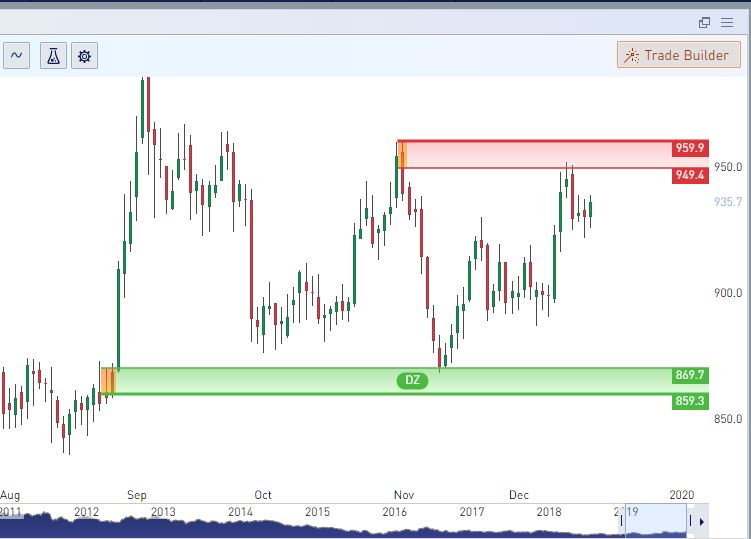
In one of my recent spotlight sessions we identified a daily demand zone (unfilled buy orders) in the Platinum futures market.

In the picture below, we see that price fell sharply into that demand zone creating a big distance between the entry and the new supply. Inertia is now in play here. If the unfilled buy orders (demand zone) will turn prices higher, how high will they go? They will continue higher until they meet a large amount of  fresh sell orders, would be the correct answer.
Lessons from the Pros - Futures

As we can see, this particular trade worked because the Platinum rallied off the demand and traveled back up to the supply before turning down. In fact, it turned down at a lower supply area, created new demand and kept moving higher before meeting more sellers.

Not all trades will work, as we all know. That’s because, unlike physics, the markets aren’t an exact science. The point here is that if we apply science versus emotion we can increase the probabilities of success. And yes, we can start anticipating market turns before they happen with a high degree of accuracy using simple laws of physics.

Please don’t misinterpret this as an indication that trading is easy. It’s actually quite challenging if you don’t have the right rules and the self-control to follow them, but it does help to keep it as simple as following the basic laws of inertia using supply and demand.

Until next time, I hope everyone has a great Holiday Season.


This content is intended to provide educational information only. This information should not be construed as individual or customized legal, tax, financial or investment services. As each individual's situation is unique, a qualified professional should be consulted before making legal, tax, financial and investment decisions. The educational information provided in this article does not comprise any course or a part of any course that may be used as an educational credit for any certification purpose and will not prepare any User to be accredited for any licenses in any industry and will not prepare any User to get a job. Reproduced by permission from OTAcademy.com click here for Terms of Use: https://www.otacademy.com/about/terms

Editors’ Picks

EUR/USD faces next resistance near 1.1930

EUR/USD faces next resistance near 1.1930

EUR/USD continues to build on its recovery in the latter part of Wednesday’s session, with upside momentum accelerating as the pair retargets the key 1.1900 barrier amid a further loss of traction in the US Dollar. Attention now shifts squarely to the US data docket, with labour market figures and the always influential CPI releases due on Thursday and Friday, respectively.

GBP/USD sticks to the bullish tone near 1.3660

GBP/USD sticks to the bullish tone near 1.3660

GBP/USD maintains its solid performance on Wednesday, hovering around the 1.3660 zone as the Greenback surrenders its post-NFP bounce. Cable, in the meantime, should now shift its attention to key UK data due on Thursday, including preliminary GDP gauges.

USD/JPY declines as Yen strengthens after election win, overshadowing US jobs data

USD/JPY declines as Yen strengthens after election win, overshadowing US jobs data

The US Dollar rose briefly after stronger-than-expected job creation but gave back gains against a firm Japanese Yen. The Unemployment Rate falls to 4.3% and wages accelerate, reinforcing expectations of a prolonged Fed pause. Sanae Takaichi’s election victory fuels demand for the Japanese Yen, pushing USD/JPY down for the day.


Editors’ Picks

AUD/USD now targets the 0.7150 zone

AUD/USD now targets the 0.7150 zone

AUD/USD has rapidly left behind Tuesday’s pullback, advancing sharply to three-year highs past the 0.7100 barrier on Wednesday. The pair’s strong performance follows investors’ assessment of the RBA’s hawkish message and the likelihood of further tightening down the road.

EUR/USD faces next resistance near 1.1930

EUR/USD faces next resistance near 1.1930

EUR/USD continues to build on its recovery in the latter part of Wednesday’s session, with upside momentum accelerating as the pair retargets the key 1.1900 barrier amid a further loss of traction in the US Dollar. Attention now shifts squarely to the US data docket, with labour market figures and the always influential CPI releases due on Thursday and Friday, respectively.

Gold holds on to higher ground ahead of the next catalyst

Gold holds on to higher ground ahead of the next catalyst

Gold keeps the bid tone well in place on Wednesday, retargeting the $5,100 zone per troy ounce on the back of modest losses in the US Dollar and despite firm US Treasury yields across the curve. Moving forward, the yellow metal’s next test will come from the release of US CPI figures on Friday.

UNI faces resistance at 20-day EMA following BlackRock's purchase and launch of BUIDL fund on Uniswap

UNI faces resistance at 20-day EMA following BlackRock's purchase and launch of BUIDL fund on Uniswap

Decentralized exchange Uniswap (UNI) announced on Wednesday that it has integrated asset manager BlackRock's tokenized Treasury product on its trading platform via a partnership with tokenization firm Securitize.

US jobs data surprises to the upside, boosts stocks but pushes back Fed rate cut expectations

US jobs data surprises to the upside, boosts stocks but pushes back Fed rate cut expectations

This was an unusual payrolls report for two reasons. Firstly, because it was released on  Wednesday, and secondly, because it included the 2025 revisions alongside the January NFP figure.

RECOMMENDED LESSONS

5 Forex News Events You Need To Know

In the fast moving world of currency markets where huge moves can seemingly come from nowhere, it is extremely important for new traders to learn about the various economic indicators and forex news events and releases that shape the markets. Indeed, quickly getting a handle on which data to look out for, what it means, and how to trade it can see new traders quickly become far more profitable and sets up the road to long term success.

Top 10 Chart Patterns Every Trader Should Know

Chart patterns are one of the most effective trading tools for a trader. They are pure price-action, and form on the basis of underlying buying and selling pressure. Chart patterns have a proven track-record, and traders use them to identify continuation or reversal signals, to open positions and identify price targets.

7 Ways to Avoid Forex Scams

The forex industry is recently seeing more and more scams. Here are 7 ways to avoid losing your money in such scams: Forex scams are becoming frequent. Michael Greenberg reports on luxurious expenses, including a submarine bought from the money taken from forex traders. Here’s another report of a forex fraud. So, how can we avoid falling in such forex scams?

What Are the 10 Fatal Mistakes Traders Make

Trading is exciting. Trading is hard. Trading is extremely hard. Some say that it takes more than 10,000 hours to master. Others believe that trading is the way to quick riches. They might be both wrong. What is important to know that no matter how experienced you are, mistakes will be part of the trading process.

Strategy

Money Management

Psychology

Best Brokers of 2025