Gold Weekly Forecast: Buyers look to retain control as focus shifts to key US data
- Gold registers weekly gains, supported by geopolitics and falling US yields.
- The technical outlook points to a bullish bias, but lacks momentum.
- Investors will focus on geopolitics and key US data releases.

Gold (XAU/USD) gained traction and climbed above $5,200, ending the fourth consecutive week in positive territory. The next round of US-Iran talks and crucial macroeconomic data releases from the US will be watched closely by market participants in the short term.
Gold benefits from retreating US yields
Gold opened with a bullish gap and registered daily gains on Monday as investors reacted to United States (US) President Donald Trump’s response to the Supreme Court’s ruling against his administration's tariffs on Friday. Trump vowed that they will impose even bigger levies using alternative legal frameworks, specifically citing national security conventions under Section 301 of the Trade Act of 1974. Over the weekend, the US president said that he will raise global tariffs to 15% from 10% "effective immediately" and warned that additional ones would follow.
After extending its rally to a fresh February-high above $5,200 in the early trading hours of the Asian session on Tuesday, Gold reversed its direction and closed the day in the red as the negative impact of the US trade policy uncertainty on risk mood faded away.
While delivering his State of the Union speech in the early trading hours of the Asian session on Wednesday, Trump noted that there is no inflation and said he sees "tremendous growth," pointing to tariffs as one of the main reasons behind the economic turnaround. Trump further added that almost all trading partners want to keep the trade deals they already made, despite the Supreme Court's ruling. As Wall Street’s main indexes shot higher midweek, the US Dollar (USD) struggled to find demand and allowed XAU/USD to register daily gains.
Gold struggled to make a decisive move in either direction on Thursday. In the absence of high-impact economic data releases, retreating US Treasury bond yields helped XAU/USD hold its ground. The benchmark 10-year US bond yield declined below 4% for the first time since late November. On the flip side, the precious metal’s upside remained capped early Friday as geopolitical tensions eased after news outlets reported that the US and Iran made significant progress during Thursday’s nuclear talks in Geneva.
In the second half of the day on Friday, however, re-escalating geopolitical tensions helped Gold climb above $5,200. Citing an email from the US Ambassador to Israel, Mike Huckabee, NBC News reported that the diplomat has advised nonessential staff members to leave the country immediately. “He also urged anyone intending to leave to go ahead and book flights, citing the likely surge in demand out of Israel after the embassy's move,” the outlet wrote.
Gold traders will scrutinize US data
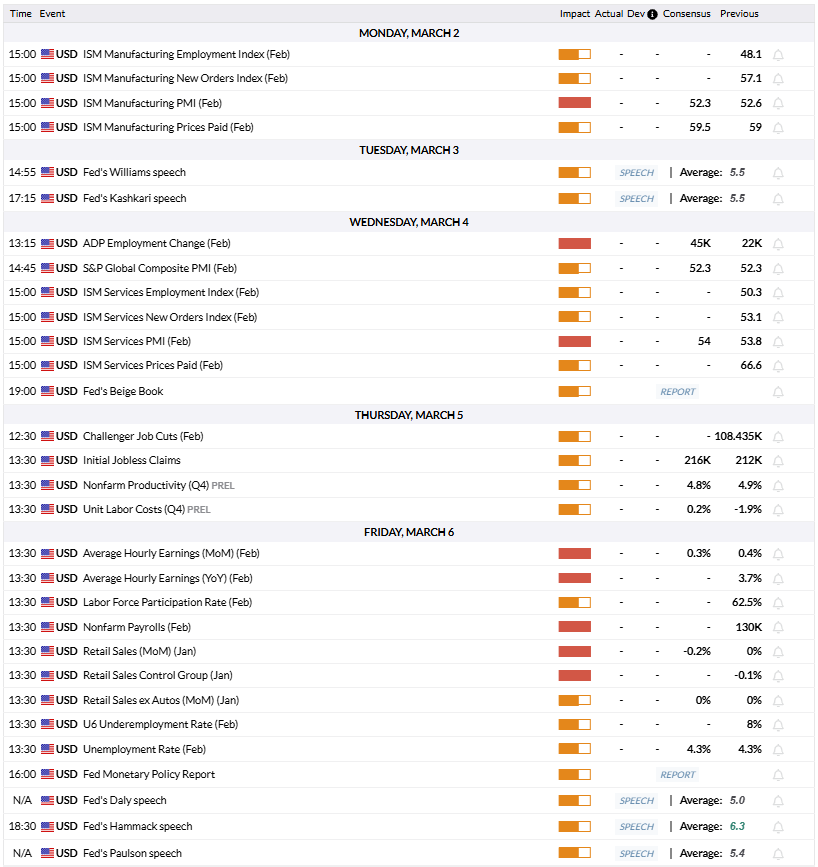
The US economic calendar will offer critical data releases that could trigger the next directional action in Gold.
On Monday, the Institute for Supply Management (ISM) will publish the Manufacturing Purchasing Managers’ Index (PMI) report for February. In case the headline PMI comes in below 50 and points to a contraction in the manufacturing sector’s business activity, the immediate reaction could hurt the USD and open the door for a leg higher in XAU/USD.
The Automatic Data Processing (ADP) will release the private sector employment figures for February on Wednesday, followed by the ISM Services PMI. A weaker-than-expected print in the ADP Employment Change data and a decline below 50 in the ISM Services Employment Index could cause investors to prepare for a disappointing Nonfarm Payrolls (NFP) report on Friday and trigger a USD selloff. Conversely, XAU/USD could come under bearish pressure if the ADP numbers and the PMI report point to healthy labor market conditions.
The US Bureau of Labor Statistics’ (BLS) official employment report will feature the Unemployment Rate, NFP and wage inflation figures for February on Friday.
n January, NFP rose by 130K, compared to the market expectation of 70K, and the Unemployment Rate declined to 4.3% from 4.4% in December. An NFP increase of 100K or more could ease concerns over the labor market slack and boost the USD. The CME Group FedWatch Tool currently shows that markets virtually see no chance of a Federal Reserve (Fed) interest rate cut in March and price in about an 80% probability of one more policy hold in April. This positioning suggests that the USD has some room on the upside in case investors see a strong employment data as a confirmation of steady policy at least until June. In this scenario, US Treasury bond yields could recover sharply and cause XAU/USD to move south heading into the weekend.
On the other hand, a disappointing NFP print at or below 50K could cause market participants to reconsider the possibility of a rate cut in April and pave the way for a bullish XAU/USD action in the American session on Friday.
ING’s Commodities Strategist Ewa Manthey argues that structural drivers are likely to support Gold prices in the near term.
"As long as geopolitical fragmentation persists, a meaningful reversal in central bank gold demand looks unlikely. This structural floor continues to underpin the market at elevated price levels,” Manthey explains, while adding, "Our US economist expects the Fed to begin cutting rates in the second quarter, with policy becoming incrementally less restrictive over the coming quarters. Even a modest easing cycle would be supportive for Gold, lowering real yields and reducing the opportunity cost of holding non‑yielding assets."
Investors will also pay close attention to headlines from the next round of US-Iran negotiations in Vienna. US Vice President JD Vance said late Thursday that there is “no chance” the US will be involved in a prolonged war in the Middle East, but added that Trump was still weighing targeted military strikes against Iran. If the US strikes Iran to force an agreement, escalating geopolitical tensions could support Gold prices. On the flip side, a nuclear deal without any military action could have the opposite impact on the precious metal’s performance.
Gold technical analysis: Bullish bias stays intact but lacks momentum
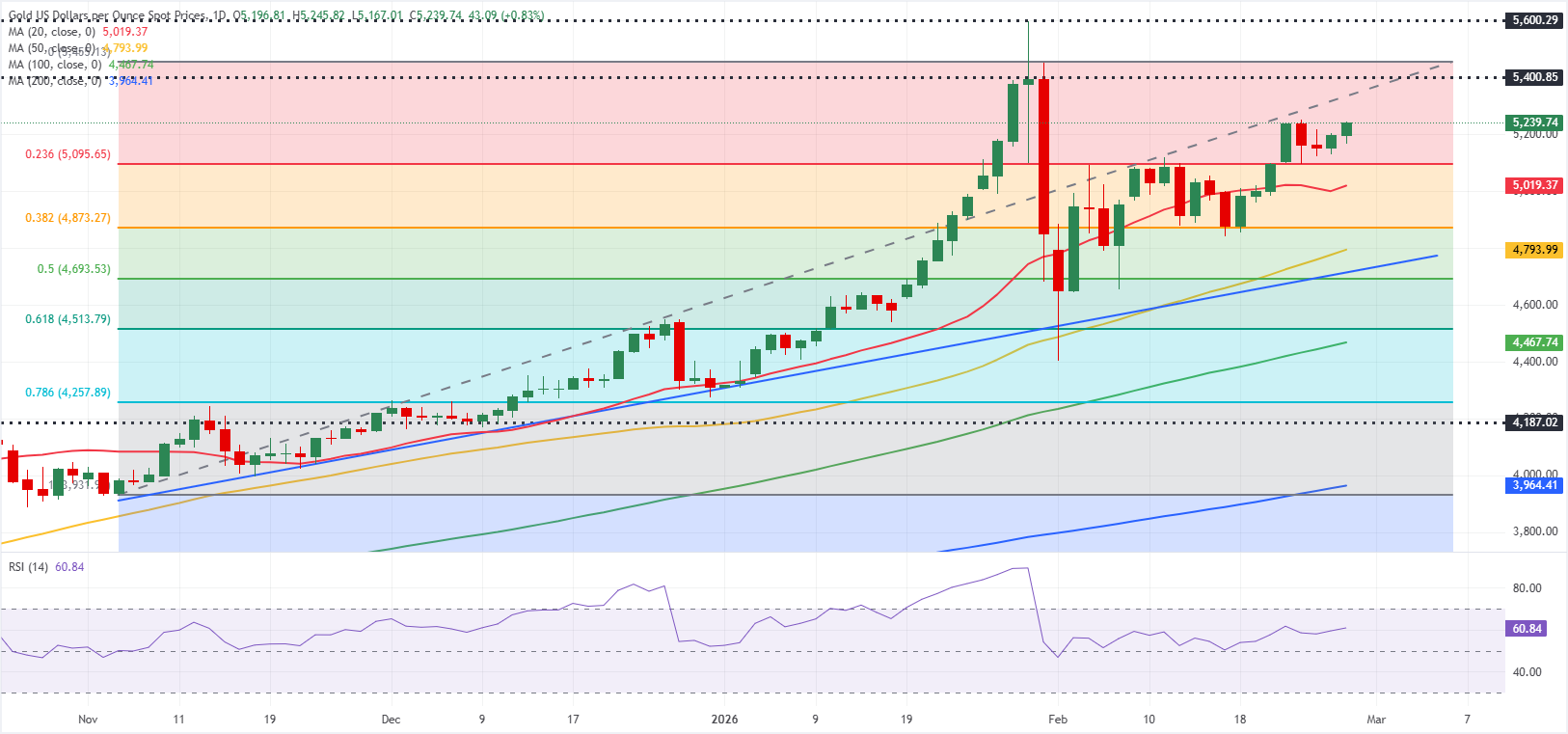
The Relative Strength Index (RSI) on the daily chart moves sideways near 60, and Gold trades well above the 20-day Simple Moving Average (SMA), reflecting a consolidation phase within a bullish structure.
The immediate resistance could be seen at $5,300 (round level). If Gold stabilizes above this level and confirms it as support, bulls could target $5,400 (static level, round level) ahead of $5,598 (all-time high).
On the downside, $5,090-$5,100 (Fibonacci 23.6% retracement of the November-February uptrend, round level) aligns as the first support area before $4,870 (Fibonacci 38.2% retracement) and $4,790 (50-day SMA).
Gold FAQs
Gold has played a key role in human’s history as it has been widely used as a store of value and medium of exchange. Currently, apart from its shine and usage for jewelry, the precious metal is widely seen as a safe-haven asset, meaning that it is considered a good investment during turbulent times. Gold is also widely seen as a hedge against inflation and against depreciating currencies as it doesn’t rely on any specific issuer or government.
Central banks are the biggest Gold holders. In their aim to support their currencies in turbulent times, central banks tend to diversify their reserves and buy Gold to improve the perceived strength of the economy and the currency. High Gold reserves can be a source of trust for a country’s solvency. Central banks added 1,136 tonnes of Gold worth around $70 billion to their reserves in 2022, according to data from the World Gold Council. This is the highest yearly purchase since records began. Central banks from emerging economies such as China, India and Turkey are quickly increasing their Gold reserves.
Gold has an inverse correlation with the US Dollar and US Treasuries, which are both major reserve and safe-haven assets. When the Dollar depreciates, Gold tends to rise, enabling investors and central banks to diversify their assets in turbulent times. Gold is also inversely correlated with risk assets. A rally in the stock market tends to weaken Gold price, while sell-offs in riskier markets tend to favor the precious metal.
The price can move due to a wide range of factors. Geopolitical instability or fears of a deep recession can quickly make Gold price escalate due to its safe-haven status. As a yield-less asset, Gold tends to rise with lower interest rates, while higher cost of money usually weighs down on the yellow metal. Still, most moves depend on how the US Dollar (USD) behaves as the asset is priced in dollars (XAU/USD). A strong Dollar tends to keep the price of Gold controlled, whereas a weaker Dollar is likely to push Gold prices up.
Author

Eren Sengezer
FXStreet
As an economist at heart, Eren Sengezer specializes in the assessment of the short-term and long-term impacts of macroeconomic data, central bank policies and political developments on financial assets.














