
I live in Southern California in a metro/bedroom community, so a lot of raw land does not surround me. However, you don’t have to drive too far east to see a great deal of raw land. I often wonder who owns land like that, how are they creating income from it and what their end game is. My mindset about property is that it should either shelter or be used to generate revenue, so let’s take a look at the possibilities.
Ways to Generate Income from Raw Land
There are two commonly known ways income can be created with raw land: land development or selling it to a developer. However, there is a third little known strategy– flipping the contract, which is like wholesaling but more advanced because it also requires that the party controlling the contract does much of the due diligence (zoning, environmental studies and such). There are important steps to follow with each of these strategies for investing in land. Here, we’ll cover land development.

How to Develop Land as an Investor
If you would like to be a land developer, there is a lot to learn. Before purchasing any land, you should do your due diligence and know your end game, which could be, for example, building a tract of 20 homes. What does the due diligence look like?
4 Phases of a Land Development Project
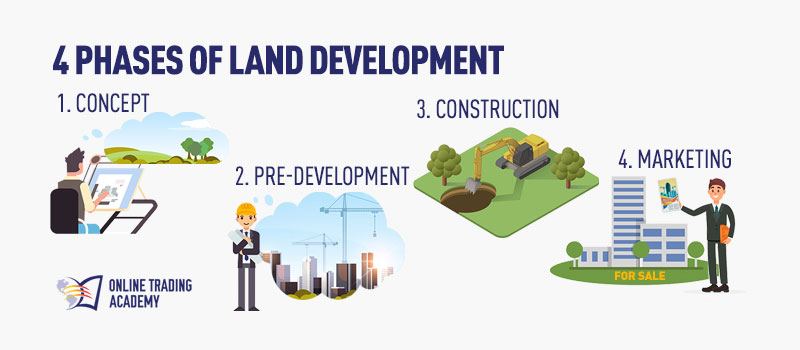
There are commonly four phases (if you don’t consider acquisition) to a land development project, and due diligence is the main focus of part one, concepts and two, pre-development.
Land Development: The Concept Phase
This part of the process takes a big vision balanced with detailed planning. One of the most significant factors when it comes to the concept phase is viability, which not only relates to profitability but also approval by the municipality. You must do your due diligence to ensure your vision for the project is realistic. Often, you’re on the right track if you can prove the project will improve the community, increase revenue (tax dollars), and fall within the scope of the master plan for the area. The Concept stage is usually your green light, red light phase where you decide if the reward of the land development project outweighs the risk, or not. This phase does require out of pocket expenses without the assurance of approval. The problem is, the project can’t get approved without it.
Land Development: The Pre-Development Phase
This part of the process takes an eye for detail and a good team. At this time, local and state laws must be taken into consideration, addressing zoning and project usage issues. There are also requirements regarding engineering and environmental regulations which will differ by area. Financing for the land development project will be sought during this phase and preliminary timelines will also be created, as they are needed for the financing package.
Land Development: The Construction Phase
This part of the process is usually handled by the general contractor using the finalized timelines created in the pre-development phase. Another major factor in the construction phase is the sequencing of the project. Sequencing affects all aspects of the project from the ordering of materials to inspections. Poor organization in this phase can result in not only production issues but can also dramatically impact the bottom line.
Land Development: The Marketing Phase
This is the marketing/sales part of the project. It will differ dramatically based on the kind of development project you’re working on. For example, with a housing development, the goal is to have the model homes completed and staged as quickly as possible. This will allow the sales team to start selling units for each phase as construction continues. Whereas the development of a warehouse will depend on the design and specs for the leasing process. Either way, a marketing and sales team needs to work together to ensure success.
My insight into this process comes from my youngest son. He is a commercial agent who deals with developers in the Inland Empire (CA). A developer will provide a concept, and he then finds and secures land suitable for the project. The developers he deals with have a focus on industrial uses such as manufacturing, transfer centers and fulfillment warehouses but, no matter the kind of development, this process is the same. It comes down to an understanding of the best and highest use for the raw land and being able to execute the vision.
Read the original article here - The 4 Phases of Land Development
Information on these pages contains forward-looking statements that involve risks and uncertainties. Markets and instruments profiled on this page are for informational purposes only and should not in any way come across as a recommendation to buy or sell in these assets. You should do your own thorough research before making any investment decisions. FXStreet does not in any way guarantee that this information is free from mistakes, errors, or material misstatements. It also does not guarantee that this information is of a timely nature. Investing in Open Markets involves a great deal of risk, including the loss of all or a portion of your investment, as well as emotional distress. All risks, losses and costs associated with investing, including total loss of principal, are your responsibility. The views and opinions expressed in this article are those of the authors and do not necessarily reflect the official policy or position of FXStreet nor its advertisers. The author will not be held responsible for information that is found at the end of links posted on this page.
If not otherwise explicitly mentioned in the body of the article, at the time of writing, the author has no position in any stock mentioned in this article and no business relationship with any company mentioned. The author has not received compensation for writing this article, other than from FXStreet.
FXStreet and the author do not provide personalized recommendations. The author makes no representations as to the accuracy, completeness, or suitability of this information. FXStreet and the author will not be liable for any errors, omissions or any losses, injuries or damages arising from this information and its display or use. Errors and omissions excepted.
The author and FXStreet are not registered investment advisors and nothing in this article is intended to be investment advice.
Editors’ Picks

EUR/USD flat lines below 1.1900; divergent Fed-ECB expectations offer support
The EUR/USD pair struggles to capitalize on the overnight bounce from the 1.1835-1.1830 region and oscillates in a narrow band during the Asian session on Thursday. Spot prices currently trade around the 1.1875 area, remaining nearly unchanged for the day and staying within striking distance of an over one-week high, reached on Tuesday, amid mixed cues.

GBP/USD slips heading into the Thursday trading window
The Pound Sterling pulled back from four-year highs on Wednesday, weighed down by a combination of Bank of England dovishness and UK political uncertainty, even as the US Dollar weakened on soft labor market revisions.

USD/JPY returns to the red below 153.00 after Japan's verbal intervention
USD/JPY attracts fresh sellers and falls back below 153.00 in the Asian session on Thursday. The US Dollar reverses the strong jobs data-led recovery, weighing on the pair amid the ongoing bullish momentum in the Japanese Yen, helped by Japanese verbal intervention. Japan's PM Sanae Takaichi's landslide election victory also keeps the local currency buoyed. The attention now remains on Friday's US Consumer Price Index inflation report.
Editors’ Picks

AUD/USD stalls near 0.7150 after RBA Bullock's comments
AUD/USD has paused its uptick to near 0.7150 in the Asian session on Thursday, at a three-year high. Cautious remarks from RBA Governor Bullock seem to cap the Aussie's upside. However, renewed US Dollar weakness cushions the pair's downside ahead of US Jobless Claims data.
USD/JPY returns to the red below 153.00 after Japan's verbal intervention
USD/JPY attracts fresh sellers and falls back below 153.00 in the Asian session on Thursday. The US Dollar reverses the strong jobs data-led recovery, weighing on the pair amid the ongoing bullish momentum in the Japanese Yen, helped by Japanese verbal intervention. Japan's PM Sanae Takaichi's landslide election victory also keeps the local currency buoyed. The attention now remains on Friday's US Consumer Price Index inflation report.

Gold down but not out as focus shifts to more US data
Gold is back in the red near $5,050 early Thursday, having faced strong offers at around the $5,100 mark once again. Buyers keep a close eye on the mid-tier US Jobless Claims data and US-Iran geopolitical developments to regain control.

Crypto trades through a confidence reset
The cryptocurrency market is navigating a liquidity-driven reset rather than a narrative-driven rally. Bitcoin, Ethereum and major altcoins remain under pressure even as new exchange-traded fund filings continue and selected inflow days appear on the tape.

The market trades the path not the past
The payroll number did not just beat. It reset the tone. 130,000 vs. 65,000 expected, with a 35,000 whisper. 79 of 80 economists leaning the wrong way. Unemployment and underemployment are edging lower. For all the statistical fog around birth-death adjustments and seasonal quirks, the core message was unmistakable. The labour market is not cracking.
RECOMMENDED LESSONS
Making money in forex is easy if you know how the bankers trade!

I’m often mystified in my educational forex articles why so many traders struggle to make consistent money out of forex trading. The answer has more to do with what they don’t know than what they do know. After working in investment banks for 20 years many of which were as a Chief trader its second knowledge how to extract cash out of the market.
5 Forex News Events You Need To Know

In the fast moving world of currency markets where huge moves can seemingly come from nowhere, it is extremely important for new traders to learn about the various economic indicators and forex news events and releases that shape the markets. Indeed, quickly getting a handle on which data to look out for, what it means, and how to trade it can see new traders quickly become far more profitable and sets up the road to long term success.
Top 10 Chart Patterns Every Trader Should Know

Chart patterns are one of the most effective trading tools for a trader. They are pure price-action, and form on the basis of underlying buying and selling pressure. Chart patterns have a proven track-record, and traders use them to identify continuation or reversal signals, to open positions and identify price targets.
7 Ways to Avoid Forex Scams

The forex industry is recently seeing more and more scams. Here are 7 ways to avoid losing your money in such scams: Forex scams are becoming frequent. Michael Greenberg reports on luxurious expenses, including a submarine bought from the money taken from forex traders. Here’s another report of a forex fraud. So, how can we avoid falling in such forex scams?
What Are the 10 Fatal Mistakes Traders Make
Trading is exciting. Trading is hard. Trading is extremely hard. Some say that it takes more than 10,000 hours to master. Others believe that trading is the way to quick riches. They might be both wrong. What is important to know that no matter how experienced you are, mistakes will be part of the trading process.
The challenge: Timing the market and trader psychology

Successful trading often comes down to timing – entering and exiting trades at the right moments. Yet timing the market is notoriously difficult, largely because human psychology can derail even the best plans. Two powerful emotions in particular – fear and greed – tend to drive trading decisions off course.