Symbols mentioned: ES

Chart Source: QST

Positions: None

Is it time to hedge risk in the S&P 500?

This week has been the perfect storm for a short squeeze in equities. The FOMC decision lands tomorrow, and this morning, we received relatively good news regarding waning inflation; thus, the Fed seems destined for a pause in rate hikes. Further, the June futures and options expire at the end of the week, which is putting pressure on those who have been short and suffering to cover (buy).

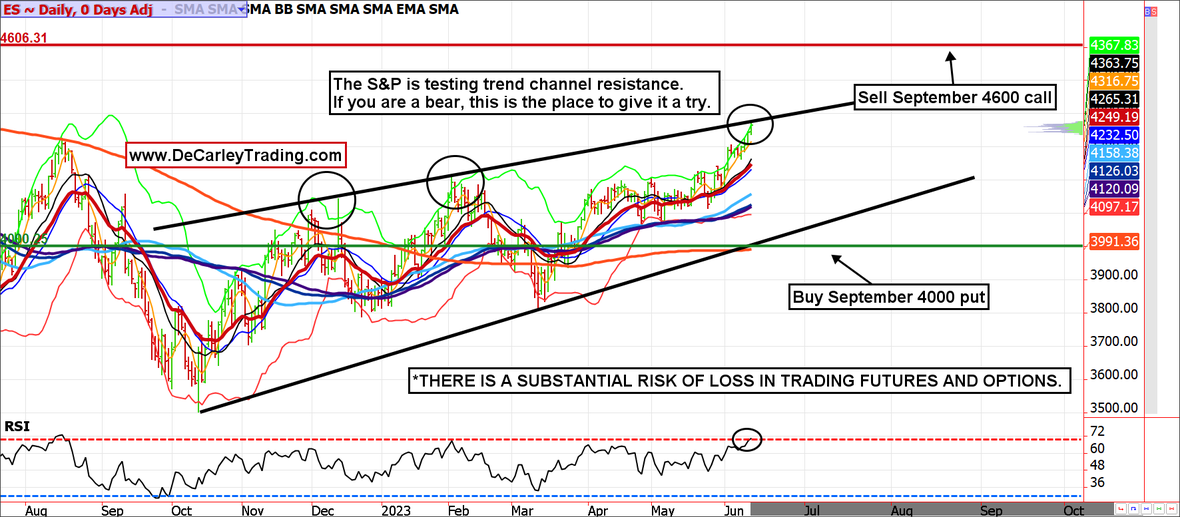
That said, the buying has been position-squaring-based, not necessarily fundamental-based, and we are approaching significant technical resistance with the RSI on a daily chart near 70.00. In the short run, the market is vulnerable to a pullback.

If you want to speculate on declining equity prices or hedge your portfolio, a risk reversal seems to make sense. This is the practice of selling a call option (currently overpriced due to the relentless uptrend) and buying a put option (which is underpriced due to the low VIX reading).
Chart

Specifically, we like selling the September S&P 500 4600 call and using the proceeds to buy the 4000 put, the cost of the spread is about $50 plus transaction costs, but risk above 4600 is unlimited for speculators. If this is done as a stock portfolio hedge with an allocation similar to the S&P 500, the risk is an opportunity cost (gains over 4600 are foregone because above that price, the portfolio is gaining, but the hedge is losing, point for point). When done as a hedge, this is a strategy that offers relatively free insurance in exchange for accepting a profit cap above 4600.

A more popular but less efficient portfolio hedging strategy is to buy puts to act as portfolio insurance. This method leaves the upside profit potential open and covers the downside risk beneath the strike price of the put option purchased, but this approach can become quite expensive. For example, purchasing the September 4000 put outright would cost a little over $1,500 for just under three months of protection under 4000. With the September E-mini S&P futures contract at about 4400, the insurance would only pay off if the S&P was 430 lower at expiration (400 points to reach the strike price and another 30 to cover the premium paid); even at that price, it merely breaks even. This means the portfolio still suffered a drawdown in the amount of 400 S&P 500 points plus despite the attempted hedge. If an investor opted to buy similar insurance each quarter, he would be out about $6,000 in premium paid for puts (insurance), or about 2.5% to 3% annually, to protect against sell-offs exceeding about 10%. Most stock market corrections are 10% or less; also, most portfolios wouldn’t fare well if you shaved 3% of the top every year. Yet, a risk reversal strategy (reserved for appropriate timing) removes the cost burden of protecting the downside.

It should be noted that the CME Group offers micro-sized options against the stock indices, allowing for speculation and portfolio hedging in smaller increments. With the S&P 500 at 4400, the E-mini S&P 500s notional value is about $220,000; the micro-sized version is $22,000. Thus, those looking to hedge $22,000 worth of stocks could construct the aforementioned risk reversal strategy using the micro E-mini options.


Due to the volatile nature of the futures markets some information and charts in this report may not be timely. There is substantial risk of loss in trading futures and options. Past performance is not indicative of future results. The information and data in this report were obtained from sources considered reliable. Their accuracy or completeness is not guaranteed and the giving of the same is not to be deemed as an offer or solicitation on our part with respect to the sale or purchase of any securities or commodities. Any decision to purchase or sell as a result of the opinions expressed in this report will be the full responsibility of the person authorizing such transaction.

Editors’ Picks

EUR/USD drops to daily lows near 1.1630

EUR/USD drops to daily lows near 1.1630

EUR/USD now loses some traction and slips back to the area of daily lows around 1.1630 on the back of a mild bounce in the US Dollar. Fresh US data, including the September PCE inflation numbers and the latest read on December consumer sentiment, didn’t really move the needle, so the pair is still on course to finish the week with a respectable gain.

GBP/USD trims gains, recedes toward 1.3320

GBP/USD trims gains, recedes toward 1.3320

GBP/USD is struggling to keep its daily advance, coming under fresh pressure and retreating to the 1.3320 zone following a mild bullish attempt in the Greenback. Even though US consumer sentiment surprised to the upside, the US Dollar isn’t getting much love, as traders are far more interested in what the Fed will say next week.

Japanese Yen refreshes three-week high vs USD; seems poised to appreciate further

Japanese Yen refreshes three-week high vs USD; seems poised to appreciate further

The Japanese Yen retains bullish bias as BoJ rate hike bets offset dismal Household Spending data. Dovish Fed expectations fail to assist the USD in attracting buyers and keep a lid on the USD/JPY pair. Traders keenly await the US PCE Price Index for Fed rate-cut cues and a fresh directional impetus.


Editors’ Picks

EUR/USD drops to daily lows near 1.1630

EUR/USD drops to daily lows near 1.1630

EUR/USD now loses some traction and slips back to the area of daily lows around 1.1630 on the back of a mild bounce in the US Dollar. Fresh US data, including the September PCE inflation numbers and the latest read on December consumer sentiment, didn’t really move the needle, so the pair is still on course to finish the week with a respectable gain.

GBP/USD trims gains, recedes toward 1.3320

GBP/USD trims gains, recedes toward 1.3320

GBP/USD is struggling to keep its daily advance, coming under fresh pressure and retreating to the 1.3320 zone following a mild bullish attempt in the Greenback. Even though US consumer sentiment surprised to the upside, the US Dollar isn’t getting much love, as traders are far more interested in what the Fed will say next week.

Gold makes a U-turn, back to $4,200

Gold makes a U-turn, back to $4,200

Gold is now losing the grip and receding to the key $4,200 region per troy ounce following some signs of life in the Greenback and a marked bounce in US Treasury yields across the board. The positive outlook for the precious metal, however, remains underpinned by steady bets for extra easing by the Fed.

Crypto Today: Bitcoin, Ethereum, XRP pare gains despite increasing hopes of upcoming Fed rate cut

Crypto Today: Bitcoin, Ethereum, XRP pare gains despite increasing hopes of upcoming Fed rate cut

Bitcoin is steadying above $91,000 at the time of writing on Friday. Ethereum remains above $3,100, reflecting positive sentiment ahead of the Federal Reserve's (Fed) monetary policy meeting on December 10.

Week ahead – Rate cut or market shock? The Fed decides

Week ahead – Rate cut or market shock? The Fed decides

Fed rate cut widely expected; dot plot and overall meeting rhetoric also matter. Risk appetite is supported by Fed rate cut expectations; cryptos show signs of life. RBA, BoC and SNB also meet; chances of surprises are relatively low.

RECOMMENDED LESSONS

5 Forex News Events You Need To Know

In the fast moving world of currency markets where huge moves can seemingly come from nowhere, it is extremely important for new traders to learn about the various economic indicators and forex news events and releases that shape the markets. Indeed, quickly getting a handle on which data to look out for, what it means, and how to trade it can see new traders quickly become far more profitable and sets up the road to long term success.

Top 10 Chart Patterns Every Trader Should Know

Chart patterns are one of the most effective trading tools for a trader. They are pure price-action, and form on the basis of underlying buying and selling pressure. Chart patterns have a proven track-record, and traders use them to identify continuation or reversal signals, to open positions and identify price targets.

7 Ways to Avoid Forex Scams

The forex industry is recently seeing more and more scams. Here are 7 ways to avoid losing your money in such scams: Forex scams are becoming frequent. Michael Greenberg reports on luxurious expenses, including a submarine bought from the money taken from forex traders. Here’s another report of a forex fraud. So, how can we avoid falling in such forex scams?

What Are the 10 Fatal Mistakes Traders Make

Trading is exciting. Trading is hard. Trading is extremely hard. Some say that it takes more than 10,000 hours to master. Others believe that trading is the way to quick riches. They might be both wrong. What is important to know that no matter how experienced you are, mistakes will be part of the trading process.

Strategy

Money Management

Psychology

Best Brokers of 2025