
Seems like we recently had yet another wild ride in the global markets. Firstly, we had Apple earnings on July 30, but hey this is a FX article, so what is more important than that? I’ll tell you what is more important: FOMC Day. The great economic experiment continues with an apparently robust economy, yet once gain the Fed is choosing to keep interest rates historically low. On July 31st, the Fed Chairman Jerome Powell lowered rates in the US to 2.25% with a quarter basis-point cut, describing their actions as a ‘mid-cycle adjustment’, with further statements indicating that the Fed was not convinced that a full round of easing was necessary in the near future. Are you feeling somewhat confused by these statements and actions? Well join the club!
In my years as a trader and investor, one of the biggest challenges I’ve faced was how to make sense of the fundamental news and economic data and then how to use that to make quality buying and selling decisions in the currency market itself. The two just never seemed to work in sync, so my decisions were down to opinion and a prayer rather than a simple rules-based approach to taking my entries. I have forgotten just how many times I have seen good news cause a selloff, or bad news precede a massive rally. More often when reading the news, we find ourselves on the wrong side of the market action. I’ve since learned better.
Follow Price, Not The Fed
Making sense of the actions of the Fed and reading between the lines of Jerome Powell’s comments is just as much of a headache today as it was when Ben Bernanke was running the place. However, translating price action and the movements of the major institutions has always been a far simpler approach to take. That’s why I embraced the concepts of letting price tell the true story, instead of the news. As my fellow instructors and I have stated on multiple occasions, the laws of Supply and Demand always dictate where price is more likely to go when probability and risk management is fully respected. You just have to follow the clues.
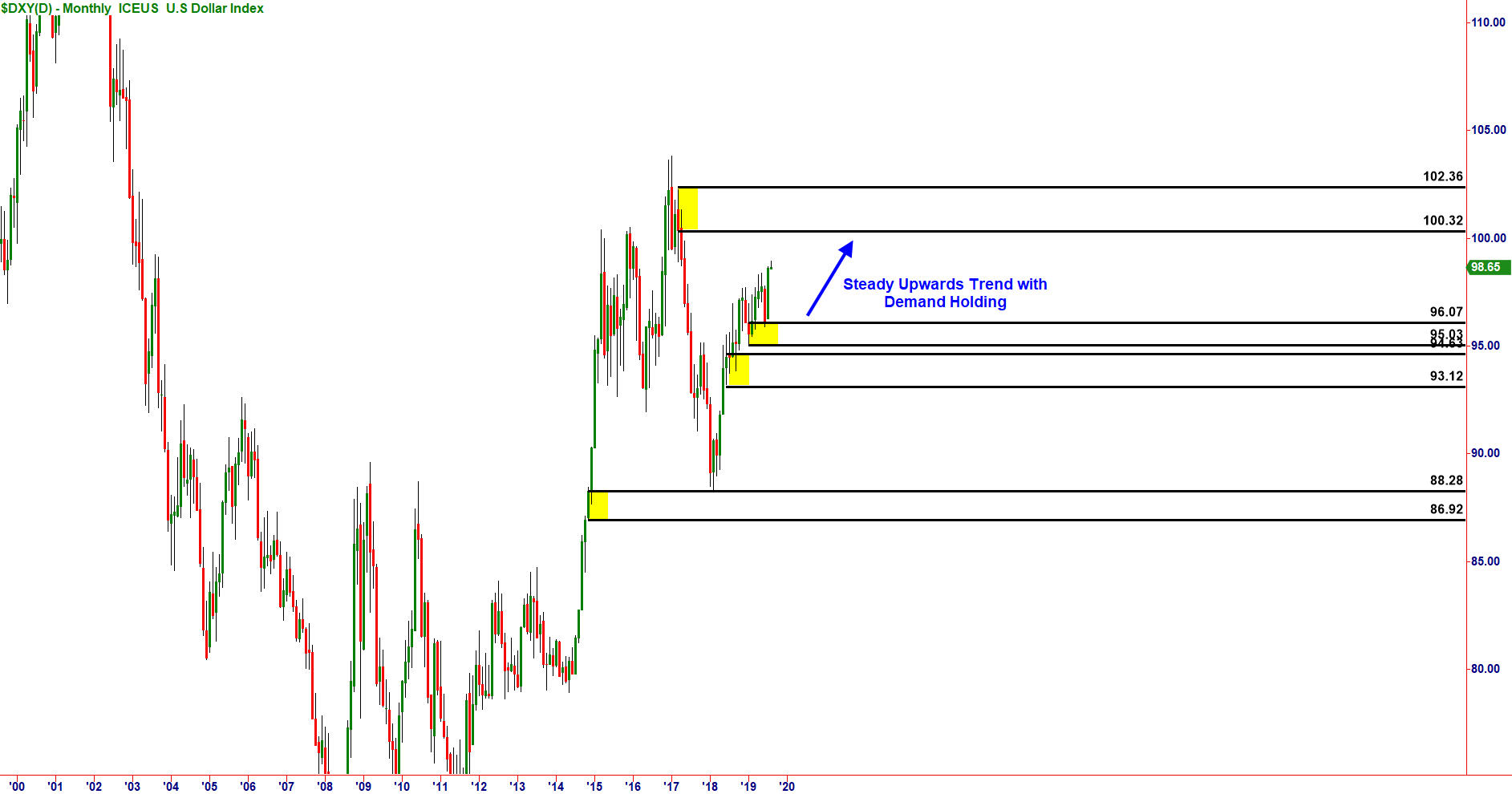
I decided to look at some very recent examples of price from shortly before and after last’s weeks rate announcement, using both the US Dollar and USDJPY. I want to start with the Dollar because this is what most likely confused traders. Fundamentally, when rates go down this weakens a currency and vice-versa. In this instance, we saw a decent rally in the US Dollar, with the Greenback making new 2-year highs, a little after The Fed announcement. This is fundamentally opposite to what it was expected to do. Were there any clues to the Dollar rally beforehand? Well, let’s see what a chart of the Dollar Index (DXY) shows us.
According to the monthly DXY chart below, we can see a series of Demand zones holding a series of higher highs in an uptrend on the Dollar. This is a very Bullish pattern which has been forming for almost 2 years. Sometimes the trend can be your friend it seems. The way things are moving; we should expect high prices in the USD up to around 100 before any real selling enters the market.
Another way to participate in the FX market without worrying about the news is to keep things very simple and focus on the major Supply and Demand zones which present themselves to us. A wiser man than me once said that news will drive prices into the zones of imbalance between supply and demand. The market will then respond accordingly. This was clearly the case before and after the rate decision as seen on the USDJPY charts.
In the below chart we can see the pair consolidating before the news in a choppy fashion, as can be expected. Once the news came out the movement followed, but what happened and how did the principles of core strategy work out after The Fed announcement?
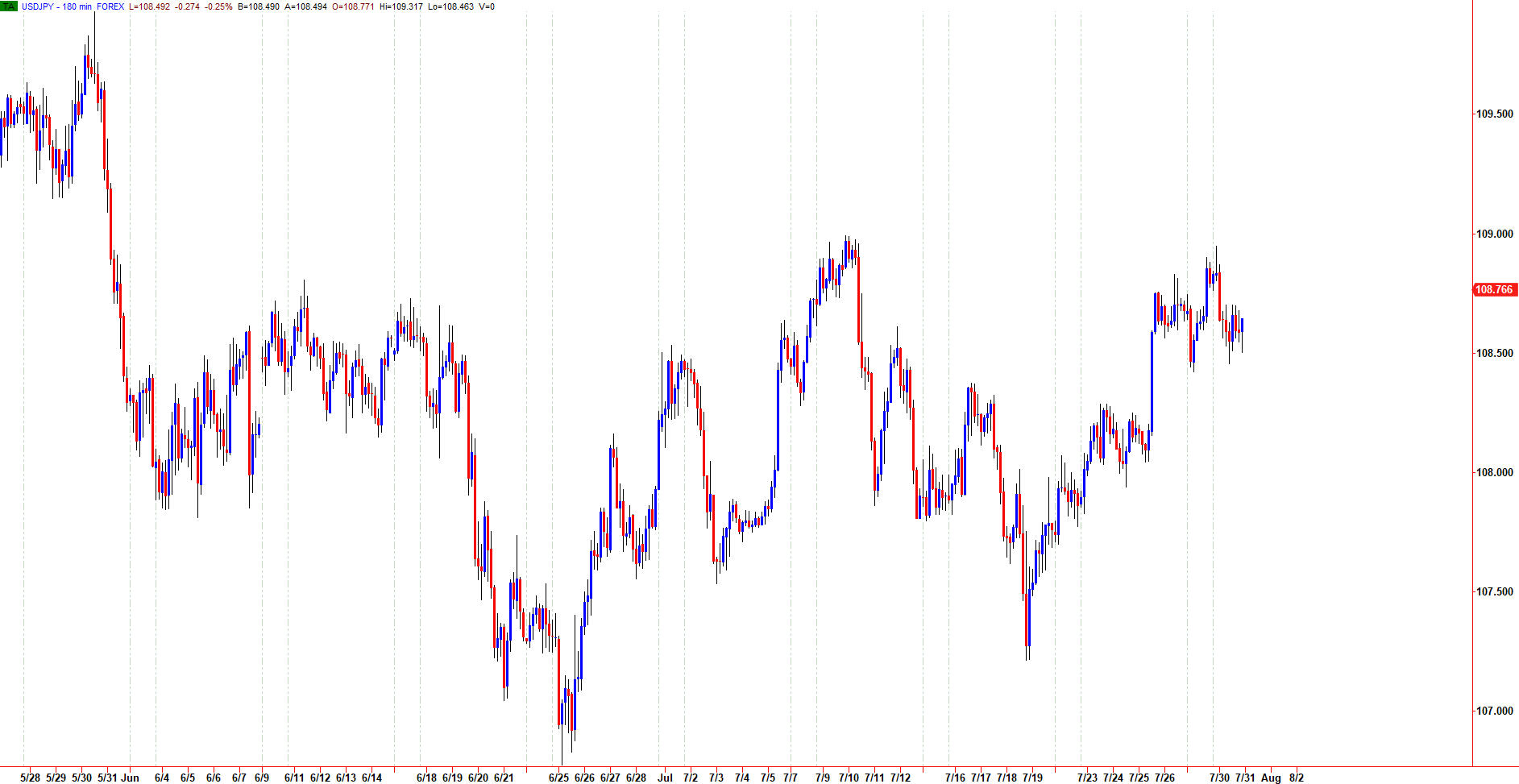
Price had already been trading at an established demand zone (low) and then, as you can see below, following the news price rallied strongly into the above supply zone and respected it for some time.

Even though price had already been at the higher area before, the sellers needed to be absorbed before it could move on to the next area of supply, as shown below.
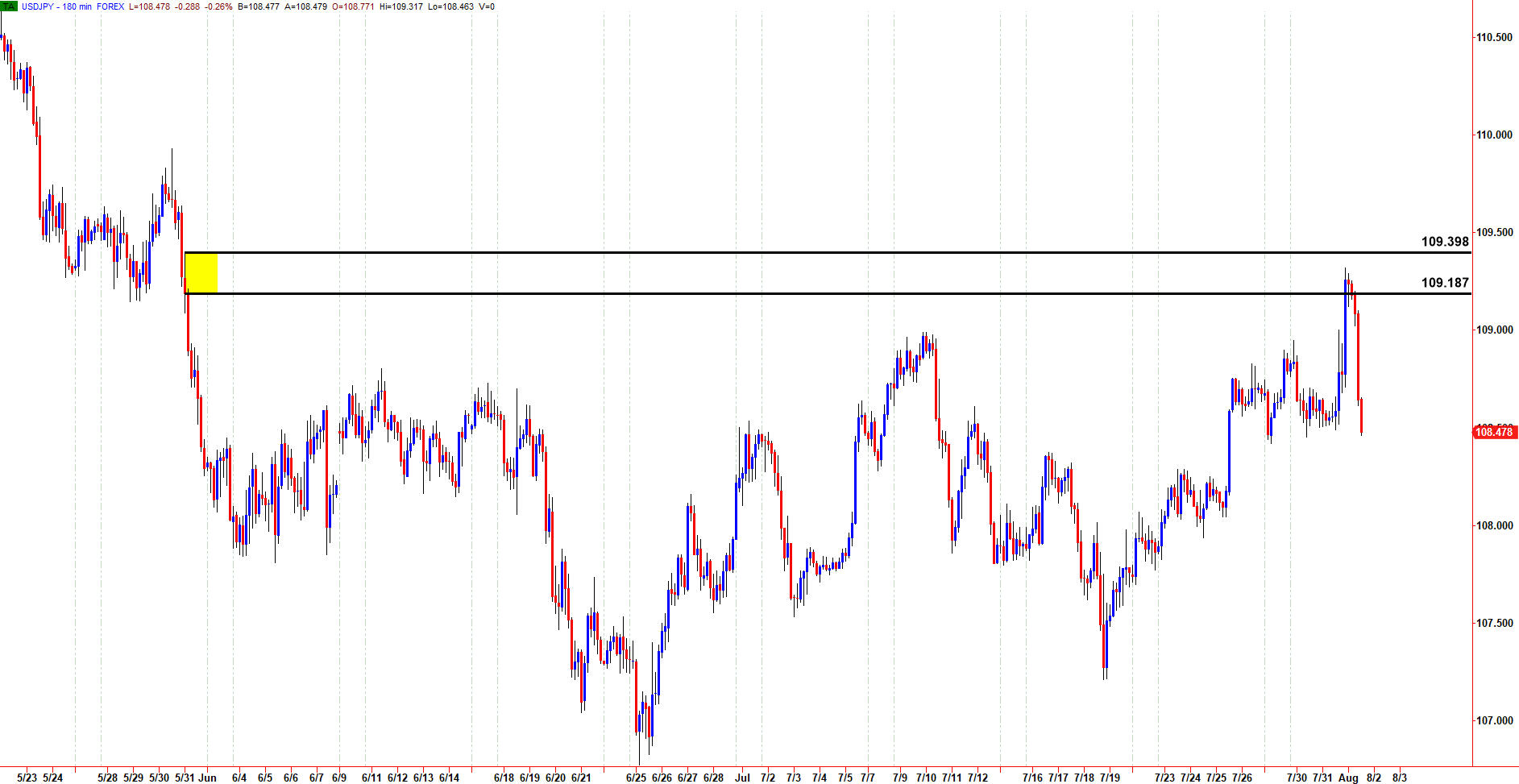
Again, we see the Supply catch out those buyers late in the move. Just as the lower zone was broken, price rallied into another area and dropped hard, returning to where it came from before the news the previous day. No wonder people find the news frustrating. My question to you is this: did you really need to read the news and attempt to decipher the fundamentals behind The Fed’s actions to find good trading opportunities, or could you have just followed the footsteps of supply and demand?
I’ve been in this business for too long and have seen too many examples of the institutional footprints on charts playing out to worry myself about how and why news plays out in the markets. Often, I just follow the big players and let them make the decision for me. When I’m wrong, I lose a little and when I’m right it works out well. Who do you think you should be listening to in the long run?
Thanks for reading and be well.
Read the original article here - Predicting Price Movement in an Unpredictable Market
The information provided is for informational purposes only. It does not constitute any form of advice or recommendation to buy or sell any securities or adopt any investment strategy mentioned. It is intended only to provide observations and views of the author(s) or hosts at the time of writing or presenting, both of which are subject to change at any time without prior notice. The information provided does not have regard to specific investment objectives, financial situation, or specific needs of any specific person who may read it. Investors should determine for themselves whether a particular service or product is suitable for their investment needs or should seek such professional advice for their particular situation. Please see our website for more information: https://bustamanteco.com/privacy-policy/
Editors’ Picks

EUR/USD climbs to daily highs near 1.1820
EUR/USD now picks up pace and advances to the area of daily peaks north of the 1.1800 barrier at the end of the week. The pair’s decent move higher comes against the backdrop of a generalised lack of direction in the FX galaxy and the mild offered stance in the US Dollar.

GBP/USD trims losses, retests 1.3460
After briefly challenging its key 200-day SMA near 1.3440, GBP/USD now manages to regain some balance and revisit the 1.3460 zone on Friday. Cable’s pullback comes as the selling pressure on the Greenback gathers traction, reigniting some recovery in the risk-linked space.

Japanese Yen gives back half of early gains against USD ahead of US PPI data
The Japanese Yen (JPY) surrenders half of its early gains against the US Dollar (USD) during the European trading session on Friday. The USD/JPY pair rebounds to near 155.90 as the JPY falls back, but is still 0.15% down.
Editors’ Picks

EUR/USD: Fed calm, ECB steady, but the Dollar still leads Premium
EUR/USD is still struggling to find real traction. The pair has tried to stabilise, but momentum keeps fading, leaving the door open to further weakness.

Gold: Falling US yields, geopolitics help XAU/USD hold ground Premium
Gold (XAU/USD) gained traction and climbed above $5,200, ending the fourth consecutive week in positive territory. The next round of US-Iran talks and crucial macroeconomic data releases from the US will be watched closely by market participants in the short term.

GBP/USD: Will Pound Sterling defend key 1.3450 support ahead of US jobs data? Premium
The Pound Sterling (GBP) entered a bearish consolidation phase against the US Dollar (USD), after having tested critical support near the 1.3450 level on several occasions.

Bitcoin: Another month of losses, and it’s been five
Bitcoin (BTC) price is stabilizing around $68,000 at the time of writing on Friday, but the Crypto King is poised to close February on a fragile footing, marking its fifth consecutive month of losses since October and a rare start to the year with back-to-back monthly corrections.

US Dollar: At a crossroads; Fed steady, tariffs in flux Premium
The US Dollar’s (USD) upward momentum from the previous week seems to have encountered a tough nut to crack in the 98.00 region, as measured by the US Dollar Index (DXY).
RECOMMENDED LESSONS
Making money in forex is easy if you know how the bankers trade!

I’m often mystified in my educational forex articles why so many traders struggle to make consistent money out of forex trading. The answer has more to do with what they don’t know than what they do know. After working in investment banks for 20 years many of which were as a Chief trader its second knowledge how to extract cash out of the market.
5 Forex News Events You Need To Know

In the fast moving world of currency markets where huge moves can seemingly come from nowhere, it is extremely important for new traders to learn about the various economic indicators and forex news events and releases that shape the markets. Indeed, quickly getting a handle on which data to look out for, what it means, and how to trade it can see new traders quickly become far more profitable and sets up the road to long term success.
Top 10 Chart Patterns Every Trader Should Know

Chart patterns are one of the most effective trading tools for a trader. They are pure price-action, and form on the basis of underlying buying and selling pressure. Chart patterns have a proven track-record, and traders use them to identify continuation or reversal signals, to open positions and identify price targets.
7 Ways to Avoid Forex Scams

The forex industry is recently seeing more and more scams. Here are 7 ways to avoid losing your money in such scams: Forex scams are becoming frequent. Michael Greenberg reports on luxurious expenses, including a submarine bought from the money taken from forex traders. Here’s another report of a forex fraud. So, how can we avoid falling in such forex scams?
What Are the 10 Fatal Mistakes Traders Make
Trading is exciting. Trading is hard. Trading is extremely hard. Some say that it takes more than 10,000 hours to master. Others believe that trading is the way to quick riches. They might be both wrong. What is important to know that no matter how experienced you are, mistakes will be part of the trading process.
The challenge: Timing the market and trader psychology

Successful trading often comes down to timing – entering and exiting trades at the right moments. Yet timing the market is notoriously difficult, largely because human psychology can derail even the best plans. Two powerful emotions in particular – fear and greed – tend to drive trading decisions off course.