 Brandon Wendell, CMT
Brandon Wendell
Technical indicators that we place on our charts simply offer a different perspective of past and current price action. These indicators are helpful, but are also lagging as they depend on past price or even need a current close before sending a signal. Online Trading Academy Graduates know that for the best trading opportunities, you need to rely on Supply and Demand to identify entries and exits.
When trading, there is nothing wrong with wanting additional confidence in our trades. That is where the indicators come into play. Indicators are technical assistance we use to help make decisions. Looking at the indicators the right way can give you the boost of confidence you need to enter your planned trade. It can also give you the necessary warning for you to honor your stop when things go awry.
Using the indicators for entry and exit signals alone can be disastrous. Remember that they are all lagging current price and will often offer their entry signals after the move has started. Extended Learning Track (XLT) program students know we want to be in the trade well before that.
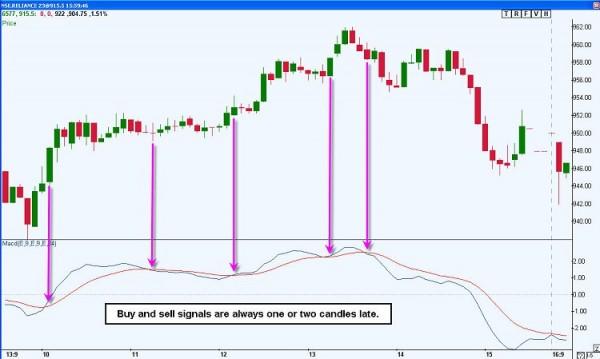
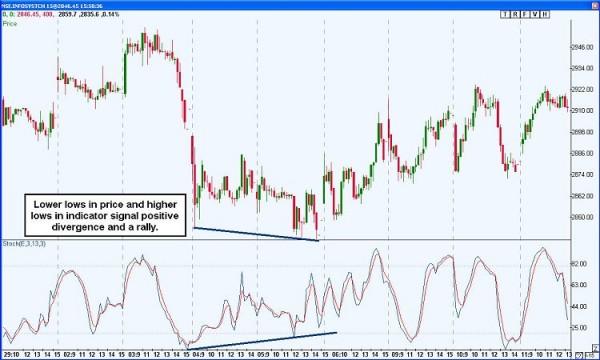
So what good are the indicators if they are late in signaling entry? Plenty, that is if you use them in the right manner. There are several ways to best use any technical indicator. The first is to look for a divergence from price at a supply or demand zone. A positive divergence is when price is making lower lows while the indicator does not. The indicator will make higher lows or the same lows. This shows a lack of selling pressure/momentum. The best signal comes at an area of demand.
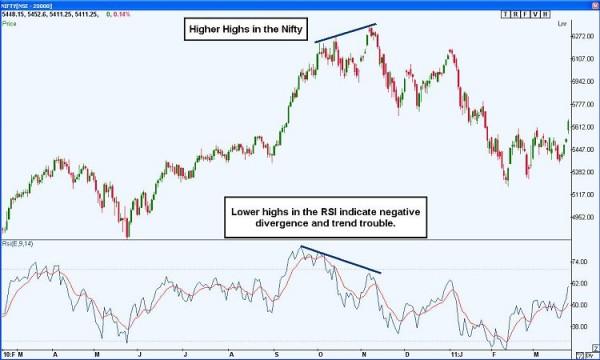
When price is reaching to new highs, but the indicator is making lower highs, or keeping the same high, you are seeing negative divergence. Combine that with price reaching a supply zone and you have an excellent signal for a reversal in trend. Notice how my divergence gave a timely signal to exit longs in the broad market well before the decline in the markets in November 2010.
Some people will undoubtedly question my entries for these trades as they want more confirmation to enter. I agree that proper entry may seem dangerous at times; you are buying when everyone seems to be selling and the markets seem weak, and you are selling when everyone wants to buy and the talk is bullish. I am not catching a falling knife in mid-air. I am grabbing it as it hits the floor and loses all momentum. At my entry, I may have more losing trades than someone who waits for the reversal of momentum. However, my losses will be much smaller as I can have tighter stops and can overcome my losses easily as I will also have larger winners.
This is the best way to use the indicators when trading. There are others though. I will discuss some additional uses for the indicators in future articles. If you are not sure how to properly use these tools, visit Online Trading Academy and sign up for a class.
Neither Freedom Management Partners nor any of its personnel are registered broker-dealers or investment advisers. I will mention that I consider certain securities or positions to be good candidates for the types of strategies we are discussing or illustrating. Because I consider the securities or positions appropriate to the discussion or for illustration purposes does not mean that I am telling you to trade the strategies or securities. Keep in mind that we are not providing you with recommendations or personalized advice about your trading activities. The information we are providing is not tailored to any individual. Any mention of a particular security is not a recommendation to buy, sell, or hold that or any other security or a suggestion that it is suitable for any specific person. Keep in mind that all trading involves a risk of loss, and this will always be the situation, regardless of whether we are discussing strategies that are intended to limit risk. Also, Freedom Management Partners’ personnel are not subject to trading restrictions. I and others at Freedom Management Partners could have a position in a security or initiate a position in a security at any time.
Editors’ Picks

EUR/USD weakens to near 1.1900 as traders eye US data
EUR/USD eases to near 1.1900 in Tuesday's European trading hours, snapping the two-day winning streak. Markets turn cautious, lifting the haven demand for the US Dollar ahead of the release of key US economic data, including Retail Sales and ADP Employment Change 4-week average.

GBP/USD stays in the red below 1.3700 on renewed USD demand
GBP/USD trades on a weaker note below 1.3700 in the European session on Tuesday. The pair faces challenges due to renewed US Dollar demand, UK political risks and rising expectations of a March Bank of England rate cut. The immediate focus is now on the US Retail Sales data.

USD/JPY drops toward 155.00 as focus shifts to US data
USD/JPY meets fresh supply and inches closer toward 155.00 in the Asian session on Tuesday. The Japanese Yen holds the upper hand over the US Dollar after Japanese Prime Minister Sanae Takaichi led the ruling Liberal Democratic Party to a historic landslide win and on intervention talks. Traders brace for key US economic data that could offer more clues on the Federal Reserve's monetary policy.
Editors’ Picks
EUR/USD weakens to near 1.1900 as traders eye US data
EUR/USD eases to near 1.1900 in Tuesday's European trading hours, snapping the two-day winning streak. Markets turn cautious, lifting the haven demand for the US Dollar ahead of the release of key US economic data, including Retail Sales and ADP Employment Change 4-week average.
GBP/USD stays in the red below 1.3700 on renewed USD demand
GBP/USD trades on a weaker note below 1.3700 in the European session on Tuesday. The pair faces challenges due to renewed US Dollar demand, UK political risks and rising expectations of a March Bank of England rate cut. The immediate focus is now on the US Retail Sales data.

Gold sticks to modest losses above $5,000 ahead of US data
Gold sticks to modest intraday losses through the first half of the European session, though it holds comfortably above the $5,000 psychological mark and the daily swing low. The outcome of Japan's snap election on Sunday removes political uncertainty, which along with signs of easing tensions in the Middle East, remains supportive of the upbeat market mood. This turns out to be a key factor exerting downward pressure on the safe-haven precious metal.

Bitcoin Cash trades lower, risks dead-cat bounce amid bearish signals
Bitcoin Cash trades in the red below $522 at the time of writing on Tuesday, after multiple rejections at key resistance. BCH’s derivatives and on-chain indicators point to growing bearish sentiment and raise the risk of a dead-cat bounce toward lower support levels.

Follow the money, what USD/JPY in Tokyo is really telling you
Over the past two Tokyo sessions, this has not been a rate story. Not even close. Interest rate differentials have been spectators, not drivers. What has moved USD/JPY in local hours has been flow and flow alone.
RECOMMENDED LESSONS
Making money in forex is easy if you know how the bankers trade!

I’m often mystified in my educational forex articles why so many traders struggle to make consistent money out of forex trading. The answer has more to do with what they don’t know than what they do know. After working in investment banks for 20 years many of which were as a Chief trader its second knowledge how to extract cash out of the market.
5 Forex News Events You Need To Know

In the fast moving world of currency markets where huge moves can seemingly come from nowhere, it is extremely important for new traders to learn about the various economic indicators and forex news events and releases that shape the markets. Indeed, quickly getting a handle on which data to look out for, what it means, and how to trade it can see new traders quickly become far more profitable and sets up the road to long term success.
Top 10 Chart Patterns Every Trader Should Know

Chart patterns are one of the most effective trading tools for a trader. They are pure price-action, and form on the basis of underlying buying and selling pressure. Chart patterns have a proven track-record, and traders use them to identify continuation or reversal signals, to open positions and identify price targets.
7 Ways to Avoid Forex Scams

The forex industry is recently seeing more and more scams. Here are 7 ways to avoid losing your money in such scams: Forex scams are becoming frequent. Michael Greenberg reports on luxurious expenses, including a submarine bought from the money taken from forex traders. Here’s another report of a forex fraud. So, how can we avoid falling in such forex scams?
What Are the 10 Fatal Mistakes Traders Make
Trading is exciting. Trading is hard. Trading is extremely hard. Some say that it takes more than 10,000 hours to master. Others believe that trading is the way to quick riches. They might be both wrong. What is important to know that no matter how experienced you are, mistakes will be part of the trading process.
The challenge: Timing the market and trader psychology

Successful trading often comes down to timing – entering and exiting trades at the right moments. Yet timing the market is notoriously difficult, largely because human psychology can derail even the best plans. Two powerful emotions in particular – fear and greed – tend to drive trading decisions off course.