I’m sure I will get a lot of doubters reading this article. Seems the majority of traders you talk to are very bearish on the Commodity and Stock markets at the moment. And that is a good thing if you are bullish. I love watching shorts scramble to cover their positions because they thought the markets were going to zero.
Unfortunately, too many traders are like lemmings and follow some guru or herd right off the edge of the bridge. Trading is a thinking game and using some common sense is very beneficial.
No market goes straight up or straight down, but they move in cycles of different durations causing price to move in large impulse waves (direction of the trend) and short choppy corrective waves (countertrend moves). I’m a trend follower type of trader, but I also follow Seasonal patterns and keep up with macro fundamental events pertaining to markets I’m trading.
I was talking with some traders the other day and the price of oil came up. They could not let go of the fact that Iran is going to start pumping oil and flooding an already crowded market. I always appreciate another trader’s opinion because that is what makes a market: differences of opinion. My response was, “News like that is already in the market and has been discounted.” In the oil market the news of too much oil is as saturated as the tankers trying to hold all of this oil, everybody knows it. The money has been made on that side of the trade. Markets are discounting and forward looking mechanisms.
The markets will not wait until there are obvious physical signs that the inventories are low in oil before it rallies. Keep in mind, I’m not looking for $100 oil anytime soon, but a bounce in price is possible in the future and worth trading if it does, in my opinion.
Note: This is not a trade recommendation. I write this for purposes of getting a trader to think out of the box and use this for educational purposes only. I currently have long positions in the Energy market.
Moore Research (MRCI) is a research company on Seasonal patterns in the Futures markets that I use. If you are interested in a trial subscription they are still offering OTA students a 10% discount after the two week free trial. Each month, they offer approximately 15 outright and Spread trading research ideas.
This month has some interesting patterns. MRCI has found that in the month of February Gasoline, Nasdaq, Crude Oil, Canadian Dollar and the Australian Dollar have all rallied between 80% and 93% of the time over the past 15 years.
Looking at this and thinking in terms of correlations got me thinking about how closely correlated these markets have been trading in the past. The MRCI website has a free market correlation page. Looking at this correlation page I found that over the last 60 trading days these markets have had the following correlations to one another:
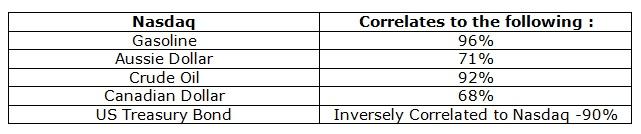
By combining the strong Seasonal tendency that MRCI has identified and the strong market correlations between all of these Seasonal Buy markets, I can see a reason for these markets to turn up in February (excluding the Treasury Bonds).
The Treasury Bonds have a Seasonal Sell this month as well, and looking at how the inverse correlation is at -90% this suggests the Bonds should be going in different directions than the Nasdaq market. Considering how far the Bond market has rallied this trend could be getting weak.
Looking back to the last Quarter of 2015, there was an auto sales report that showed the largest auto sales for a 4th quarter. Typically Energy prices rally into the spring driving season as refiners refine gasoline for the busy summer driving season. My question is, “Do you think that the largest auto sales report will have cars sitting in driveways or out on our nation’s highways this summer with low gasoline prices?”
“Believe you can and you’re halfway there.” Theodore Roosevelt
This content is intended to provide educational information only. This information should not be construed as individual or customized legal, tax, financial or investment services. As each individual's situation is unique, a qualified professional should be consulted before making legal, tax, financial and investment decisions. The educational information provided in this article does not comprise any course or a part of any course that may be used as an educational credit for any certification purpose and will not prepare any User to be accredited for any licenses in any industry and will not prepare any User to get a job. Reproduced by permission from OTAcademy.com click here for Terms of Use: https://www.otacademy.com/about/terms
Editors’ Picks
USD/JPY gathers strength to near 157.50 as Takaichi’s party wins snap elections
The USD/JPY pair attracts some buyers to around 157.45 during the early Asian session on Monday. The Japanese Yen weakens against the US Dollar after Japan’s ruling Liberal Democratic Party won an outright majority in Sunday’s lower house election, opening the door to more fiscal stimulus by Prime Minister Sanae Takaichi.
Gold: Volatility persists in commodity space
After losing more than 8% to end the previous week, Gold remained under heavy selling pressure on Monday and dropped toward $4,400. Although XAU/USD staged a decisive rebound afterward, it failed to stabilize above $5,000. The US economic calendar will feature Nonfarm Payrolls and Consumer Price Index data for January, which could influence the market pricing of the Federal Reserve’s policy outlook and impact Gold’s performance.
AUD/USD eyes 0.7050 hurdle amid supportive fundamental backdrop
AUD/USD builds on Friday's goodish rebound from sub-0.6900 levels and kicks off the new week on a positive note, with bulls awaiting a sustained move and acceptance above mid-0.7000s before placing fresh bets. The widening RBA-Fed divergence, along with the upbeat market mood, acts as a tailwind for the risk-sensitive Aussie amid some follow-through US Dollar selling for the second straight day.
Week ahead: US NFP and CPI data to shake Fed cut bets, Japan election looms
US NFP and CPI data awaited after Warsh’s nomination as Fed chief. Yen traders lock gaze on Sunday’s snap election. UK and Eurozone Q4 GDP data also on the agenda. China CPI and PPI could reveal more weakness in domestic demand.
Three scenarios for Japanese Yen ahead of snap election Premium
The latest polls point to a dominant win for the ruling bloc at the upcoming Japanese snap election. The larger Sanae Takaichi’s mandate, the more investors fear faster implementation of tax cuts and spending plans.
RECOMMENDED LESSONS
Making money in forex is easy if you know how the bankers trade!
I’m often mystified in my educational forex articles why so many traders struggle to make consistent money out of forex trading. The answer has more to do with what they don’t know than what they do know. After working in investment banks for 20 years many of which were as a Chief trader its second knowledge how to extract cash out of the market.
5 Forex News Events You Need To Know
In the fast moving world of currency markets where huge moves can seemingly come from nowhere, it is extremely important for new traders to learn about the various economic indicators and forex news events and releases that shape the markets. Indeed, quickly getting a handle on which data to look out for, what it means, and how to trade it can see new traders quickly become far more profitable and sets up the road to long term success.
Top 10 Chart Patterns Every Trader Should Know
Chart patterns are one of the most effective trading tools for a trader. They are pure price-action, and form on the basis of underlying buying and selling pressure. Chart patterns have a proven track-record, and traders use them to identify continuation or reversal signals, to open positions and identify price targets.
7 Ways to Avoid Forex Scams
The forex industry is recently seeing more and more scams. Here are 7 ways to avoid losing your money in such scams: Forex scams are becoming frequent. Michael Greenberg reports on luxurious expenses, including a submarine bought from the money taken from forex traders. Here’s another report of a forex fraud. So, how can we avoid falling in such forex scams?
What Are the 10 Fatal Mistakes Traders Make
Trading is exciting. Trading is hard. Trading is extremely hard. Some say that it takes more than 10,000 hours to master. Others believe that trading is the way to quick riches. They might be both wrong. What is important to know that no matter how experienced you are, mistakes will be part of the trading process.
The challenge: Timing the market and trader psychology
Successful trading often comes down to timing – entering and exiting trades at the right moments. Yet timing the market is notoriously difficult, largely because human psychology can derail even the best plans. Two powerful emotions in particular – fear and greed – tend to drive trading decisions off course.