 Don Dawson
Online Trading Academy
It’s time to try and explain how the Futures markets work. If you have ever tried to explain something like trading to someone who has never had an interest in the markets you can probably relate to this story.
Free WorkshopWhen I first started trading, there were only seminars on how to teach you to trade around the country at hotels. I attended a couple of them but to my disappointment learned absolutely nothing. And, of course, when you needed to ask a question the “circus” had left town.
My next direction was to get a Commodity Brokers license (Series 3). For this I had to finish a course and then take an exam that lasted about 10 hours. The main reason I did this was to learn the mechanics of the markets, not necessarily how to trade. Mission accomplished and now I felt better prepared to learn more about trading. Knowing about options, limit moves, types of orders used in the markets, etc. all helped me gain some confidence. Soon after this I registered with the National Futures Association as a Commodity Trading Advisor.
From the moment I began getting involved with Futures trading I knew I would be in this industry in some capacity or another for a career. My preference was to be a Futures trader first, but if that did not work out I could work as a Commodity Broker.
While there are many great brokers, the job basically is a sales position first with a little trading. I kept practicing my trading and each time I got frustrated and wanted to quit I looked at that broker’s license. Each time reminding myself that calling people to sell was not something that fit my personality, so I pressed on to try and become a better trader.
It was during this time that my dad knew I had my broker’s license, though he just did not know what it was. There were times we would be out somewhere and we would meet somebody he knew. It never failed he would say, “This is my son, he is a Bookie.” To him and many others, trading is a form of gambling. While I would agree to that to an extent, the biggest difference is professional traders place the odds in their favor before placing a trade. Unlike gambling at a casino, the house always has the edge.
So, I decided to try and explain the significance that speculators like I and others who speculate on market directions make to the markets. Basically, we provide liquidity for larger Commercial traders to place their trades. This, in turn, helps to keep the higher cost from being passed on to the consumer.
Let’s review the two primary market participants:
Commercial Traders
Large and Small Speculators
Commercial traders are using the Futures markets to hedge against price risk. They are not trying to speculate on market direction. They use Futures contracts as an insurance policy against large price changes in a Commodity that could have a huge impact on their profit margins. You will find Commercial traders most long at market bottoms and most short at market tops.
Large and Small Speculators are trying to capitalize on correctly identifying market directions. Small Speculators are usually trading contract size under the minimum reporting levels and, therefore, do not have a huge impact on the markets today. Large Speculators do have a huge impact on the markets. These traders have a lot of managed money to put to work in the markets. Their style of trading is usually trend following. You will notice this group of traders are mostly long at market tops and are mostly short at market bottoms. They make their money in the middle, not tops and bottoms of market moves.
Figure 1 is a weekly chart of the Wheat market going back about 2 years.
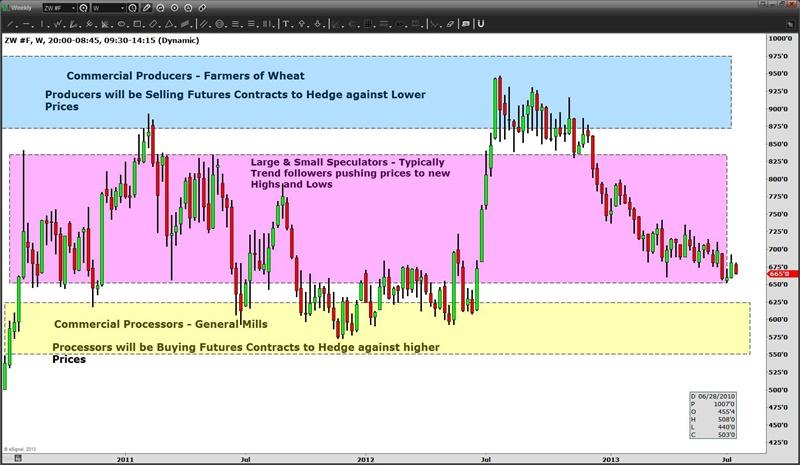
Looking at the chart you will see a blue box on top. This is where the Commercial Producers have been selling the Wheat market trying to lock in high prices. This way when the harvest season comes and there is an overabundance of Wheat the price will be much lower, but the Commercials have hedged themselves against this price decline. These producers who sold in the blue area will get paid for selling Futures contracts at much higher levels and buying them back or making delivery of Wheat against their contracts.
The yellow box below is where Commercial Processors of Wheat have been buying dips in this market. I used General Mills because they will be buying Wheat to process breads, pastries, cereals etc. They will be looking to buy at the lowest prices possible and this will allow for a larger profit margin after they process the Wheat and resell it.
At any given time you notice that the Producers are trying to sell at the highest prices possible and the Processors are trying to buy at the lowest prices possible. This means that if the Producer and the Processor were to trade with each other somebody would have to take a loss.
If the Producer agreed to sell their Wheat at the prices in the yellow box they will not be able to afford to operate their farms very long without making a profit.
If the Processors had to pay the prices in the blue box then their profit margin would be at a loss unless they could pass on much higher prices to the consumer. Can you imagine what a loaf of bread would cost today if the Producer and the Processor of Commodities had to trade with each other? What would a gallon of gasoline cost? What would it cost to build a home with Copper and Lumber?
This is where Speculators come in to help keep world Commodity prices as low as possible by providing liquidity for these Commercial traders. Since Large Speculators are typically trend followers, when they start to buy for an extended period of time prices naturally rally. It’s the same when they sell for long periods of time, the prices will naturally decline.
Notice in Figure 1 on the left side of the chart. Price starts out in the yellow area of Processor buying. Eventually they absorb all the Supply in the market and prices start to rally. As prices start to rally with this excessive Demand in the market our Large Speculator trend following systems detect an uptrend and they start putting large long positions on causing an uptrend in price.
Eventually these trend followers push prices high enough that the Producers of Wheat feel they can profit by selling at these higher prices. As they sell very large numbers of contracts they absorb the Demand in the market. Eventually the price starts to fall away from the blue area. Large Speculators trend following systems detect a downtrend and the market begins to trend lower.
The purple box shows where the Large Speculators are aggressively entering trends in the market. While the Producer and Processors are sitting patiently waiting until price is at value for them and then they will begin to aggressively place trades in the market.
Some people think the trend followers are always losing money because they are buying tops and selling bottoms. These traders do not wait until price is at these extremes to start placing their trades. They have been accumulating Futures contracts as the market moves in their direction. The use of a trailing stop is how they finally get stopped out when the market turns against them. This is how they make so much money in the middle of the moves.
I hope the next time somebody calls you a gambler or tells you to get a real job that you can explain to them that without Speculators in the Futures markets prices of that Starbucks coffee would be $15.00 instead of $5.00.
“Don’t worry about failures, worry about chances you miss when you don’t even try.” Jack Canfield
Your favorite “Bookie”,
This content is intended to provide educational information only. This information should not be construed as individual or customized legal, tax, financial or investment services. As each individual's situation is unique, a qualified professional should be consulted before making legal, tax, financial and investment decisions. The educational information provided in this article does not comprise any course or a part of any course that may be used as an educational credit for any certification purpose and will not prepare any User to be accredited for any licenses in any industry and will not prepare any User to get a job. Reproduced by permission from OTAcademy.com click here for Terms of Use: https://www.otacademy.com/about/terms
Editors’ Picks

EUR/USD holds firm near 1.1850 amid USD weakness
EUR/USD remains strongly bid around 1.1850 in European trading on Monday. The USD/JPY slide-led broad US Dollar weakness helps the pair build on Friday's recovery ahead of the Eurozone Sentix Investor Confidence data for February.

GBP/USD holds medium-term bullish bias above 1.3600
The GBP/USD pair trades on a softer note around 1.3605 during the early European session on Monday. Growing expectation of the Bank of England’s interest-rate cut weighs on the Pound Sterling against the Greenback.

USD/JPY falls further toward 156.00 as intervention risks dominate
The Japanese Yen is looking to build on its strong intraday move up amid speculations that authorities will step in to stem weakness in the domestic currency. In fact, Japan’s Finance Minister Satsuki Katayama stepped up intervention warnings and confirmed close coordination with the US against disorderly FX moves. This, along with some follow-through US Dollar selling, triggers an intraday USD/JPY turnaround from the 157.65 region, touched in reaction to Prime Minister Sanae Takaichi's landslide win in Sunday's election.
Editors’ Picks
EUR/USD holds firm near 1.1850 amid USD weakness
EUR/USD remains strongly bid around 1.1850 in European trading on Monday. The USD/JPY slide-led broad US Dollar weakness helps the pair build on Friday's recovery ahead of the Eurozone Sentix Investor Confidence data for February.
USD/JPY falls further toward 156.00 as intervention risks dominate
The Japanese Yen is looking to build on its strong intraday move up amid speculations that authorities will step in to stem weakness in the domestic currency. In fact, Japan’s Finance Minister Satsuki Katayama stepped up intervention warnings and confirmed close coordination with the US against disorderly FX moves. This, along with some follow-through US Dollar selling, triggers an intraday USD/JPY turnaround from the 157.65 region, touched in reaction to Prime Minister Sanae Takaichi's landslide win in Sunday's election.

Gold sticks to gains above $5,000 as China's buying and Fed rate-cut bets drive demand
Gold surges past the $5,000 psychological mark during the Asian session on Monday in reaction to the weekend data, showing that the People's Bank of China extended its buying spree for a 15th month in January. Moreover, dovish US Federal Reserve expectations and concerns about the central bank's independence drag the US Dollar lower for the second straight day, providing an additional boost to the non-yielding yellow metal.

Bitcoin, Ethereum and Ripple consolidate after massive sell-off
Bitcoin, Ethereum, and Ripple prices consolidated on Monday after correcting by nearly 9%, 8%, and 10% in the previous week, respectively. BTC is hovering around $70,000, while ETH and XRP are facing rejection at key levels.

Japan's Takaichi secures historic victory in snap election
In Japan, Prime Minister Sanae Takaichi's coalition secured a supermajority in the lower house, winning 328 out of 465 seats following a rare winter snap election. This provides her with a strong mandate to advance her legislative agenda.
RECOMMENDED LESSONS
Making money in forex is easy if you know how the bankers trade!

I’m often mystified in my educational forex articles why so many traders struggle to make consistent money out of forex trading. The answer has more to do with what they don’t know than what they do know. After working in investment banks for 20 years many of which were as a Chief trader its second knowledge how to extract cash out of the market.
5 Forex News Events You Need To Know

In the fast moving world of currency markets where huge moves can seemingly come from nowhere, it is extremely important for new traders to learn about the various economic indicators and forex news events and releases that shape the markets. Indeed, quickly getting a handle on which data to look out for, what it means, and how to trade it can see new traders quickly become far more profitable and sets up the road to long term success.
Top 10 Chart Patterns Every Trader Should Know

Chart patterns are one of the most effective trading tools for a trader. They are pure price-action, and form on the basis of underlying buying and selling pressure. Chart patterns have a proven track-record, and traders use them to identify continuation or reversal signals, to open positions and identify price targets.
7 Ways to Avoid Forex Scams

The forex industry is recently seeing more and more scams. Here are 7 ways to avoid losing your money in such scams: Forex scams are becoming frequent. Michael Greenberg reports on luxurious expenses, including a submarine bought from the money taken from forex traders. Here’s another report of a forex fraud. So, how can we avoid falling in such forex scams?
What Are the 10 Fatal Mistakes Traders Make
Trading is exciting. Trading is hard. Trading is extremely hard. Some say that it takes more than 10,000 hours to master. Others believe that trading is the way to quick riches. They might be both wrong. What is important to know that no matter how experienced you are, mistakes will be part of the trading process.
The challenge: Timing the market and trader psychology

Successful trading often comes down to timing – entering and exiting trades at the right moments. Yet timing the market is notoriously difficult, largely because human psychology can derail even the best plans. Two powerful emotions in particular – fear and greed – tend to drive trading decisions off course.