 Gabe Velázquez
Online Trading Academy
When I travel around the country meeting prospective students of Online Trading Academy, one thing that always strikes me is the vast misconceptions people have about the markets and what profitable trading entails. First, let me say that it is not their fault. I, like everyone else, used to have the same misguided thoughts about what it takes to be a consistently profitable trader.
Let’s start the conversation by talking about volume. The general perception is that volume is required for a move to be sustainable. The reality is that in any free market, in order for a transaction to occur there have to be two parties, a buyer and a seller that agree upon a certain price. This being the case, what causes price to move higher or lower? Prices move higher primarily because of the eagerness of buyers to pay higher and higher prices. Conversely, a price decline is the result of sellers that are compelled to take lower prices because of their emotional responses to bad news, a steep decline in price or other factors.
In the actual execution of trades, conventional technical analysis teaches traders to wait for volume confirmation before entering a trade. There is a major flaw with this way of thinking, however. In the chart below we can see that when The E-mini Russell 2000 (TF) futures contract was trading sideways the volume was paltry, but as the sell-off began in earnest the volume began to expand.
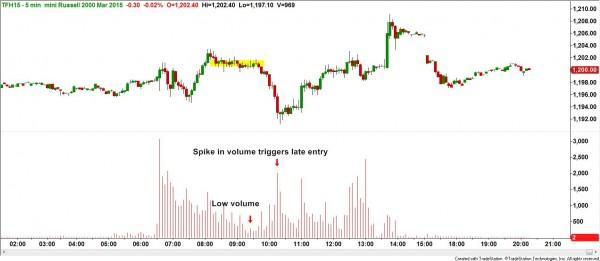
Unfortunately, for those traders that needed to see a spike in volume to enter a short trade the highest volume figure printed right as the TF bottomed. Could the market have sold off further and produced profits for those traders? Yes, of course. However, the point here is that waiting for volume confirmation will never get you into a trade at the lowest risk entry point. This will only occur where supply and demand is most out of balance. Coincidentally, volume is usually low when this occurs.
A question I’m frequently asked is what news service I use. When I respond that I never watch the financial news channels, I often get a befuddled look from people. They can’t understand how anyone can trade without knowing what’s happening in the economy, globally or otherwise. That fact is that good news usually gets traders to buy after a rally in price into a price level where institutions have a ton of sell orders. How can we make this assertion? Think about the last time you bought a stock, or any financial instrument for that matter, after a positive news release only to see the stock decline. The same goes for selling after presumed bad news. Similar to volume, news is not what we need to make trading decisions. Instead, the way to look at these releases is that bad news generally pushes price lower into high quality demand zones, which turn out be great buying opportunities. And, as you might have guessed, good news provides a great pool of buyers for the institutions to sell a bunch of their shares.
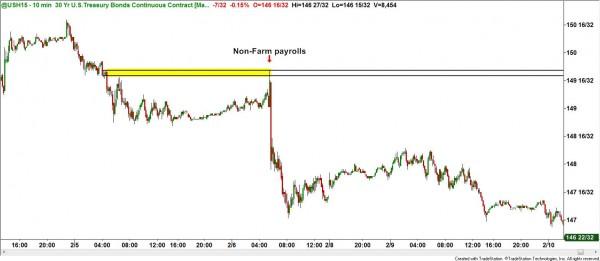
In a recent example, the government released their report on non-farm payrolls (employment). On this occasion the economy grew nicely and there were over 250,000 jobs created, which is generally bad news for the bond market. In the chart below we can see that bonds initially reacted very positive driving price into a high quality supply zone. Bonds should have sold off immediately after the good news but they didn’t. This triggered new buyers to come in. The result is that the institutions needed buyers in order to unload a big bond position.
The bottom line is that most people are looking in all the wrong places for their information, and in doing so lose focus of how the markets really work. Change what you look at and perhaps your results will also change.
This content is intended to provide educational information only. This information should not be construed as individual or customized legal, tax, financial or investment services. As each individual's situation is unique, a qualified professional should be consulted before making legal, tax, financial and investment decisions. The educational information provided in this article does not comprise any course or a part of any course that may be used as an educational credit for any certification purpose and will not prepare any User to be accredited for any licenses in any industry and will not prepare any User to get a job. Reproduced by permission from OTAcademy.com click here for Terms of Use: https://www.otacademy.com/about/terms
Editors’ Picks

EUR/USD hovers around nine-day EMA above 1.1800
EUR/USD remains in the positive territory after registering modest gains in the previous session, trading around 1.1820 during the Asian hours on Monday. The 14-day Relative Strength Index momentum indicator at 54 is edging higher, signaling improving momentum. RSI near mid-50s keeps momentum balanced. A sustained push above 60 would firm bullish control.

GBP/USD holds medium-term bullish bias above 1.3600
The GBP/USD pair trades on a softer note around 1.3605 during the early European session on Monday. Growing expectation of the Bank of England’s interest-rate cut weighs on the Pound Sterling against the Greenback.

USD/JPY drops back below 157.00 on Japan's verbal intervention
USD/JPY has come under moderate selling pressure below 157.00 in the Asian session on Monday. The Japanese Yen lost ground to near 157.70 following Japan’s ruling Liberal Democratic Party's outright majority win in Sunday’s lower house election, opening the door to more fiscal stimulus by Prime Minister Sanae Takaichi. However, JPY buyers jumped back and dragged the pair southward on FX verbal intervention by Japan’s Finance Minister Katayama.
Editors’ Picks
EUR/USD hovers around nine-day EMA above 1.1800
EUR/USD remains in the positive territory after registering modest gains in the previous session, trading around 1.1820 during the Asian hours on Monday. The 14-day Relative Strength Index momentum indicator at 54 is edging higher, signaling improving momentum. RSI near mid-50s keeps momentum balanced. A sustained push above 60 would firm bullish control.

Gold sticks to gains above $5,000 as China's buying and Fed rate-cut bets drive demand
Gold surges past the $5,000 psychological mark during the Asian session on Monday in reaction to the weekend data, showing that the People's Bank of China extended its buying spree for a 15th month in January. Moreover, dovish US Federal Reserve expectations and concerns about the central bank's independence drag the US Dollar lower for the second straight day, providing an additional boost to the non-yielding yellow metal.
GBP/USD holds medium-term bullish bias above 1.3600
The GBP/USD pair trades on a softer note around 1.3605 during the early European session on Monday. Growing expectation of the Bank of England’s interest-rate cut weighs on the Pound Sterling against the Greenback.

Bitcoin, Ethereum and Ripple consolidate after massive sell-off
Bitcoin, Ethereum, and Ripple prices consolidated on Monday after correcting by nearly 9%, 8%, and 10% in the previous week, respectively. BTC is hovering around $70,000, while ETH and XRP are facing rejection at key levels.

Weekly column: Saturn-Neptune and the end of the Dollar’s 15-year bull cycle
Tariffs are not only inflationary for a nation but also risk undermining the trust and credibility that go hand in hand with the responsibility of being the leading nation in the free world and controlling the world’s reserve currency.
RECOMMENDED LESSONS
Making money in forex is easy if you know how the bankers trade!

I’m often mystified in my educational forex articles why so many traders struggle to make consistent money out of forex trading. The answer has more to do with what they don’t know than what they do know. After working in investment banks for 20 years many of which were as a Chief trader its second knowledge how to extract cash out of the market.
5 Forex News Events You Need To Know

In the fast moving world of currency markets where huge moves can seemingly come from nowhere, it is extremely important for new traders to learn about the various economic indicators and forex news events and releases that shape the markets. Indeed, quickly getting a handle on which data to look out for, what it means, and how to trade it can see new traders quickly become far more profitable and sets up the road to long term success.
Top 10 Chart Patterns Every Trader Should Know

Chart patterns are one of the most effective trading tools for a trader. They are pure price-action, and form on the basis of underlying buying and selling pressure. Chart patterns have a proven track-record, and traders use them to identify continuation or reversal signals, to open positions and identify price targets.
7 Ways to Avoid Forex Scams

The forex industry is recently seeing more and more scams. Here are 7 ways to avoid losing your money in such scams: Forex scams are becoming frequent. Michael Greenberg reports on luxurious expenses, including a submarine bought from the money taken from forex traders. Here’s another report of a forex fraud. So, how can we avoid falling in such forex scams?
What Are the 10 Fatal Mistakes Traders Make
Trading is exciting. Trading is hard. Trading is extremely hard. Some say that it takes more than 10,000 hours to master. Others believe that trading is the way to quick riches. They might be both wrong. What is important to know that no matter how experienced you are, mistakes will be part of the trading process.
The challenge: Timing the market and trader psychology

Successful trading often comes down to timing – entering and exiting trades at the right moments. Yet timing the market is notoriously difficult, largely because human psychology can derail even the best plans. Two powerful emotions in particular – fear and greed – tend to drive trading decisions off course.