With the US Presidential election coming up, a unique trade has developed called a synthetic cross pair with the Mexican Peso and the Russian Ruble. A synthetic cross pair is a trade between 2 currencies of which neither one of the currencies is referencing the US dollar. They do not directly trade against each other. This strategy is based off of one currency weakening against the US Dollar while at the same time another currency strengthens. The synthetic cross pair that has been gaining in popularity over the last few weeks has been dubbed the “Trump Trade”.

This synthetic cross pair is created when you buy a USDMXN and sell a USDRUB.  In this trade, the Mexican Peso would weaken against the US Dollar while the Russian Ruble would strengthen against the US Dollar. This strategy can be utilized off of a macro/geo political event or a potential change in monetary policy. In this case, it is a geo political event. The two currencies involved should have an inverse relationship to each other against the US dollar, boosting the return of the trade. This type of trade should not be looked at as any sort of hedge.

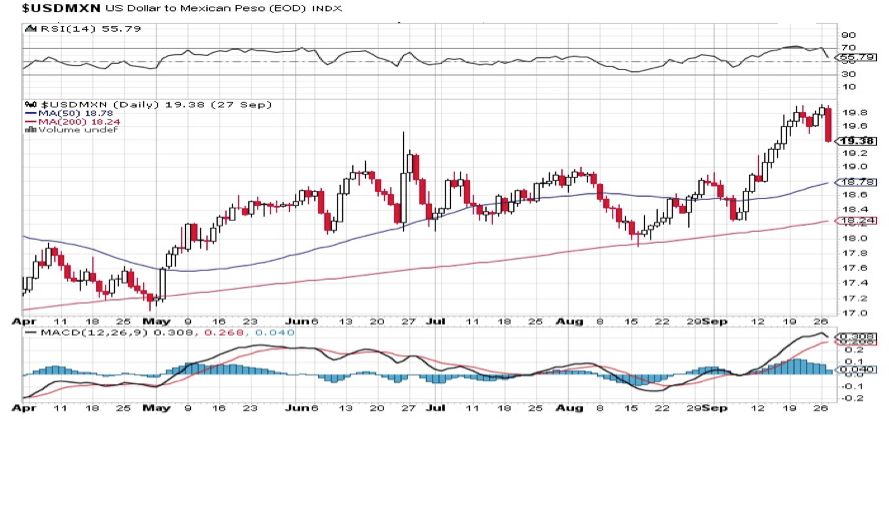
Their has been a direct correlation to a weakening of the Mexican Peso against the US Dollar as Presidential polling numbers show the Republican candidate, Donald Trump closing the lead against Democratic candidate, Hillary Clinton. With Trump’s rhetoric about building a wall on the Mexican border and altering NAFTA, Mexico’s economy would suffer sending the price of the Peso lower against the US dollar. In the last few weeks, as Trump’s polling numbers continue to climb, we saw the Mexican Peso hit an all-time low against the US Dollar the other week. However, with polls suggesting that Trump lost the first debate this past Monday, the Peso strengthened but is still down 6% for the month.
 

We can say the opposite for the Russian Ruble as that currency has strengthened as Trump makes Pro Russian statements, talks about a potential shift in NATO and would likely build a strong relationship with the Russian President Vladimir Putin. If Trump were President, sanctions against Russia by the US would be lifted strengthening Russia’s economy. This new US-Russian relationship would strengthen the Ruble against the US Dollar. Similar to Mexico, as recent polls showed Trump narrowing Clinton’s lead, the Ruble gained in strength. And as reiterated earlier, with polls suggesting that Trump lost the debate, the Ruble weakened as a vote for Clinton is a vote for the staus quo. Clinton and Putin are also not the biggest fans of eachother.     

With the information given above, to now create this synthetic cross pair would include 2 trades. One downside to the potential boost in return is that you will have to pay more in bid offers since you are paying for both trades.


This blog represents the view/opinions of the author and not those of his employer.

Editors’ Picks

EUR/USD softens below 1.1750 amid ECB rate hold expectations

EUR/USD softens below 1.1750 amid ECB rate hold expectations

The EUR/USD pair declines to around 1.1730 during the early European session on Wednesday, pressured by renewed US Dollar demand. Nonetheless, the potential downside for the major pair might be limited amid the growing acceptance that the European Central Bank is done cutting interest rates. 

GBP/USD gains ground above 1.3400 on UK PMI optimism

GBP/USD gains ground above 1.3400 on UK PMI optimism

The GBP/USD pair gains momentum to around 1.3425 during the early Asian session on Wednesday. The Pound Sterling edges higher against the Greenback on the upbeat UK preliminary S&P Global Purchasing Managers' Index data. Traders will take more cues from the Fedspeak later on Wednesday. 

USD/JPY bounces to 155.00 as Japanese Yen sees pre-BoJ profit taking

USD/JPY bounces to 155.00 as Japanese Yen sees pre-BoJ profit taking

USD/JPY is back on the bids, retaking 150.00 in the Asian session on Wednesday. The Japanese Yen sees fresh declines on profit-taking ahead of Friday's BoJ event risk, while the US Dollar recovers following the mixed US jobs data-led sell-off. Fedspeak awaited.


Editors’ Picks

AUD/USD consolidates near weekly lows below 0.6650

AUD/USD consolidates near weekly lows below 0.6650

AUD/USD trades with a negative bias for the fifth straight day early Wednesday, close to weekly lows below 0.6650. A softer risk tone, China's economic woes and a broad US Dollar bounce undermine the Aussie. However, the downside appears cushioned by the hawkish RBA outlook and commodities' uptick. 

USD/JPY bounces to 155.00 as Japanese Yen sees pre-BoJ profit taking

USD/JPY bounces to 155.00 as Japanese Yen sees pre-BoJ profit taking

USD/JPY is back on the bids, retaking 150.00 in the Asian session on Wednesday. The Japanese Yen sees fresh declines on profit-taking ahead of Friday's BoJ event risk, while the US Dollar recovers following the mixed US jobs data-led sell-off. Fedspeak awaited.

Gold advances to near seven-week highs amid US labor market cooling

Gold advances to near seven-week highs amid US labor market cooling

Gold price extends its upside to near seven-week highs above $4,300 during the Asian trading hours on Wednesday. The precious metal gains momentum as the US labor market remains relatively resilient but shows signs of slowing. The mixed US employment report for November reinforces bets of further rate cuts by the US Federal Reserve and weighs on the US Dollar.

WTI climbs above $55.50 as Trump orders blockade of sanctioned Venezuelan oil tankers

WTI climbs above $55.50 as Trump orders blockade of sanctioned Venezuelan oil tankers

West Texas Intermediate, the US crude oil benchmark, is trading around $55.75 during the Asian trading hours on Wednesday. The WTI price climbs amid rising volatility around Latin American crude supply. Traders await the release of the Energy Information Administration crude oil stockpiles report later on Wednesday.

Ukraine-Russia in the spotlight once again

Ukraine-Russia in the spotlight once again

Since the start of the week, gold’s price has moved lower, but has yet to erase the gains made last week. In today’s report we intend to focus on the newest round of peace talks between Russia and Ukraine, whilst noting the release of the US Employment data later on day and end our report with an update in regards to the tensions brewing in Venezuela.

RECOMMENDED LESSONS

5 Forex News Events You Need To Know

In the fast moving world of currency markets where huge moves can seemingly come from nowhere, it is extremely important for new traders to learn about the various economic indicators and forex news events and releases that shape the markets. Indeed, quickly getting a handle on which data to look out for, what it means, and how to trade it can see new traders quickly become far more profitable and sets up the road to long term success.

Top 10 Chart Patterns Every Trader Should Know

Chart patterns are one of the most effective trading tools for a trader. They are pure price-action, and form on the basis of underlying buying and selling pressure. Chart patterns have a proven track-record, and traders use them to identify continuation or reversal signals, to open positions and identify price targets.

7 Ways to Avoid Forex Scams

The forex industry is recently seeing more and more scams. Here are 7 ways to avoid losing your money in such scams: Forex scams are becoming frequent. Michael Greenberg reports on luxurious expenses, including a submarine bought from the money taken from forex traders. Here’s another report of a forex fraud. So, how can we avoid falling in such forex scams?

What Are the 10 Fatal Mistakes Traders Make

Trading is exciting. Trading is hard. Trading is extremely hard. Some say that it takes more than 10,000 hours to master. Others believe that trading is the way to quick riches. They might be both wrong. What is important to know that no matter how experienced you are, mistakes will be part of the trading process.

Strategy

Money Management

Psychology

Best Brokers of 2025