Breakout Trading - Part Two

…Following on from “Breakout Trading – Part One” we now have the second instalment where we look at some advanced breakout methodologies and talk more about really focusing on choosing the right setups. To see part one, click here!
Playing The Retest
Whilst considering your personal risk profile in how you trade breakouts, another important option is to consider trading the retest. You see, even if you opt for the more conservative approach of waiting for a candle close to confirm the breakout, there is still a risk that the break-out is false and price will simply reverse and head back inside the range. The real test of whether or not the break-out is going to play out properly comes when/if price retests the range. If price breaks-out then reverses back to retest the range but fails to break back inside and starts to head off again, this is a high-probability pattern you can look to take advantage of.
Again, as with any strategy there are pros and cons. Not all breakouts retest the range and so you might end up missing quite a lot of trades. However, it is important to remember that trade frequency doesn’t guarantee returns. A failed retest of the range is a much more strategic way to play breakouts and can actually allow you to tighten your risk.
When we trade the basic breakout method our stop is the other side of the range to allow for price retesting the range and possibly trading back within the range before breaking out properly. However, when we trade the retest method we are assuming that the market has made its retest of the range and the failure to break back inside signals that the break-out is in play.
So as this is the case we no longer need to place our stop the other side of the range, we could for instance place our stop at the midpoint of the range or even, being slightly more tactical, look to use a recent swing high in the range to place our stop (when trading short) or use a recent swing low in the range for stop placement (when trading long).
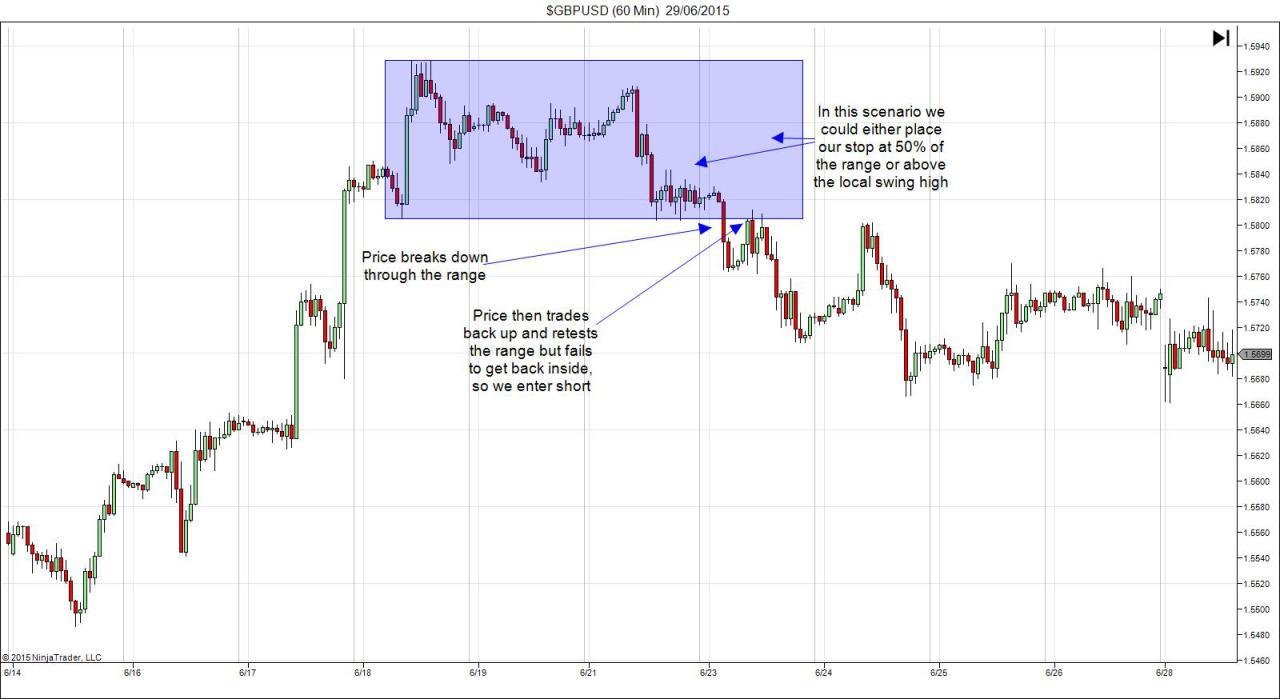
The example above demonstrates this retest trade idea clearly and shows you how you could use either the midpoint of the range or against a local structure point, in this case above a recent swing high. Targets in this scenario remain the same, simply target multiples of risk with the same options to exit a portion of the trade and or trail stops.
Using Further Tools
So far we’ve only looked at the naked price action alone in trading this method but there are some other tools you can look to use to help increase your chances of success when trading “breakouts”. If you think about the essence of this method, we are simply attempting to latch on to momentum in the market and catch a directional move, so it makes sense to use a tool that can help identify momentum in the market.
One of the tools I find most useful when trading breakouts is the ATR indicator. The ATR indicator gives the average range of the instrument over whichever time period you are trading. So using ATR on the daily charts gives you the average daily range and using the ATR on the 60 minute charts gives you the average range 1 hour range. The ATR can come in extremely useful in identifying the conditions necessary for successful breakout trading.
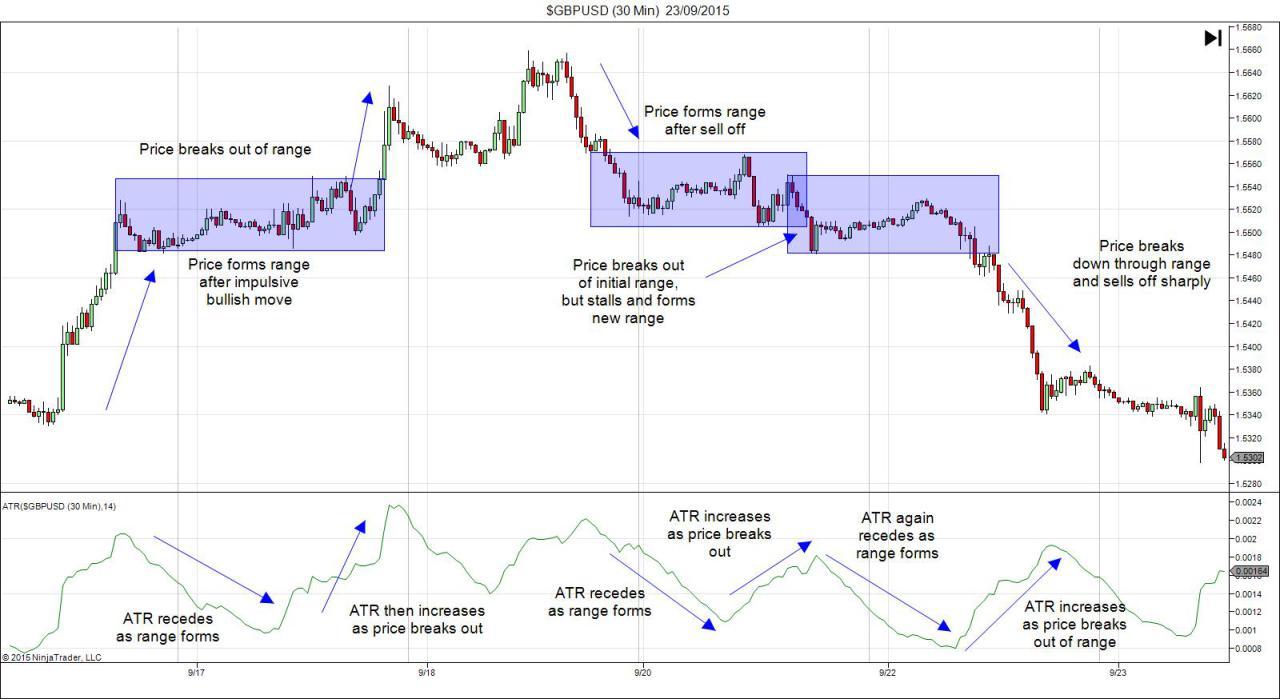
In the example above note how price first of all sees an impulsive move to the upside before stalling and forming a range. Whilst the range is forming ATR decreases showing us that volatility and momentum have leaked from the market but as price starts to break out through the range high notice how ATR starts increasing rapidly confirming the move,
After topping out, price sells off and forms a range, again with ATR having decreased over the formation of the range. Then once more we see price breaking out of its range with ATR increasing confirming the return of volatility and momentum. Interestingly at this point (and why it makes a great example) is that although we see an initial break of the range in line with an increase in ATR, we don’t get a proper breakdown just yet and price once again forms a range as ATR falls back. The increase in ATR as price moved to the downside however signals to use that momentum in the market favours a bearish move, and having consolidated for a period we then see price breaking down properly as ATR once again increases.
In this scenario, whether we had our stop above the range high, or above the local swing high we can see that we are kept in the trade to catch the sell-off.
Session Breakout Strategies
This is a method that I personally employ at times. The way that I like to operate this strategy is to look for an impulsive burst following the London open ( with an accompanying increase in ATR) and then look for a brief consolidation before trading a continuation (breakout). This is quite a specific way to use this strategy and doesn’t always occur but where it does it can be a very simple, very effective trade to take.
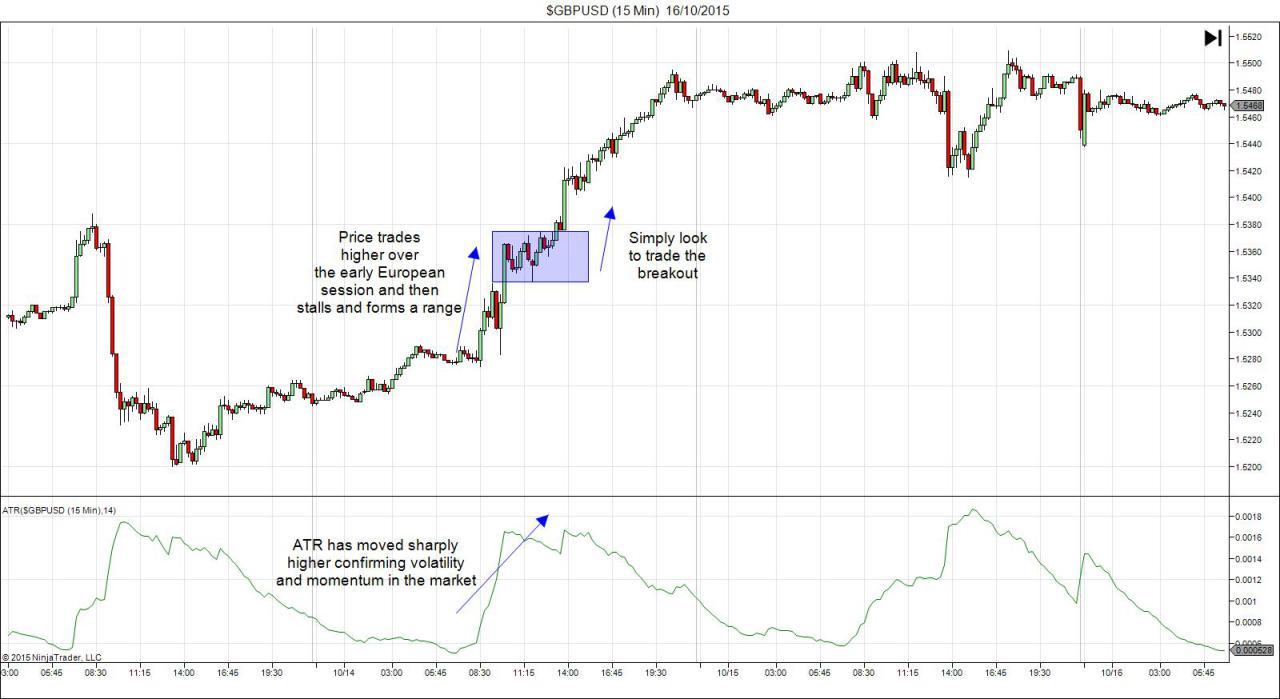
In the example above we can see how following quite late New York and Asian session trading price breaks sharply higher following the London open, with ATR confirming the move, before price stalls out and forms a mid session range. Once these conditions materialise I then simply look to trade a breakout.
Another way to use this method is to look to trade the breakout of the Asian session range using this same setup. So instead of waiting for price to consolidate in the European session, we look to use the burst of liquidity at the start of the European session.
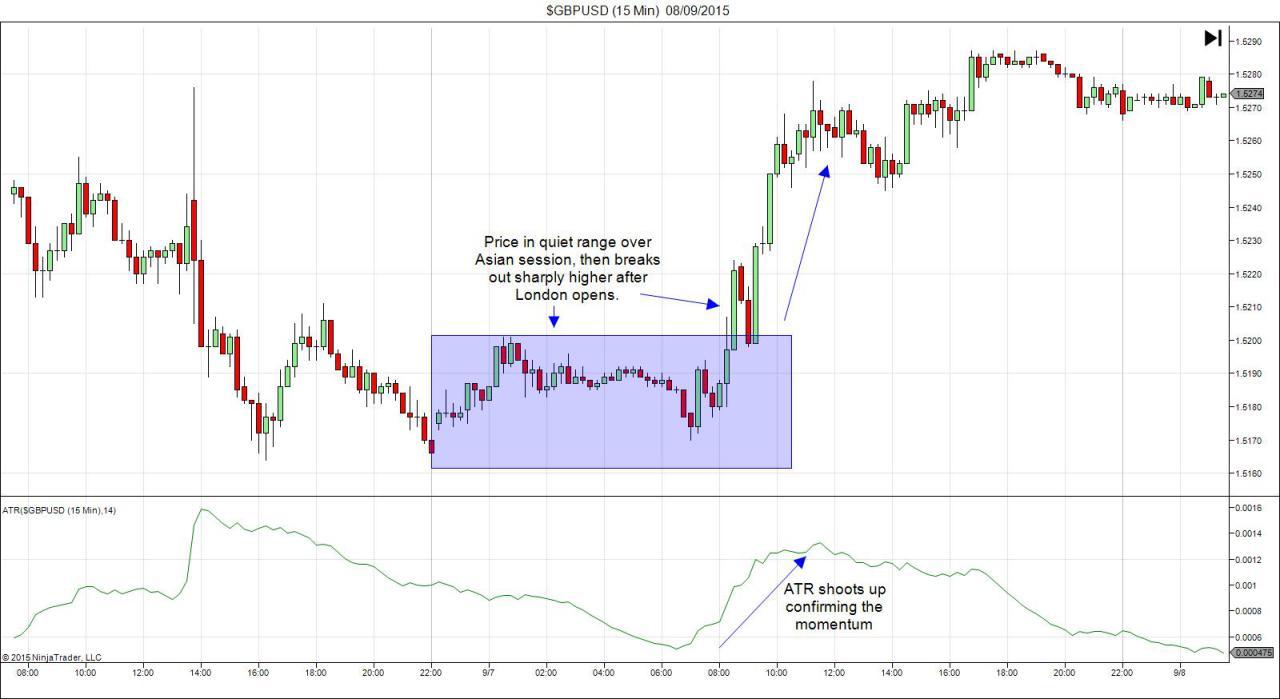
In the example above we can see that price trades a very quiet range over the Asian session but then shortly after London opens and European traders take to their desks we see price breaking out to the topside with ATR rapidly increasing confirming the momentum and volatility. Notice that we also get a lovely little retest trade as price boomerangs back to retest the broken range before taking off again.
Focus On Your Trading
Both of these setups are fantastic ways to trade breakouts. The problem that a lot of traders have with typical “session breakout” strategies ( and indeed the majority of strategies) is that they look to use them everyday in all market conditions and really, they just aren’t there everyday.
Identify the ideal scenarios in which these setups occur and how the charts look and how both price and ATR behave and then simply wait for these exact setups to occur, even if it means printing off examples of great setups and having them to hand so you can reference them when looking to trade these methods. Trading in this manner, instead of looking to arbitrarily apply the same strategy each day will give you far more success.
Don’t fear missing a trade, learn to understand the wealth of opportunity the markets present on a daily basis and really focus on finding your ideal setups where you don’t have to question the setup at all. Trying to stick to taking these trades only is a sure fire way to improve your trading success.
As Bill Lipschutz says – “If most traders would learn how to sit on their hands 50% of the time, they would make a lot more money.”
Playing The Retest
Whilst considering your personal risk profile in how you trade breakouts, another important option is to consider trading the retest. You see, even if you opt for the more conservative approach of waiting for a candle close to confirm the breakout, there is still a risk that the break-out is false and price will simply reverse and head back inside the range. The real test of whether or not the break-out is going to play out properly comes when/if price retests the range. If price breaks-out then reverses back to retest the range but fails to break back inside and starts to head off again, this is a high-probability pattern you can look to take advantage of.
Again, as with any strategy there are pros and cons. Not all breakouts retest the range and so you might end up missing quite a lot of trades. However, it is important to remember that trade frequency doesn’t guarantee returns. A failed retest of the range is a much more strategic way to play breakouts and can actually allow you to tighten your risk.
When we trade the basic breakout method our stop is the other side of the range to allow for price retesting the range and possibly trading back within the range before breaking out properly. However, when we trade the retest method we are assuming that the market has made its retest of the range and the failure to break back inside signals that the break-out is in play.
So as this is the case we no longer need to place our stop the other side of the range, we could for instance place our stop at the midpoint of the range or even, being slightly more tactical, look to use a recent swing high in the range to place our stop (when trading short) or use a recent swing low in the range for stop placement (when trading long).
The example above demonstrates this retest trade idea clearly and shows you how you could use either the midpoint of the range or against a local structure point, in this case above a recent swing high. Targets in this scenario remain the same, simply target multiples of risk with the same options to exit a portion of the trade and or trail stops.
Using Further Tools
So far we’ve only looked at the naked price action alone in trading this method but there are some other tools you can look to use to help increase your chances of success when trading “breakouts”. If you think about the essence of this method, we are simply attempting to latch on to momentum in the market and catch a directional move, so it makes sense to use a tool that can help identify momentum in the market.
One of the tools I find most useful when trading breakouts is the ATR indicator. The ATR indicator gives the average range of the instrument over whichever time period you are trading. So using ATR on the daily charts gives you the average daily range and using the ATR on the 60 minute charts gives you the average range 1 hour range. The ATR can come in extremely useful in identifying the conditions necessary for successful breakout trading.
In the example above note how price first of all sees an impulsive move to the upside before stalling and forming a range. Whilst the range is forming ATR decreases showing us that volatility and momentum have leaked from the market but as price starts to break out through the range high notice how ATR starts increasing rapidly confirming the move,
After topping out, price sells off and forms a range, again with ATR having decreased over the formation of the range. Then once more we see price breaking out of its range with ATR increasing confirming the return of volatility and momentum. Interestingly at this point (and why it makes a great example) is that although we see an initial break of the range in line with an increase in ATR, we don’t get a proper breakdown just yet and price once again forms a range as ATR falls back. The increase in ATR as price moved to the downside however signals to use that momentum in the market favours a bearish move, and having consolidated for a period we then see price breaking down properly as ATR once again increases.
In this scenario, whether we had our stop above the range high, or above the local swing high we can see that we are kept in the trade to catch the sell-off.
Session Breakout Strategies
This is a method that I personally employ at times. The way that I like to operate this strategy is to look for an impulsive burst following the London open ( with an accompanying increase in ATR) and then look for a brief consolidation before trading a continuation (breakout). This is quite a specific way to use this strategy and doesn’t always occur but where it does it can be a very simple, very effective trade to take.
In the example above we can see how following quite late New York and Asian session trading price breaks sharply higher following the London open, with ATR confirming the move, before price stalls out and forms a mid session range. Once these conditions materialise I then simply look to trade a breakout.
Another way to use this method is to look to trade the breakout of the Asian session range using this same setup. So instead of waiting for price to consolidate in the European session, we look to use the burst of liquidity at the start of the European session.
In the example above we can see that price trades a very quiet range over the Asian session but then shortly after London opens and European traders take to their desks we see price breaking out to the topside with ATR rapidly increasing confirming the momentum and volatility. Notice that we also get a lovely little retest trade as price boomerangs back to retest the broken range before taking off again.
Focus On Your Trading
Both of these setups are fantastic ways to trade breakouts. The problem that a lot of traders have with typical “session breakout” strategies ( and indeed the majority of strategies) is that they look to use them everyday in all market conditions and really, they just aren’t there everyday.
Identify the ideal scenarios in which these setups occur and how the charts look and how both price and ATR behave and then simply wait for these exact setups to occur, even if it means printing off examples of great setups and having them to hand so you can reference them when looking to trade these methods. Trading in this manner, instead of looking to arbitrarily apply the same strategy each day will give you far more success.
Don’t fear missing a trade, learn to understand the wealth of opportunity the markets present on a daily basis and really focus on finding your ideal setups where you don’t have to question the setup at all. Trying to stick to taking these trades only is a sure fire way to improve your trading success.
As Bill Lipschutz says – “If most traders would learn how to sit on their hands 50% of the time, they would make a lot more money.”
Author

James Harte, IMC
Orbex
James Harte is a Market Analyst and Content Author at Orbex with over eight years’ experience in analysing and trading currency markets.
More from James Harte, IMC