Many of us have traded an AUD currency pair, left the position overnight and then came back to see an “inexplicable” large move. There was no Australian data, no data for the other currency in the pair and no speaker for either of the currency pairs. That move was in fact a result of a large miss or beat for key Chinese data. But why does AUD move when Chinese data is released?

China is the largest trading partner of Australia, with China consuming around 33% of Australia’s exports such as iron ore, coal, copper, gold and other commodities. Strong performance of China’s economy usually suggests that Chinese demand for Australian commodities will increase, and vice versa for when the Chinese economy performs poorly. During my time as a professional Market Analyst, we would often see a positive correlation between the Chinese stock markets and copper when stocks were higher for the day. This is because speculators assume that when companies are doing well they will seek to expand, and while doing so will purchase raw materials, such as copper, in order to build infrastructure; thus increasing demand and price for the metal.

So, when we see a high volatility Chinese data release, we can expect a reaction in the AUD. A worse-than-expected value indicates poor performance for China, and will lead to a weaker AUD due to the assumption that demand from the Chinese for Australian commodities will fall. We see the opposite reaction for AUD when a better-than-expected value is released. As explained, a negative data release from China affects AUD, and in the long term will affect the growth of Australia, due to the decreasing demand for Australian commodities. The Australian economy relies on exports to drive aggregate demand as the export of goods accounts for around 20% of the nation’s GDP.

The data that has the greatest effect on AUD and the Australian economy I sChinese CPI. To simplify, Chinese CPI has an indirect effect on Australian CPI. If the former falls, the latter is likely to follow, and in turn leads to the RBA using lower rates to stimulate the economy. When Chinese CPI is trending either higher or lower, we then know that there is a high probability that Australian CPI will soon follow that same trend.
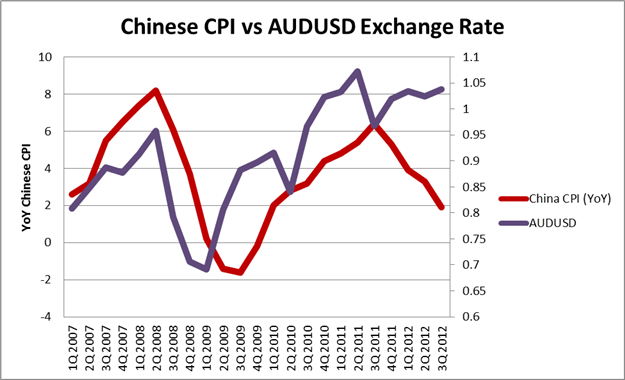
China CPI vs Australia

(source: Trading Economics)

The chart above shows the relationship between Chinese CPI and the AUD/USD exchange from 2007-2012. As We can see, AUD/USD lags behind Chinese CPI. We can also see some divergence in the latter part of the chart as Chinese CPI continued lower to near 3-year lows, however the general relationship has since resumed. When trading, it is important to keep an eye on Chinese CPI projections as well as the current trend, in order to construct detailed fundamental analysis.
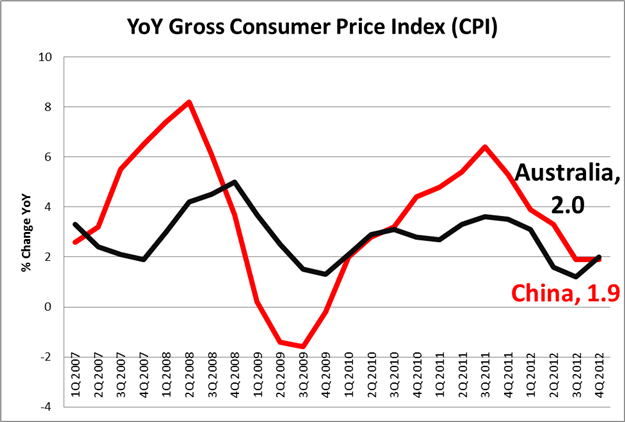
China vs Australia CPI

(source: Trading Economics)

The chart above shows the relationship between CPI Y/Y for both Australia (black) and China (red). Once again, some correlation can be seen, with Australia lagging behind.

To conclude, it is now clear to see why China has a large effect on the Australian economy and currency. With this knowledge, we can have an edge in the market as we have a deeper understanding of the fundamentals that influence these two trade partners.


Risk Warning: This is the SBForex view of the market and is not trading/investment advice. Foreign Exchange and CFD trading carries a high level of risk and may not be suitable for all investors. There is a possibility that you may sustain a loss equal to or greater than your entire investment. Therefore, you should not invest or risk money that you cannot afford to lose.

Editors’ Picks

EUR/USD moves sideways below 1.1800 on Christmas Eve

EUR/USD moves sideways below 1.1800 on Christmas Eve

EUR/USD struggles to find direction and trades in a narrow channel below 1.1800 after posting gains for two consecutive days. Bond and stock markets in the US will open at the usual time and close early on Christmas Eve, allowing the trading action to remain subdued. 

GBP/USD keeps range around 1.3500 amid quiet markets

GBP/USD keeps range around 1.3500 amid quiet markets

GBP/USD keeps its range trade intact at around 1.3500 on Wednesday. The Pound Sterling holds the upper hand over the US Dollar amid pre-Christmas light trading as traders move to the sidelines heading into the holiday season. 

USD/JPY corrects further to near 155.80, gives up entire BoJ policy-led gains

USD/JPY corrects further to near 155.80, gives up entire BoJ policy-led gains

USD/JPY surrenders its entire gains made on the BoJ policy announcement day, and retraces to near 155.80. Investors are in vogue over the outlook of the BoJ’s monetary tightening campaign. The Fed is expected to cut interest rates by at least 50 bps next year.


Editors’ Picks

EUR/USD Price Annual Forecast: Growth to displace central banks from the limelight in 2026

EUR/USD Price Annual Forecast: Growth to displace central banks from the limelight in 2026 Premium

What a year! Donald Trump’s return to the United States (US) Presidency was no doubt what led financial markets throughout 2025. His not-always-unexpected or surprising decisions shaped investors’ sentiment, or better said, unprecedented uncertainty.

Gold Price Annual Forecast: 2026 could see new record-highs but a 2025-like rally is unlikely

Gold Price Annual Forecast: 2026 could see new record-highs but a 2025-like rally is unlikely Premium

Gold hit multiple new record highs throughout 2025. Trade-war fears, geopolitical instability and monetary easing in major economies were the main drivers behind Gold’s rally.

GBP/USD Price Annual Forecast: Will 2026 be another bullish year for Pound Sterling?

GBP/USD Price Annual Forecast: Will 2026 be another bullish year for Pound Sterling? Premium

Having wrapped up 2025 on a positive note, the Pound Sterling (GBP) eyes another meaningful and upbeat year against the US Dollar (USD) at the start of 2026.

US Dollar Price Annual Forecast: 2026 set to be a year of transition, not capitulation

US Dollar Price Annual Forecast: 2026 set to be a year of transition, not capitulation Premium

The US Dollar (USD) enters the new year at a crossroads. After several years of sustained strength driven by US growth outperformance, aggressive Federal Reserve (Fed) tightening, and recurrent episodes of global risk aversion, the conditions that underpinned broad-based USD appreciation are beginning to erode, but not collapse.

Bitcoin Price Annual Forecast: BTC holds long-term bullish structure heading into 2026

Bitcoin Price Annual Forecast: BTC holds long-term bullish structure heading into 2026

Bitcoin (BTC) is wrapping up 2025 as one of its most eventful years, defined by unprecedented institutional participation, major regulatory developments, and extreme price volatility.

RECOMMENDED LESSONS

5 Forex News Events You Need To Know

In the fast moving world of currency markets where huge moves can seemingly come from nowhere, it is extremely important for new traders to learn about the various economic indicators and forex news events and releases that shape the markets. Indeed, quickly getting a handle on which data to look out for, what it means, and how to trade it can see new traders quickly become far more profitable and sets up the road to long term success.

Top 10 Chart Patterns Every Trader Should Know

Chart patterns are one of the most effective trading tools for a trader. They are pure price-action, and form on the basis of underlying buying and selling pressure. Chart patterns have a proven track-record, and traders use them to identify continuation or reversal signals, to open positions and identify price targets.

7 Ways to Avoid Forex Scams

The forex industry is recently seeing more and more scams. Here are 7 ways to avoid losing your money in such scams: Forex scams are becoming frequent. Michael Greenberg reports on luxurious expenses, including a submarine bought from the money taken from forex traders. Here’s another report of a forex fraud. So, how can we avoid falling in such forex scams?

What Are the 10 Fatal Mistakes Traders Make

Trading is exciting. Trading is hard. Trading is extremely hard. Some say that it takes more than 10,000 hours to master. Others believe that trading is the way to quick riches. They might be both wrong. What is important to know that no matter how experienced you are, mistakes will be part of the trading process.

Strategy

Money Management

Psychology

Best Brokers of 2025