
Picture yourself at a tennis match.
You're watching an intense 'rally' as opponents dance with each other from opposite baselines—exchanging shots across the court.
With each return, anticipation mounts—who'll deliver the knockout blow?
Jump the gun and you risk losing the point. Instead the strategic way is to let mounting evidence show you the perfect moment. Then without hesitation execute an attacking knockout play. Correct?
Can you see and hear why tennis is a great analogy to trading?
-
You have an opponent.
-
You press when you can catch your opponent off guard.
-
Go too soon or too late and you lose.
But first an important footnote:
Are you aware it's vital to vary trade size to win at trading? From Warren Buffet and George Soros to unknown market wizards, you only succeed at trading by varying trade size—including "pressing your bet" (increase size)—at precisely the right time.
Are you aware it's vital to vary trade size to win at trading? From Warren Buffet and George Soros to unknown market wizards, you only succeed at trading by varying trade size—including "pressing your bet" (increase size)—at precisely the right time.
How the knockout blow in tennis also applies to your trading
Trade write-up
Notice how the trading below dances with the market?
The blue arrows are buys and the pink arrows are sells. There is a mix of long and short trades.
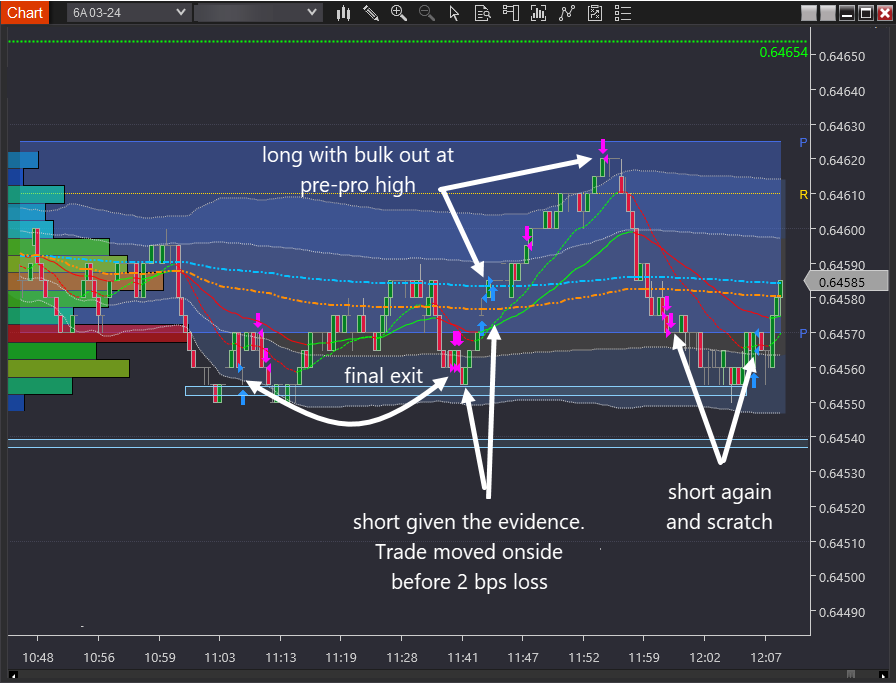
And if you think the trading above resembles treading water — you're right!
But consider this:
When it comes to swimming what's the most critical skill? Not drowning. Correct?
Therefore the initial focus in trading—like in swimming—is on mastering treading water. Make sense?
Now ask yourself:
If it was you who made all of those trades shown above including:
-
Trades that go your way but turn around on you.
-
Trades that lose.
-
Trades that look promising only to end in a small draw.
After grinding away without tangible results—how confident are you in increasing your trade size and going for the knockout blow on the very next trade? Not—Very—Confident. Right? But can you change? Tell you in a minute.
Below you can see all the same trades with one exception—a single additional trade labelled 'Press' indicating an increase in trade size.
Where you change gears and put on (in this case three times) more size than the previous trades. Make sense?
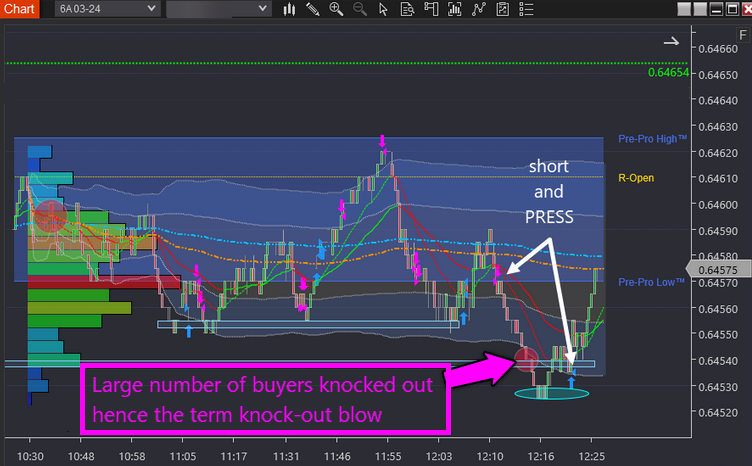
Confidence evidence or a combination of both
Like the tennis player—the knockout play is built on evidence.
The final trade shown above combined nine points of evidence which scream "Go for the knockout blow."
Imagine you'd made that exact trade—based on nine points of evidence—between thirty and fifty times previously. What do you have in addition to evidence?
You also have self-confidence.
After so many repetitions—it's hardwired into your DNA to "Go for the knockout blow" each time those nine points of evidence show up. Right?
Why?
The secret to confidence is nothing more than repetition—experiencing the process and outcome until they become ingrained in you.
But what else?
Confidence isn't solely about entering with size. Right?
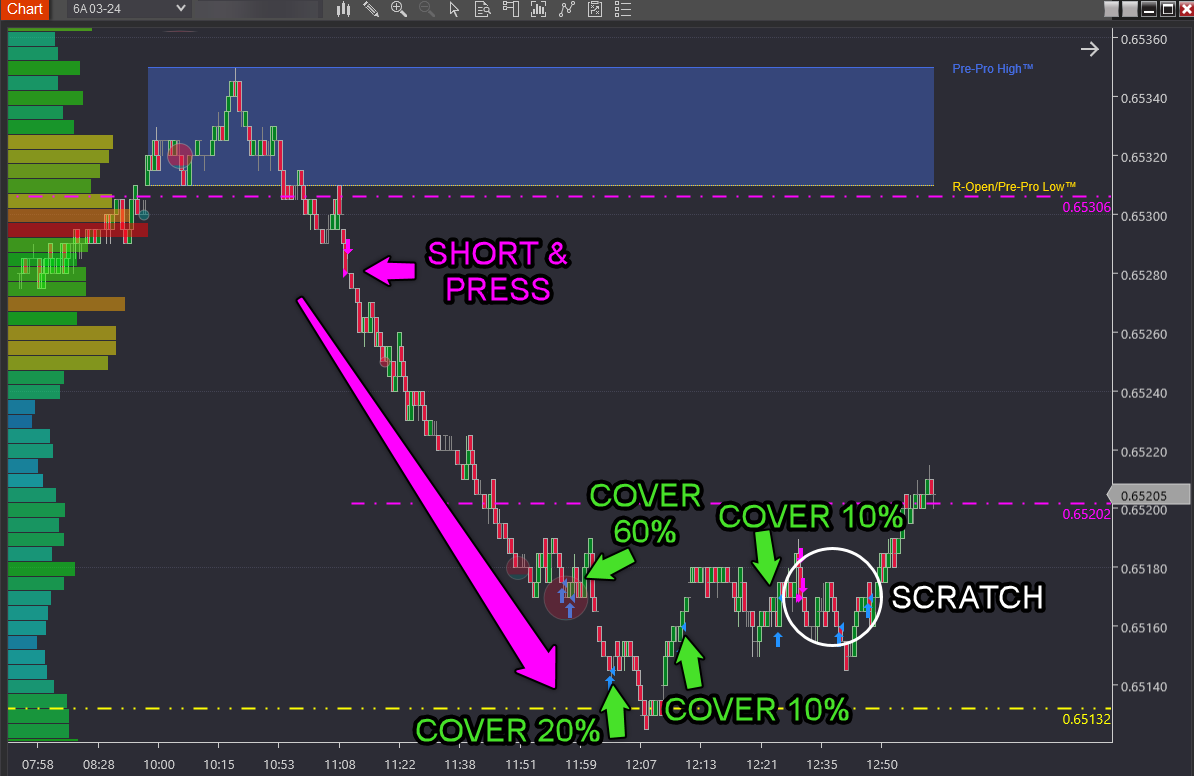
It empowers you to continue holding—and holding—and holding...
Until you extract maximum payout as per your game plan and playbook—as shown by Friday's short trade below.
But if you're like most people trading, you've experienced numerous challenges that erode your confidence over time. Agree?
Can you see why it's important to allow for ample time for confidence to deeply root into your DNA —enabling you to execute knockout trades instinctively and without hesitation?
Trading skills aren't just about knowledge. Correct? To be effective you must build intrinsic confidence through real-world application.
Forex and derivatives trading is a highly competitive and often extremely fast-paced environment. It only rewards individuals who attain the required level of skill and expertise to compete. Past performance is not indicative of future results. There is a substantial risk of loss to unskilled and inexperienced players. The high degree of leverage can work against you as well as for you. Before deciding to trade any such leveraged products you should carefully consider your investment objectives, level of experience, and risk appetite. The possibility exists that you could sustain a loss of some or all of your initial investment and therefore you should not invest money that you cannot afford to lose. You should be aware of all the risks associated with trading on margin, and seek advice from an independent
Editors’ Picks

EUR/USD plummets to 1.1840 on US NFP
EUR/USD’s selling momentum now picks up pace and rapidly hits the 1.1840 region on Wednesday. Indeed, the pair’s decline comes amid rising buying pressure on the US Dollar in the wake of firmer-than-expected results from US NFP in January.

GBP/USD approaches 1.3600 on USD-buying
GBP/USD adds to Tuesday’s pullback and trades closer to the 1.3600 support on Wednesday. That said, Cable’s extra downside traction comes against the backdrop of renewed strength in the Greenback as investors assess the latest US NFP data.

USD/JPY remains heavy around 153.00 on firmer Japanese Yen
USD/JPY is sustaining its three-day rout at around 153.00 in the European session on Wednesday, awaiting the closely-watched US NFP report. Rising bets on Fed rate cuts keep the US Dollar depressed. In contrast, expectations that PM Takaichi's policies will boost the economy and allow the BoJ to stick to its hawkish stance bolster the Japanese Yen, weighing on the pair amid intervention fears.
Editors’ Picks
EUR/USD plummets to 1.1840 on US NFP
EUR/USD’s selling momentum now picks up pace and rapidly hits the 1.1840 region on Wednesday. Indeed, the pair’s decline comes amid rising buying pressure on the US Dollar in the wake of firmer-than-expected results from US NFP in January.
GBP/USD approaches 1.3600 on USD-buying
GBP/USD adds to Tuesday’s pullback and trades closer to the 1.3600 support on Wednesday. That said, Cable’s extra downside traction comes against the backdrop of renewed strength in the Greenback as investors assess the latest US NFP data.

Gold trims gains post-NFP, targets $5,000
Gold rapidly reverses initial gains and retreats to the vicinity of the $5,000 region per troy ounce amid further gains in the Greenback and rising US Treasury yields, all following the latest US NFP readings.

Ripple Price Forecast: XRP sell-side pressure intensifies despite surge in addresses transacting on-chain
Ripple (XRP) is edging lower around $1.36 at the time of writing on Wednesday, weighed down by low retail interest and macroeconomic uncertainty, which is accelerating risk-off sentiment.
US jobs data surprises to the upside, boosts stocks but pushes back Fed rate cut expectations
This was an unusual payrolls report for two reasons. Firstly, because it was released on Wednesday, and secondly, because it included the 2025 revisions alongside the January NFP figure.
RECOMMENDED LESSONS
Making money in forex is easy if you know how the bankers trade!

I’m often mystified in my educational forex articles why so many traders struggle to make consistent money out of forex trading. The answer has more to do with what they don’t know than what they do know. After working in investment banks for 20 years many of which were as a Chief trader its second knowledge how to extract cash out of the market.
5 Forex News Events You Need To Know

In the fast moving world of currency markets where huge moves can seemingly come from nowhere, it is extremely important for new traders to learn about the various economic indicators and forex news events and releases that shape the markets. Indeed, quickly getting a handle on which data to look out for, what it means, and how to trade it can see new traders quickly become far more profitable and sets up the road to long term success.
Top 10 Chart Patterns Every Trader Should Know

Chart patterns are one of the most effective trading tools for a trader. They are pure price-action, and form on the basis of underlying buying and selling pressure. Chart patterns have a proven track-record, and traders use them to identify continuation or reversal signals, to open positions and identify price targets.
7 Ways to Avoid Forex Scams

The forex industry is recently seeing more and more scams. Here are 7 ways to avoid losing your money in such scams: Forex scams are becoming frequent. Michael Greenberg reports on luxurious expenses, including a submarine bought from the money taken from forex traders. Here’s another report of a forex fraud. So, how can we avoid falling in such forex scams?
What Are the 10 Fatal Mistakes Traders Make
Trading is exciting. Trading is hard. Trading is extremely hard. Some say that it takes more than 10,000 hours to master. Others believe that trading is the way to quick riches. They might be both wrong. What is important to know that no matter how experienced you are, mistakes will be part of the trading process.
The challenge: Timing the market and trader psychology

Successful trading often comes down to timing – entering and exiting trades at the right moments. Yet timing the market is notoriously difficult, largely because human psychology can derail even the best plans. Two powerful emotions in particular – fear and greed – tend to drive trading decisions off course.