Stablecoin survival: Navigating the future amid global de-dollarization

It is an empirical fact that the United States dollar is continuing to lose its dominant role as the global reserve currency, but what might happen to the stablecoin market should it be superseded?
According to data from the International Monetary Fund, the U.S. dollar now accounts for just over 58% of global foreign exchange reserves, a considerable decrease from the 71% share it had in 2001.
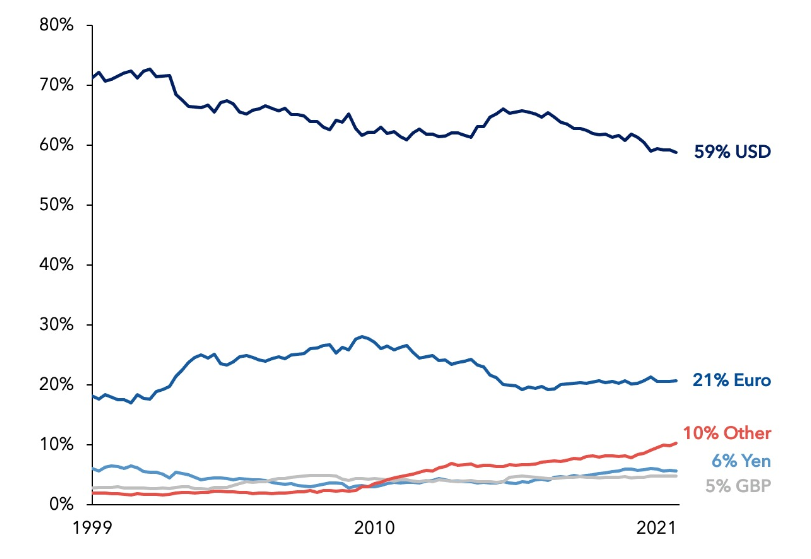
Global foreign exchange reserves from 1999 to 2021. Source: IMF
Jeremy Allaire — the CEO of USD Coin (USDC $1.00) issuer Circle — highlighted this shift at the April 26 Consensus 2023 conference, arguing that the U.S. must implement stablecoin legislation and digitize the U.S. dollar to remain competitive amid the “very active de-dollarization taking place.”
De-dollarization refers to the process of reducing the use of the U.S. dollar in a country’s economy, and powerhouses like Russia and China are actively pursuing de-dollarization as they look to replace the U.S. dollar with digital assets, other fiat currencies, and potentially a BRICS currency between Brazil, Russia, India, China and South Africa.
As an example of this de-dollarization taking place, the Chinese yuan has recently overtaken the U.S. dollar as China’s most used cross-border currency according to Bloomberg, increasing to a high of 48% of transactions after it made up nearly 0% in 2010.
Another example that may be more familiar to crypto users can be seen in El Salvador, which in 2021 became the first country in the world to use Bitcoin (BTC $26,918) as a legal tender.
Following news that crypto exchange Coinbase is launching a derivatives exchange in Bermuda, some crypto proponents such as venture capitalist David Sacks have even suggested that the U.S. may be attempting to prevent crypto firms from accessing bank services in the country in an intentional effort to drive them overseas out of fear that crypto could further eat into the dominance of the U.S. dollar.
Speaking to Cointelegraph, Dr. Joachim Schwerin — principal economist for the European Commission — suggested changes in the world’s leading reserve currency regularly occur, adding:
Since we have records on financial data, the role of globally leading currency has changed every 80 to 110 years. Times of accelerated global frictions that significantly affect trade patterns vastly accelerate such changes.
The sanctions placed on Russia by the U.S. are a prime example of this global friction, and on April 16 Treasury Secretary Janet Yellen noted that sanctions could risk the U.S. dollar hegemony as targeted countries look for alternative currencies.
Implications for the global economy
Many people are likely familiar with the video “Principles for Dealing with the Changing World Order’ by billionaire investor and hedge fund manager Ray Dalio, in which Dalio suggested that having the leading reserve currency “is a key factor in a country becoming the richest and most powerful empire,” which is an opinion shared by many pundits.
One of the main benefits of being the dominant reserve currency is thought to be the increased level of demand it experiences relative to other countries due to it being widely accepted globally and regarded as a safe-haven asset, thus making it more valuable.
In response to questions from Cointelegraph, Tether — the issuer of the largest stablecoin by market capitalization Tether (USDT $1.00) – noted that stablecoins which are pegged to the U.S. dollar also increase demand for the currency.
Increased demand for the U.S. dollar theoretically makes it more valuable relative to other currencies, which makes importing goods and services relatively cheaper for the U.S. and allows the country to borrow funds at lower costs.
Yet in response to concerns about what would occur if the U.S. dollar lost its hegemony, many economists cite the words of Nobel Prize-winning economist Paul Krugman, who argued back in August 2015 that “while reserve-currency status may have political symbolism attached, it's essentially irrelevant as an economic goal” due to its benefits being worth “a small fraction of one percent of GDP.”
It is worth noting that economists are famous for disagreeing with one another. In an April 11 survey of economists, 50% of them disagreed with Krugman’s assertion that the benefits are only minor.
A time for innovation in the stablecoin market
According to CoinMarketCap, every stablecoin with a market cap exceeding $1 billion is pegged to the U.S. dollar, which makes sense given its dominant status.
As the U.S. dollar continues to lose its dominance, however, these stablecoins may see their usage diminish.
Tether highlighted that stablecoins are “particularly beneficial for citizens in emerging markets who may face high levels of inflation and currency instability,” or those in countries with limited access to financial services, so even if the U.S. dollar and stablecoins pegged to it diminish, others will likely step in.
Schwerin noted that “big issuers are already now reaching out outside the U.S. to cater for exactly this scenario,” referencing stablecoins like Circle’s Euro Coin (EUROC) which is pegged to the euro, adding:
There will have to be quite a lot of improvisation and experimentation, which is good for innovation.
Schwerin noted that he didn’t know exactly what would work, but expressed optimism that the crypto community would be able to quickly find solutions.
Tether said that it “has always been at the forefront of innovation,” and pointed to other products it has released such as Tether Gold (XAUT) — a stablecoin collateralized by gold — as well as other fiat-backed stablecoins.
While stablecoins can be designed in very different ways, the most frequently used ones are currently both fully/over-collateralized and exogenous (backed by external assets).
As long as stablecoins have sufficient collateral, their users should not be worried that a transition away from U.S. pegged stablecoins will cause any liquidity issues, particularly when a high proportion of the collateral is stored as highly liquid assets.
Author
Cointelegraph Team
Cointelegraph
We are privileged enough to work with the best and brightest in Bitcoin.