Polygon Labs’s MATIC-POL migration confirmed for Sept. 4

The Polygon proof-of-stake (PoS) network will replace its original MATIC token with POL (POL) tokens following an upgrade slated for Sept. 4.
Polygon Labs launched the Ethereum contract for the POL token on Oct. 25 as part of the Polygon 2.0 roadmap, primarily intended to “power a vast ecosystem of zero knowledge-based layer 2 chains.”
The POL upgrade aims to expand the utility of Polygon’s native token and power its growing network of aggregated blockchains, a.k.a. AggLayer.
Laying the foundation for Polygon 2.0
The POL upgrade initially went live on the Polygon testnet on July 17, which leaves its community with approximately six weeks to identify and fix potential issues before the mainnet migration.
In the initial phase, the POL tokens will replace MATIC (MATIC $0.5399) as the native gas and staking token for Polygon PoS. However, the Polygon community sees greater potential in its new “future-proof native token.”
According to current community consensus, POL will support a broader role in the upcoming Polygon staking hub in 2025, which includes block generation, zero-knowledge proof generation, and participation in Data Availability Committees (DACs).
Responsibilities of users for smooth MATIC-POL migration
The recent POL upgrade on the testnet will allow users, developers, and infrastructure providers to better prepare for the upcoming mainnet upgrade. According to the announcement shared with Cointelegraph, MATIC holders on Polygon PoS will be automatically upgraded to POL without intervention.
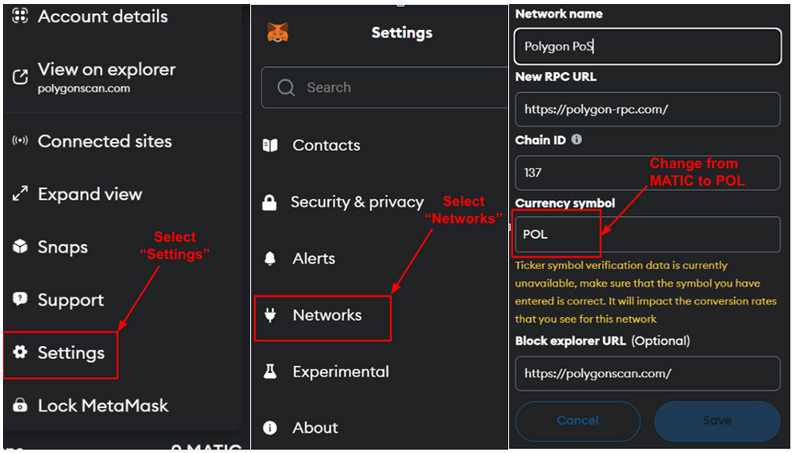
Steps to update MetaMask for the most accurate view of onchain assets during MATIC-POL upgrade. Source: Polygon
However, MATIC holders on Ethereum, Polygon zkEVM, or centralized exchanges will need to either bridge, update smart contracts or use a migration contract — on a case-to-case basis — for a manual upgrade. The announcement added:
“If users don’t update RPC settings in a wallet (MetaMask, Rabby, Zerion, etc.), the wallet may still display “MATIC” instead of “POL” as the token symbol for the native gas token for the Polygon PoS chain.”
Polygon Labs is also working with the TON Application Chain (TAC) to bring Ethereum Virtual Machine (EVM) functionality to the TON ecosystem.
On July 9, the TON Application Chain and Polygon announced that the TON L2 had integrated Polygon CDK and the interoperability protocol Agglayer to bring EVM-compatible decentralized applications (DApps) to TAC.
Author

Cointelegraph Team
Cointelegraph
We are privileged enough to work with the best and brightest in Bitcoin.