Pi Network Price Forecast: Whale demand fails to absorb incoming supply
- Pi Network marks its fourth reversal from the 50-day EMA since May.
- Two large wallet investors withdrew 2.76 million PI, contributing to the CEX outflows of 3.48 million in the last 24 hours.
- Pi Network Ventures has officially announced an investment in OpenMind, with Pi Nodes operating image recognition AI models.

Pi Network (PI) price is down 2.5% at press time on Friday, extending the 3% loss from the previous day. The recovery from earlier this week failed to surpass the 50-day Exponential Moving Average (EMA) despite a rise in Centralized Exchanges (CEXs) outflows.
Furthermore, the announcement that Pi Network Ventures was investing in OpenMind and conducting AI test runs failed to lift sentiment.
Pi Network nodes run AI models' test runs
Pi Network Ventures, the $100 million investment arm that funds startups, officially announced on Thursday its investment in OpenMind, a company that develops operating systems and protocols for robots. The amount of capital invested has not been made public in the announcement.
On a more positive note, collaboration between Pi Network and OpenMind has successfully run image recognition AI models on Pi Node operators, consisting of 350,000 active nodes. This highlights the capabilities of Pi Nodes for decentralized AI training and computing tasks.

On-chain activity shows steady demand
The amount of PI tokens available on Know Your Business (KYB) verified Centralized Exchanges (CEXs) originates from Know Your Customer (KYC) approved Pi Network users, who were permitted to transfer tokens to the mainnet. A decline in PI tokens available on these CEXs suggests that on-exchange users are acquiring the tokens, signaling a surge in demand.
PiScan data shows a net outflow of 3.48 million PI tokens from the CEXs’ wallet balances in the last 24 hours, indicating that on-exchange demand is increasing.
At the same time, two of the largest transactions on the Pi Network reveal that two large wallet investors, commonly referred to as whales, have withdrawn 2.76 million PI tokens from the OKX exchange over the last 24 hours. This reflects the confidence among whales.
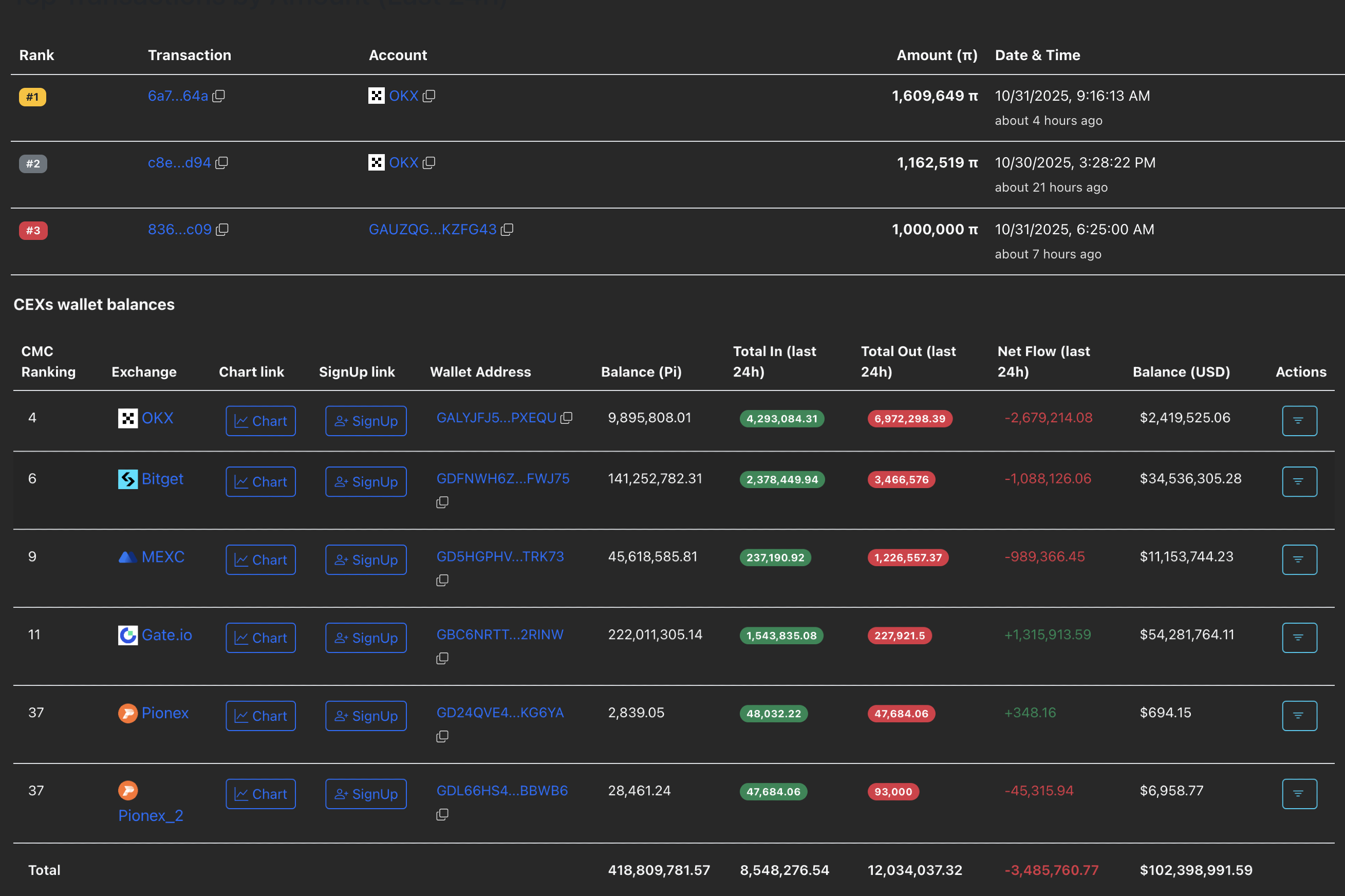
Pi Network activity. Source: PiScan
Technical Outlook: Pi Network risks losing weekly gains
Pi Network trades below $0.2500 at press time on Friday, marking its second consecutive day of loss. The PI token's reversal from the 50-day EMA at $0.2605 aligns with a decline in buying pressure, as the Relative Strength Index (RSI) on the daily chart, currently at 54, traces downwards towards the neutral level of 50.
Pi Network’s fourth reversal from this average line, acting as a crucial dynamic resistance that has remained intact since May, risks erasing the gains made earlier this week. The immediate support for PI lies at the $0.2000 round figure and the $0.1919 level, marked by the October 11 low.
Corroborating the decline in bullish momentum, the Moving Average Convergence Divergence (MACD) hovers near the zero line, as green histogram bars above this line decline. If MACD reverses towards its signal line, resulting in a crossover, it would confirm a bearish shift in trend momentum.
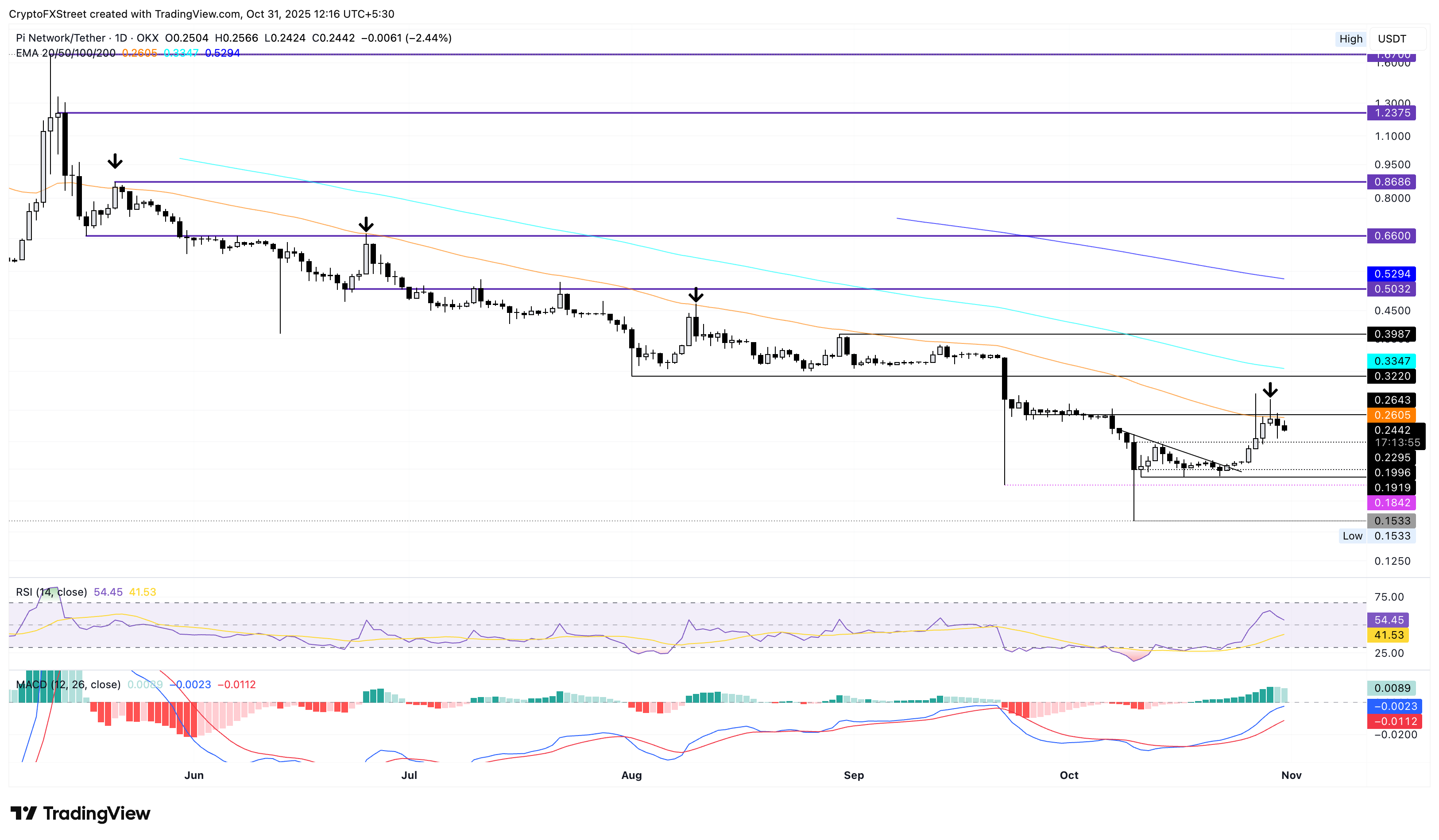
PI/USDT daily price chart.
On the upside, a potential breakout of the 50-day EMA at $0.2605 could extend Pi Network’s recovery to $0.3220, marked by the August 1 low.
Cryptocurrency prices FAQs
Token launches influence demand and adoption among market participants. Listings on crypto exchanges deepen the liquidity for an asset and add new participants to an asset’s network. This is typically bullish for a digital asset.
A hack is an event in which an attacker captures a large volume of the asset from a DeFi bridge or hot wallet of an exchange or any other crypto platform via exploits, bugs or other methods. The exploiter then transfers these tokens out of the exchange platforms to ultimately sell or swap the assets for other cryptocurrencies or stablecoins. Such events often involve an en masse panic triggering a sell-off in the affected assets.
Macroeconomic events like the US Federal Reserve’s decision on interest rates influence crypto assets mainly through the direct impact they have on the US Dollar. An increase in interest rate typically negatively influences Bitcoin and altcoin prices, and vice versa. If the US Dollar index declines, risk assets and associated leverage for trading gets cheaper, in turn driving crypto prices higher.
Halvings are typically considered bullish events as they slash the block reward in half for miners, constricting the supply of the asset. At consistent demand if the supply reduces, the asset’s price climbs.
Author

Vishal Dixit
FXStreet
Vishal Dixit holds a B.Sc. in Chemistry from Wilson College but found his true calling in the world of crypto.