What the midterm elections mean for Treasury yields, the Dollar and Gold

Democrats are priced to take the House, so November 3 comes down to the Senate and how much Washington can borrow without the other party. Treasury yields will show the answer first, then the Dollar and Gold.
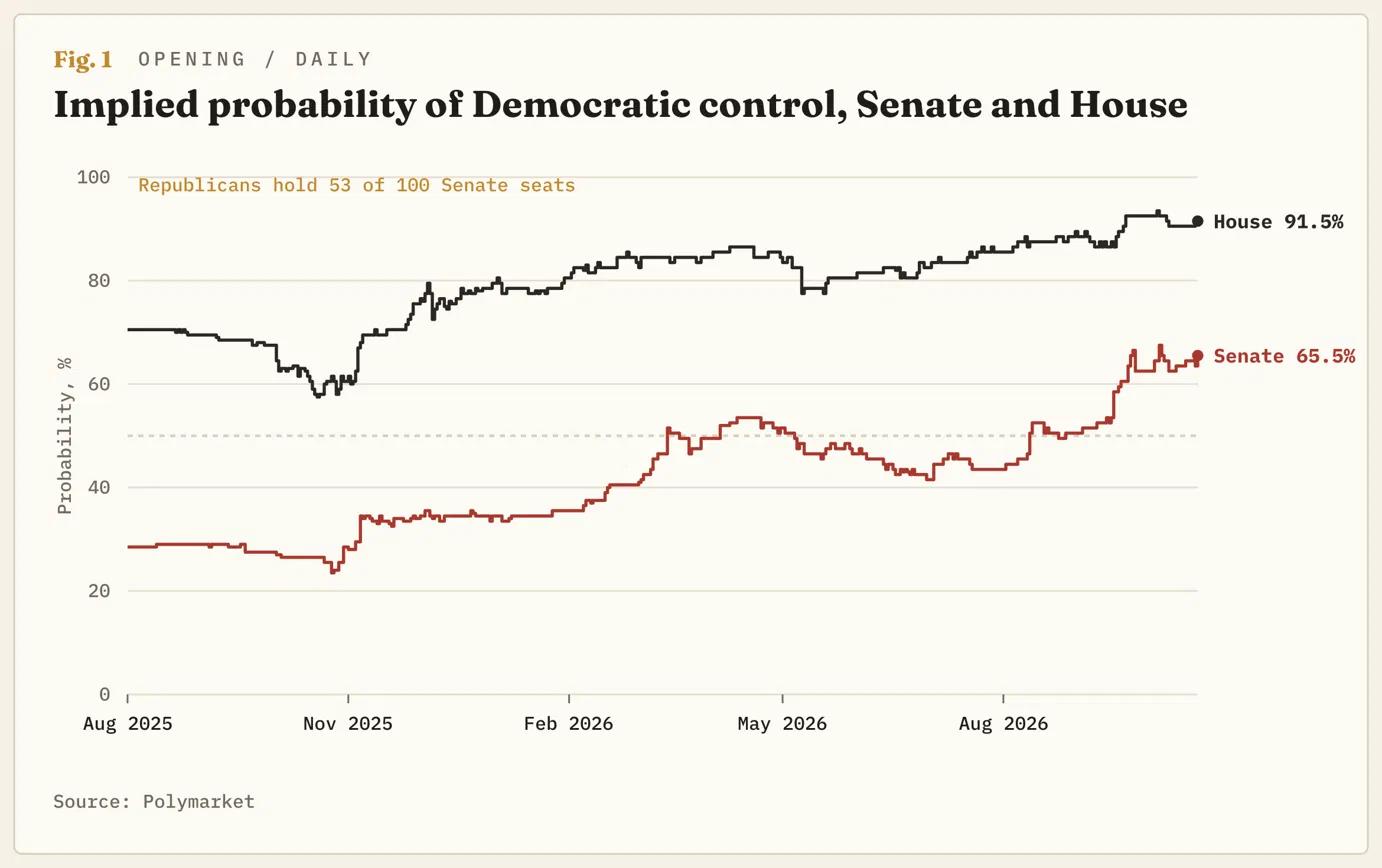
On November 3, Americans vote for all 435 House seats and 35 Senate seats. For bond prices, the result comes down to one thing: how much the government will borrow over the next two years. Only when the party in the White House holds both chambers can it pass tax and spending bills without the other side. Traders on Kalshi put Democrats at 91% to win the House as of October 21, so the House is already priced as lost for Republicans, and at 64% to win the Senate. The Senate result decides whether Republicans can pass another borrowing bill on their own in 2027 or whether every spending decision needs Democratic votes.
An election result reaches the Dollar through borrowing. If investors expect the government to borrow more, yields on long-dated Treasuries, the 10-year and 30-year bonds, rise. Higher yields usually lift the Dollar, raise mortgage rates, and increase what banks charge for credit. That is already happening: the Dollar Index, which measures the Dollar against six other currencies, rose about 2% in September as yields climbed. Treasury yields will react to the result before the Dollar does, and the Dollar's direction will depend on why yields moved. Higher yields on stronger growth tend to lift the Dollar; higher yields on a bigger deficit tend to weaken it.
The borrowing shortcut is stuck in the Senate
Most bills need 60 Senate votes to get past the filibuster, the rule that lets a minority talk a bill to death. Reconciliation, the once-a-year budget procedure, lets a bill about taxes, spending or the debt limit pass with 51 votes. The 2017 tax cuts and the 2025 tax-and-spending law both went through it, and each added to the debt the Treasury had to sell. The procedure works only when both chambers adopt the same budget plan.
The House adopted its plan, H.Con.Res. 113, on July 22 by 216 votes to 214. It allows up to $95 billion in new borrowing, mostly for the Pentagon, with nothing to offset the cost. Senate Majority Leader John Thune said on July 23 that he did not have 50 votes. He has since said the Senate will not act on it before the election and that he is holding it in reserve in case reconciliation is needed to avoid a shutdown, making a wartime military funding plan the Senate's fallback for keeping the government open in December. For Treasury yields, the risk is narrow: only a Republican sweep, which Kalshi traders put at 11%, lets that $95 billion pass on a party-line vote.
Three results, and only one adds to the debt
A Republican sweep keeps the shortcut and probably enlarges the plan, since the House blueprint could grow toward the $350 billion defence request, and more Treasury issuance would push long-dated yields up. A split Congress, priced at 28%, passes little either way. A Democratic sweep, at 64%, is the same gridlock plus fights over government funding and the debt limit.
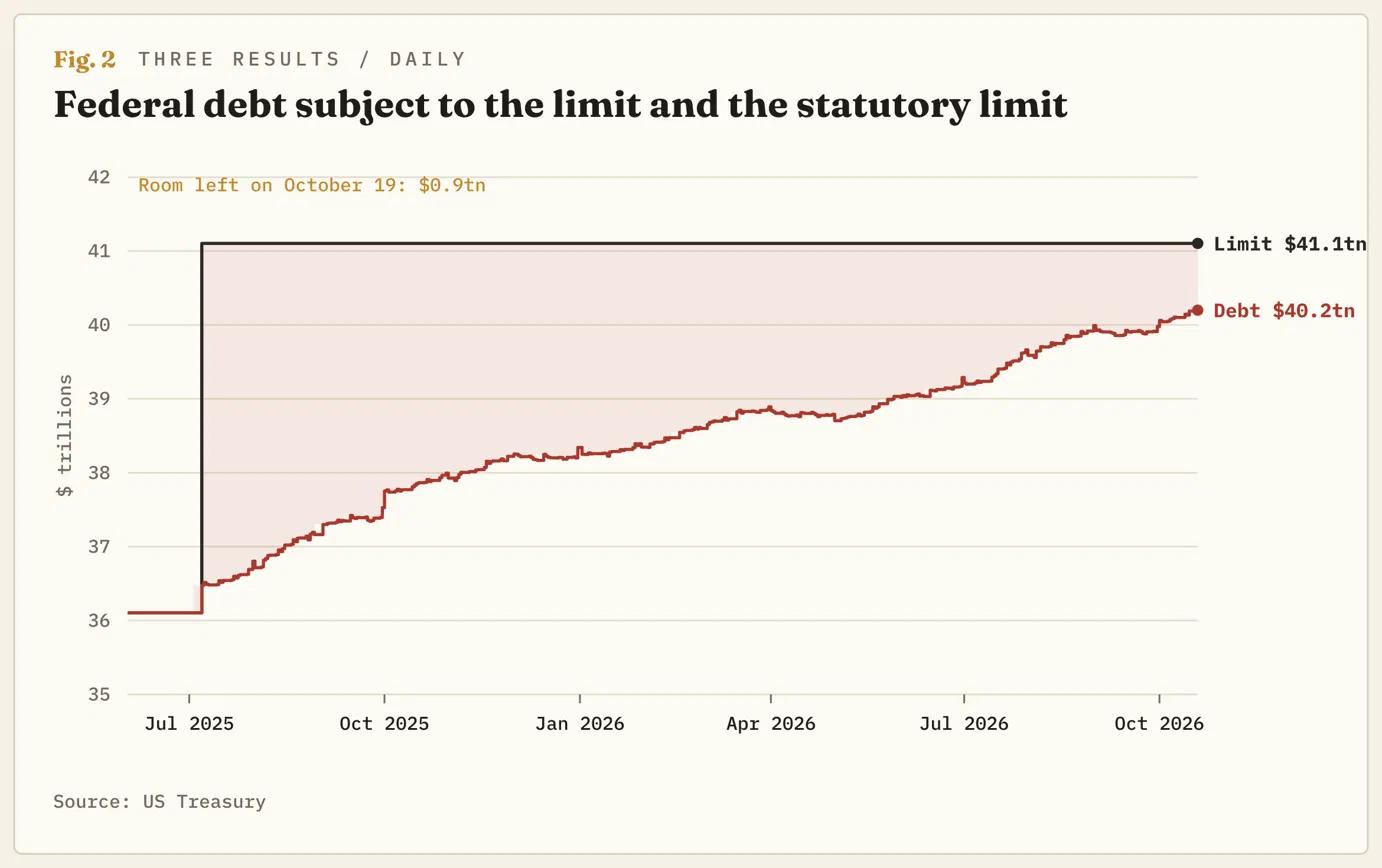
Those fights start on December 11, when the stopgap funding law signed on September 2 runs out. That is two days after the Fed's December meeting and five weeks after an election that some of the members voting on it will have lost. The cap on what the Treasury can borrow is $41.1 trillion, raised by $5 trillion in July 2025. The National Taxpayers Union expects the cap to be reached around May 2027 and the money to run out around February 2028, so the new Congress will spend most of 2027 arguing about a deadline that falls in 2028. The last two funding fights ended in a 43-day shutdown in autumn 2025 and a 76-day partial shutdown of Homeland Security in early 2026.
Yields move first and the Dollar can go either way
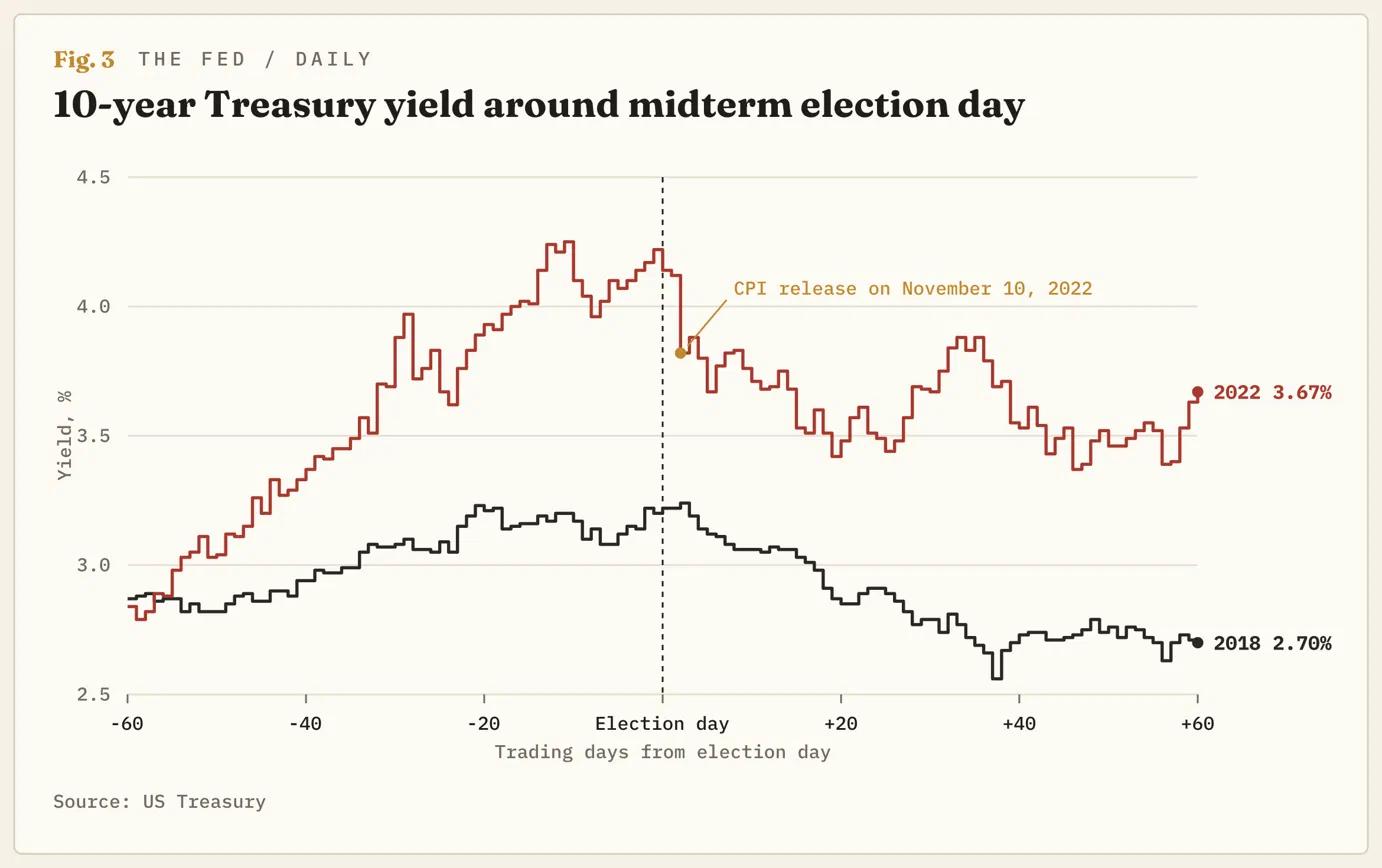
The bank research published since mid-September agrees on the scenarios. A Republican sweep is the result most likely to strengthen the Dollar, with yields and the Dollar higher at first. A Democratic sweep works the other way, because less government spending means slower growth and a smaller gap between US and foreign interest rates. Lombard Odier's data shows Treasury yields have usually fallen in the months after a midterm, whoever won, and none of the scenarios work from that pattern.
The complication is why yields rise. Brown Brothers Harriman argues that if yields climb because investors doubt the government's finances rather than because growth improved, the Dollar falls instead of rising. Bank of America strategist Michael Hartnett makes the same bet from the other side: his trades for a Democratic sweep are bets against bank stocks and against the Dollar, and he calls a split Congress "gridlock is Goldilocks".
Stocks have done best after a split Congress
T. Rowe Price's read is that a split Congress could help the Dollar and weigh on Gold, because the political risk already priced into Gold would shrink. Since 1874, the S&P 500 has averaged a 14% gain in the 12 months after a midterm and risen 84% of the time. Unified Republican control is the one arrangement with a negative average, so the only result that keeps the borrowing shortcut is also the one with the worst stock market record. Hartnett's downside case is a Democratic sweep knocking 10% or more off US stocks, and US Bank's study of 31 midterms found the party outcome made no measurable difference to the following year.
The Fed votes a week before the country does
The Fed meets October 27-28, six days before the polls open, having raised its rate to 3.75%-4.00% on September 16. September's Consumer Price Index (CPI) came in at 3.7% on October 14, a tenth above the forecast, and futures traders betting on Fed decisions afterward priced in a December rise at better than 90% and an October rise at roughly one in three. Fed Chair Warsh said on October 16 that he does not believe in saying what he might do at meetings for the rest of 2026, and in the same remarks named October and December as the meetings where the decisions get made.
The election lands in a crowded week. The Bank of Japan (BoJ) meets October 29-30, the October jobs report comes out on November 6, October CPI on November 10, the Fed meets again on December 8-9, and the funding deadline is December 11. In 2022, the Dollar fell more on the inflation report two days after the midterm than on the midterm itself. Whatever yields do in the first week of November will owe more to the Fed and the data than to the vote, and the election's own effect is whatever is left once the November 10 inflation number is out.
Seven states and one deadline
Senate control is the decision, and it comes down to seven states: Texas, Maine, Michigan, Ohio, Iowa, Kansas and Nebraska. A Republican sweep is the only result that adds borrowing, so it means higher long-dated yields, a stronger Dollar and weaker Gold, and at 11% it is the cheapest of the three outcomes to insure against. After a split Congress, stocks have risen in 13 of the 14 cases under a Republican president, and yields have usually drifted lower. A Democratic sweep is the same gridlock plus a debt-limit fight in 2027, which tends to move Treasury bills, the government's shortest-term debt, and Gold more than the Dollar. Tariffs are mostly out of Congress's hands: the Supreme Court struck down the emergency-powers duties in February and the replacement lapsed in July. What November 3 removes is the political reason to hold off on new ones, and the extra price that Comex Copper for January 2027 carries over the London price is the market's running estimate of whether one comes.
This call is wrong if long-dated yields rise on a Democratic sweep. That would mean investors worry about whether the government can manage its finances, not how much it borrows, and in that case the Dollar falls as yields rise. The yield calls above would still stand, and the Dollar calls would reverse. The vote decides how much Washington borrows, and the 10-year Treasury yield the week after will be the first sign of the cost.
Author

Joshua Gibson
FXStreet
Joshua joins the FXStreet team as an Economics and Finance double major from Vancouver Island University with twelve years' experience as an independent trader focusing on technical analysis.
















