Oil Forecast and News
Oil prices rally for the second consecutive day on Tuesday, with the barrel of the US benchmark West Texas Intermediate (WTI) trading at $83.50 during the European trading session. WTI Oil has jumped nearly 10% from last week’s closing prices, as hopes of an upcoming peace deal between the US and Iran fade.
Technical Analysis
WTI Technical Analysis
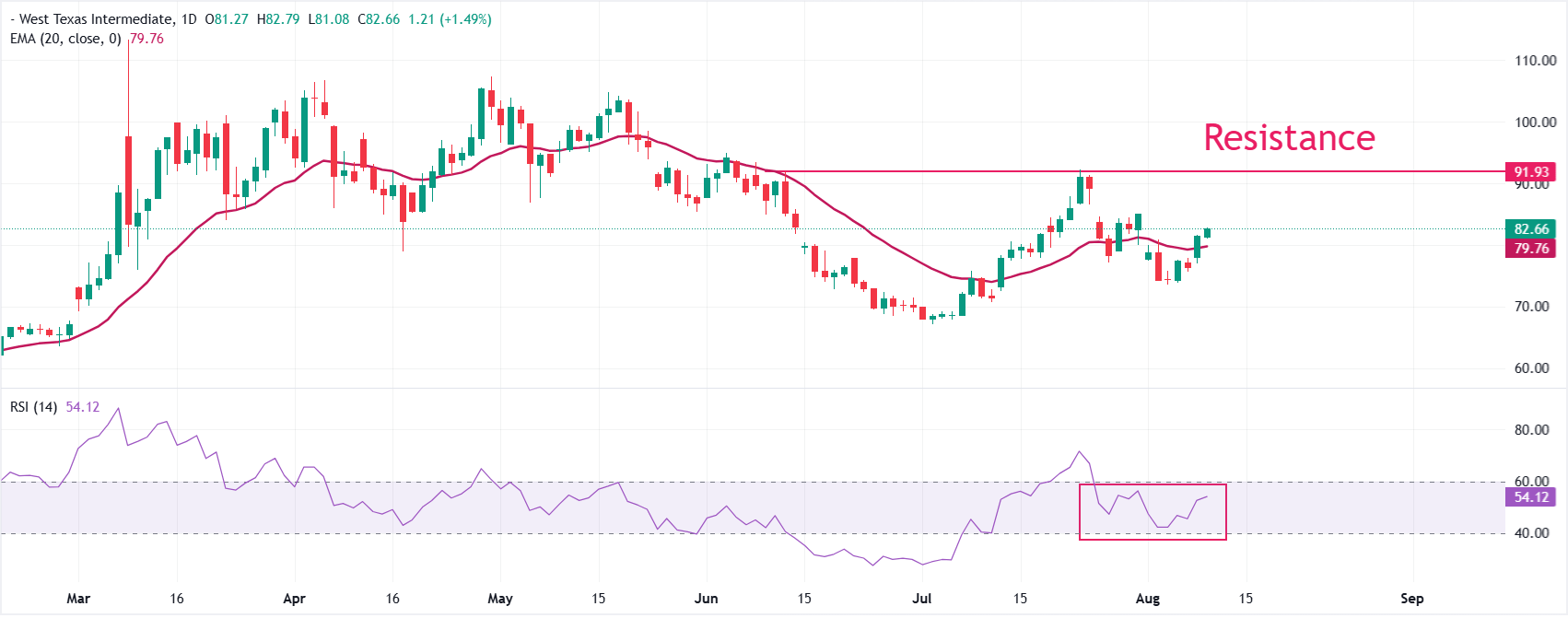
The WTI US Oil trades sharply higher at around $82.65, maintaining a bullish near-term bias as price holds above the 20-day exponential moving average (EMA) at $79.76.
Spot above this key trend indicator suggests underlying demand remains in control, while the Relative Strength Index (RSI) at 54.11 stays in neutral territory, hinting at steady rather than overstretched upside momentum after the recent recovery from the mid-$70s.
On the downside, initial support is seen at the 20-day EMA around $79.76, which reinforces the $80 area as a near-term floor, followed by deeper demand from the recent consolidation lows in the mid-$70s region. Looking up, the oil price will likely extend the advance towards the July 31 high at $85.11; above that, the July 23 high at $92.25 is the key resistance level.
(The technical analysis of this story was written with the help of an AI tool. Know more.)
Fundamental Analysis
| Time | Event | Impact | Actual | Consensus | Previous |
|---|
Growing uncertainty in the Middle East is pushing petrol prices higher this week, as the US and Iran fail to find a formula to reopen the Strait of Hormuz, entangled in reciprocal requests for compensation for war damages, which push back hopes of a durable peace agreement.
Tehran has restructured the country’s military leadership with six new senior appointments, with former Islamic Revolutionary Guard Corps (IRGC) commander Mohsen Rezaee taking over as Secretary of the Supreme National Security Council. The new security chief, a key role in Iran’s foreign policy, holds a skeptical view regarding the negotiations with the US, which is not particularly promising in regard to the peace process.
Meanwhile, traffic through the Strait of Hormuz remains restricted to a trickle. Reuters, citing shipping data, reported that only six vessels had crossed the waterway on Monday, below the 10 to 11 average of recent weeks and a marginal percentage of the 130 to 160 ships crossing the corridor before the war started in February.
About Oil
Crude oil, commonly known as petroleum, is a naturally occurring fossil fuel liquid composed of hydrocarbon underground deposits and organic materials. Its prices are typically measured in US Dollars (USD).
The top oil-producing countries include Saudi Arabia, Russia, the United States, Iran, and China, while the largest consumers are the United States, China, Japan, Russia, and Germany.
Crude oil is classified into various grades according to density (heavy versus light) and sulfur content (sour versus sweet). Lighter and sweeter crude commands higher prices because refiners can produce a greater yield of high-quality refined products from it.
Density is measured by API gravity, a scale developed to compare the density of petroleum to water. An API greater than 10 means the liquid floats on water. In general, crude Oils with API values between 40 and 45 degrees have the highest commercial value.
Sulfur content determines the quality of crude Oil. Crude with high sulfur content (sour crude) is less pure and sells cheaper compared to crude with low sulfur content (sweet crude).
Major benchmarks
There are two main benchmarks for pricing crude Oil: West Texas Intermediate (WTI) from the United States (US) and Brent from the United Kingdom (UK).
WTI Crude
WTI Oil is a type of Crude Oil sold on international markets. The WTI stands for West Texas Intermediate, one of three major types including Brent and Dubai Crude. WTI is also referred to as "light" and "sweet" because of its relatively low gravity and sulfur content respectively. It is considered a high-quality Oil that is easily refined. It is sourced in the United States and distributed via the Cushing hub, which is considered "The Pipeline Crossroads of the World".
Most WTI crude Oil is refined in the Midwest and the Gulf Coast regions of the US.
Supply and demand are the key drivers of WTI Oil price. As such, global growth can be a driver of increased demand and vice versa for weak global growth. Political instability, wars, and sanctions can disrupt supply and impact prices. The decisions of OPEC, a group of major Oil-producing countries, are another key driver of price. The value of the US Dollar influences the price of WTI Crude Oil since Oil is predominantly traded in US Dollars, thus a weaker US Dollar can make Oil more affordable and vice versa.
WTI serves as a benchmark in Oil pricing and is the underlying commodity of NYMEX Oil futures contracts.
Brent
Brent Crude Oil is a type of Crude Oil found in the North Sea that is used as a benchmark for international Oil prices. It is considered "light" and "sweet" because of its high gravity and low sulfur content, making it easier to refine into gasoline and other high-value products. Brent Crude Oil serves as a reference price for approximately two-thirds of the world's internationally traded Oil supplies. Its popularity rests on its availability and stability: the North Sea region has well-established infrastructure for Oil production and transportation, ensuring a reliable and consistent supply.
Brent crude is a blend from 15 different oil fields in the North Sea. It has an API gravity of 38.3 degrees and a sulfur content of around 0.37%, making it heavier and less sweet than WTI crude. Brent is suitable for the refinery of gasoline and middle distillates.
Originally traded on the International Petroleum Exchange in London, Brent crude futures have been listed on the Intercontinental Exchange (ICE) since 2005.
Oil and USD/CAD Correlation
The special relationship between Oil and the Loonie
Canada is among the world's largest Oil producers and it exports crude primarily to the US. This trade relationship directly impacts the Canadian Dollar (CAD), popularly known as the Loonie. Since Canadian dollars are needed to purchase and move Oil across the border, the fluctuation in Oil prices has a direct impact on the USD/CAD pair.
When Oil prices decline, the demand for the Loonie often weakens, causing USD/CAD to rise. Conversely, higher Oil prices frequently lead to CAD strength and a drop in the pair.
Oil prices are a significant factor influencing the Loonie's price action, alongside risk sentiment and economic fundamentals. If you are trading USD/CAD, monitoring Oil charts can provide crucial insights.